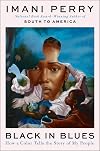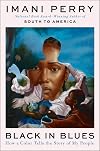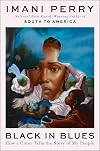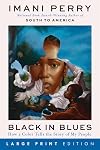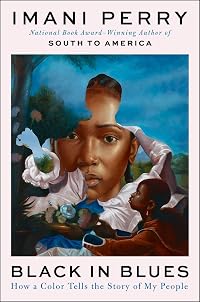
Black in Blues: How a Color Tells the Story of My People
by Imani Perry
On This Page
Description
A surprising and beautiful meditation on the color blue-and its fascinating role in Black history and culture-from award winner Imani Perry. Throughout history, the concept of Blackness has been remarkably intertwined with another color: blue. In daily life, it is evoked in countless ways. Blue skies and blue water offer hope for that which lies beyond the current conditions. But blue is also the color of deep melancholy and heartache, echoing Louis Armstrong's question, "What did I do to be show more so Black and blue?" In this book, celebrated author Imani Perry uses the world's favorite color as a springboard for a riveting emotional, cultural, and spiritual journey-an examination of race and Blackness that transcends politics or ideology. Perry traces both blue and Blackness from their earliest roots to their many embodiments of contemporary culture, drawing deeply from her own life as well as art and history: The dyed indigo cloths of West Africa that were traded for human life in the 16th century. The mixture of awe and aversion in the old-fashioned characterization of dark-skinned people as "Blue Black." The fundamentally American art form of blues music, sitting at the crossroads of pain and pleasure. The blue flowers Perry plants to honor a loved one gone too soon. Poignant, spellbinding, and utterly original, "Black in Blues" is a brilliant new work that could only have come from the mind of one of our greatest writers and thinkers. Attuned to the harrowing and the sublime aspects of the human experience, it is every bit as vivid, rich, and striking as blue itself. show lessTags
Recommendations































Member Reviews
Imani Perry has gifted us with a deep cultural history of the color blue as it is found in Black history, both in Africa, in the Islands and in the US. What a marvelous way to explore Black culture. As I was reading this book, I had a strong sense that I was not the intended audience. That is not to say I felt left out, but simply could I truly appreciate everything she was relaying without having black ancestors myself? I felt like an outsider looking in from the edge of the circle. This was not a bad feeling, but just an acknowledgement that I am still at the very early stages of understanding Black culture. As with her book, South to America, I appreciated the depth of her research, the lyrical storytelling and the great importance show more of her work. show less
Thanks Ecco Books for the gifted ARC copy.
I loved the concept of blue as the overarching theme. Perry examines Blackness through a series of essays with topics such as indigo, blue jays, and blues music. The structure and style did not follow a typical narrative for historical nonfiction work. Perry addresses motivation and form of the book early on in the chapter ‘Writing in Color’, adding context to her choices.
My reading experience felt akin to listening to jazz. Areas of writing were tight while others meandered lyrically. Topics danced around between literal and figurative ‘blues’ with some topics being quite loud. These ebbs and flows produced a song of Black culture and history.
In the middle of the ‘Blue Pots’ show more chapter, I got sidetracked researching Commeraw pottery and then realized it was 2am! I had unintentionally stayed up way too late that night, engrossed in reading. Despite not always knowing where things were going and desiring more from certain essays, I really enjoyed this book overall. If I had to sum it up in one word, I’d choose “curious”. There’s a lot here and a lot to read more about. I tabbed numerous pages to revisit. show less
I loved the concept of blue as the overarching theme. Perry examines Blackness through a series of essays with topics such as indigo, blue jays, and blues music. The structure and style did not follow a typical narrative for historical nonfiction work. Perry addresses motivation and form of the book early on in the chapter ‘Writing in Color’, adding context to her choices.
My reading experience felt akin to listening to jazz. Areas of writing were tight while others meandered lyrically. Topics danced around between literal and figurative ‘blues’ with some topics being quite loud. These ebbs and flows produced a song of Black culture and history.
In the middle of the ‘Blue Pots’ show more chapter, I got sidetracked researching Commeraw pottery and then realized it was 2am! I had unintentionally stayed up way too late that night, engrossed in reading. Despite not always knowing where things were going and desiring more from certain essays, I really enjoyed this book overall. If I had to sum it up in one word, I’d choose “curious”. There’s a lot here and a lot to read more about. I tabbed numerous pages to revisit. show less
A multi-layered poetic meditation on black art, music, history, identity and the African diaspora. I was entranced by this book, which stares unblinking at the crimes of whites against people of color in the U.S. but also rightly celebrates the creative, continuity and resiliance of African-americans.
In this erudite narrative, author and MacArthur fellow Imani Perry free-associates about Blackness and its long connection to the color blue.
There is a lot of interesting (and to me, unfamiliar) material here, but I found Perry's artsy, nonlinear writing style confusing. I wished Perry would stop wandering from topic to topic. For example, in the chapter entitled "Eating the Other," Perry introduced Baudelaire's lover Jeanne Duval (c. 1820-c. 1870), a mixed-race actress whom the French poet called his “Black Venus.” But Perry didn’t stay with Duval. Instead the author segued into discussions of Tiffany diamonds and bouclé fabric. Duval reappeared only briefly at the end of the chapter. As a reader, I was disappointed.
This show more discursiveness, however, is a deliberate part of Perry's design. She writes that in gathering her notes regarding the many intersections of Black and blue, she “wasn't constructing a story; [she] was revealing and witnessing, quilting something present" (5).
On the plus side, this book got me listening to Nina Simone, so there's that. show less
There is a lot of interesting (and to me, unfamiliar) material here, but I found Perry's artsy, nonlinear writing style confusing. I wished Perry would stop wandering from topic to topic. For example, in the chapter entitled "Eating the Other," Perry introduced Baudelaire's lover Jeanne Duval (c. 1820-c. 1870), a mixed-race actress whom the French poet called his “Black Venus.” But Perry didn’t stay with Duval. Instead the author segued into discussions of Tiffany diamonds and bouclé fabric. Duval reappeared only briefly at the end of the chapter. As a reader, I was disappointed.
This show more discursiveness, however, is a deliberate part of Perry's design. She writes that in gathering her notes regarding the many intersections of Black and blue, she “wasn't constructing a story; [she] was revealing and witnessing, quilting something present" (5).
On the plus side, this book got me listening to Nina Simone, so there's that. show less
This read is beautiful and hard as it's a compendium of different aspects of joy and despair all based around the color blue; the essays are definitely to be pored over, and I loved all the history the author shares along with glimpses of herself as well.
4.5 stars, I really enjoyed Perry's writing and the stories she chose to tell with the thread of blue woven throughout.
Ratings
Members
- Recently Added By
Lists

BLM
210 works; 1 member

Bitter Southerner Summer Reading Roundup
198 works; 8 members
Author Information

12+ Works 1,650 Members
Imani Perry is the Hughes-Rogers Professor of African American Studies at Princeton University and the author of six books.
Awards and Honors
Awards
Distinctions
Notable Lists
Classifications
- Genres
- Anthropology, Nonfiction, General Nonfiction, History, Art & Design
- DDC/MDS
- 305.896 — Society, government, & culture Social sciences, sociology & anthropology Social group - Age, Gender, Ethnicity Ethnic and national groups Other ethnic and national groups Africans and people of African descent; Blacks of African origin
- LCC
- E185.86 .P476 — History of the United States United States Elements in the population Afro-Americans Status and development since emancipation
- BISAC
Statistics
- Members
- 236
- Popularity
- 138,019
- Reviews
- 6
- Rating
- (4.29)
- Languages
- English
- Media
- Paper, Audiobook, Ebook
- ISBNs
- 9
- ASINs
- 2