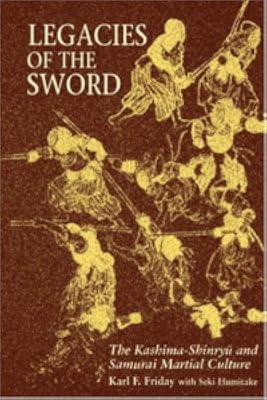
Legacies of the Sword: The Kashima-Shinryu and Samurai Martial Culture
by Karl F. Friday
On This Page
Description
"Western scholars and educators are generally far less familiar with the samurai in his original - and, ostensibly, primary - role as warrior and master of arms than in his other functions as landowner, feudal lord, literateur, or philosopher. Yet any attempt to comprehend fully the samurai without considering his military abilities and training (bugei) is futile." "Karl Friday combines the results of nearly two decades of fieldwork and archival research to examine samurai martial culture show more from a broad perspective: as a historical phenomenon, as a worldview, and as a system of physical, spiritual, and moral education. Legacies of the Sword is the first attempt by a Westerner scholar trained both in bugei and in Japanese studies and historical methodology to discuss this major and compelling component of Japanese culture. It presents a case study of the Kashima-Shinryu, one of the oldest of the extant samurai training organizations, and was written in close collaboration with its current headmaster, Seki Humitake. The volume illuminates the extraordinary complexity of the bugei and the manner in which various physical, technical, psychological, and philosophical factors merge to produce a coherent art that guides the lives of those who practice it."--Jacket show lessTags
Recommendations






Member Reviews
To be honest after reading the back-cover of this book for the first time I was little bit put-off. I was not aware that samurai were considered bureaucrats only and were looked at outside the martial part of their history. This would be equivalent of looking into modern elite forces through the eyes of general administration office - weird.
I always considered them equivalent to retainers and vassals first to Emperors (in early days) and then later Shogun. I am aware that they played administrative roles but so did their contemporaries and equivalents in the Europe (knights, barons etc). But with all of that taken into account they remained warrior caste. They fielded the armies, provided their own troops to the front line duty, fought show more with their troops and were responsible for their fiefdoms in every way (social and economical).
So after reading [and being baffled by] the cover description I thought this was more philosophical treaty on the subject of samurai. Therefore I skipped it (my reason for this is the following - although there are differences between Europe and Japan in regard to the medieval military affairs (Japanese geographical isolation being one of the major elements) existence of professional armed man is constant that is present everywhere, in any period of time and in any society; I am put off by works that try presenting certain societies (like Japanese) as extraordinary when it comes to professional warriors and warlords - in this regard no society is extraordinary because human nature is always the same, where there is wealth and poor people there will always be professional armed man) and pursued other works by [a:Karl F. Friday|110195|Karl F. Friday|https://s.gr-assets.com/assets/nophoto/user/u_50x66-632230dc9882b4352d753eedf9396530.png] that covered military history of Japan. If you haven't read them I truly recommend them, in my opinion one of the best books on the subject.
And then I finally got this book. And what a book.
Author gives information on the way samurai's were schooled, what was the origin and role of various combat schools (bugei) on keeping the martial prowess of Japan military elite through the ages. Samurai martial arts are presented through one of the senior schools still active today - Kashima-Shinryu.
Book does not go into occult or arcane (as sometimes book about Asian martial arts have tendency to do), it is very well grounded and presents all aspects of the combat school from past to modern times - from learning the techniques, to encouraging the students to experiment and build on the techniques (and thus create their own styles, or "branches" of their original combat school) to preparation for real-life in the warrior caste where possibility of loss of life is constant.
I especially liked parts describing how various schools tested their skills against one another (and thus comes the difference between this type of schools and more sportive martial arts) but through protocols established to avoid embarrassment of any school/teachings involved.
Also interesting are traditional Japanese approaches to learning - there is a lot of here that simply begs for further research and finding ways of applying the knowledge to improve ones approach to learning.
Excellent book that sheds light on the part of samurai caste life that people are not that familiar with, path of constant learning and skill improvement.
Highly recommended. show less
I always considered them equivalent to retainers and vassals first to Emperors (in early days) and then later Shogun. I am aware that they played administrative roles but so did their contemporaries and equivalents in the Europe (knights, barons etc). But with all of that taken into account they remained warrior caste. They fielded the armies, provided their own troops to the front line duty, fought show more with their troops and were responsible for their fiefdoms in every way (social and economical).
So after reading [and being baffled by] the cover description I thought this was more philosophical treaty on the subject of samurai. Therefore I skipped it (my reason for this is the following - although there are differences between Europe and Japan in regard to the medieval military affairs (Japanese geographical isolation being one of the major elements) existence of professional armed man is constant that is present everywhere, in any period of time and in any society; I am put off by works that try presenting certain societies (like Japanese) as extraordinary when it comes to professional warriors and warlords - in this regard no society is extraordinary because human nature is always the same, where there is wealth and poor people there will always be professional armed man) and pursued other works by [a:Karl F. Friday|110195|Karl F. Friday|https://s.gr-assets.com/assets/nophoto/user/u_50x66-632230dc9882b4352d753eedf9396530.png] that covered military history of Japan. If you haven't read them I truly recommend them, in my opinion one of the best books on the subject.
And then I finally got this book. And what a book.
Author gives information on the way samurai's were schooled, what was the origin and role of various combat schools (bugei) on keeping the martial prowess of Japan military elite through the ages. Samurai martial arts are presented through one of the senior schools still active today - Kashima-Shinryu.
Book does not go into occult or arcane (as sometimes book about Asian martial arts have tendency to do), it is very well grounded and presents all aspects of the combat school from past to modern times - from learning the techniques, to encouraging the students to experiment and build on the techniques (and thus create their own styles, or "branches" of their original combat school) to preparation for real-life in the warrior caste where possibility of loss of life is constant.
I especially liked parts describing how various schools tested their skills against one another (and thus comes the difference between this type of schools and more sportive martial arts) but through protocols established to avoid embarrassment of any school/teachings involved.
Also interesting are traditional Japanese approaches to learning - there is a lot of here that simply begs for further research and finding ways of applying the knowledge to improve ones approach to learning.
Excellent book that sheds light on the part of samurai caste life that people are not that familiar with, path of constant learning and skill improvement.
Highly recommended. show less
Good information about the centuries-long operations of the Kashima school of swordsmanship and the 12 arts studied. Good theoretical treatment as well as the practical aspects of training.
Ratings
Members
- Recently Added By
Lists

Bujutsu treaties and manuals: old Japanese (Koryu)
34 works; 1 member
Author Information
6 Works 256 Members
Karl F. Friday is Professor in the Graduate School of Humanities and Social Sciences at Saitama University and Professor Emeritus at the University of Georgia, USA.
Classifications
- Genres
- Sports and Leisure, Nonfiction, History, General Nonfiction
- DDC/MDS
- 796.8 — Arts & recreation Recreation, sports, and performing arts Athletic and outdoor sports and games Wrestling / Martial Arts, Judo, Karate
- LCC
- GV1100.77 .A2 .F75 — Geography, Anthropology and Recreation Recreation. Leisure Recreation. Leisure Sports
- BISAC
Statistics
- Members
- 62
- Popularity
- 500,002
- Reviews
- 2
- Rating
- (4.25)
- Languages
- English
- Media
- Paper, Ebook
- ISBNs
- 4