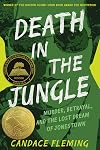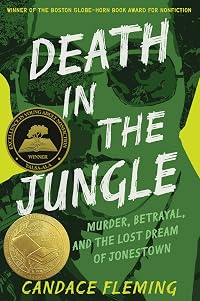
Death in the Jungle: Murder, Betrayal, and the Lost Dream of Jonestown
by Candace Fleming
On This Page
Description
"How did Jim Jones, the leader of Peoples Temple, convince more than 900 of his followers to commit "revolutionary suicide" by drinking cyanide-laced punch? From a master of narrative nonfiction comes a chilling chronicle of one of the most notorious cults in American history. Using riveting first-person accounts, award-winning author Candace Fleming reveals the makings of a monster: from Jones's humble origins as a child of the Depression... to his founding of a group whose idealistic show more promises of equality and justice attracted thousands of followers... to his relocation of Temple headquarters from California to an unsettled territory in Guyana, South America, which he dubbed "Jonestown"... to his transformation of Peoples Temple into a nefarious experiment in mind-control."-- show lessTags
Recommendations













Member Reviews
From a young age, Jim Jones learned that strong orators -- preachers, politicians, etc. -- could amass great power. Over the course of his life, he sought to gain that power by taking on the forms of religion that served him, and by whipping his followers up into a frenzy of devotion to him. Some of his closest followers moved from Indiana to California, and from California to Guyana. But others questioned his demands and the strictures of life in his organization. Still, at the point when he demanded the ultimate sacrifice from his followers, over 900 people died in the South American jungle compound known as Jonestown.
In the book, Candace Fleming compiles the story of Jonestown from the massive piles of primary sources left behind, as show more well as interviews with survivors. I found this book such a compelling read that I finished it in a single day. She asks the question: how were so many people convinced to make such an extreme decision? It's easy to dismiss them as "crazy cultists" and assume that, in the same situation, one would make a different choice... but in reality, it's not that simple. This is a complex exploration of a deeply disturbing topic. If you can stomach the subject matter, highly recommended. show less
In the book, Candace Fleming compiles the story of Jonestown from the massive piles of primary sources left behind, as show more well as interviews with survivors. I found this book such a compelling read that I finished it in a single day. She asks the question: how were so many people convinced to make such an extreme decision? It's easy to dismiss them as "crazy cultists" and assume that, in the same situation, one would make a different choice... but in reality, it's not that simple. This is a complex exploration of a deeply disturbing topic. If you can stomach the subject matter, highly recommended. show less
As a high schooler, I recall being amazed that so many people would commit suicide in a jungle in Guyana because their leader Jim Jones told them to do so. I didn't truly realize how brain-washed cult members were until that moment. Author Candace Fleming talked to survivors of the tragedy as well as looking at articles, diaries, and books written about the tragedy. She's created a book designed for a Young Adult audience (the exact age I was at the time this occurred and was so fascinated by it) which chronicles Jones' development as a cult leader and his involvement with church. Jones chose religion because he realized he could become persuasive to studying preachers who captivated audiences. He abandoned the traditional church, but show more included some elements of church teachings to attract new members. He moved from Indiana to California where he built up a following in the San Francisco and Los Angeles areas. All the while, he sought a place where he could practice his form of religion without a lot of governmental pressure. He found the place in the jungles of Guyana. Jones created barriers and punished anyone caught trying to leave. Congressman Ryan and his delegation which included reporters met with tragedy when they went to investigate claims that people were being forcefully held against their will. Realizing that they would soon be caught, Jones implemented a mass suicide plan he'd been talking about for a long time--even before they went to Guyana. I did not realize how many of those in the jungle were African-Americans until I read this. Jones had especially studied the preaching style of black preachers, so he probably drew them in greater numbers because of that. This is well-researched. I think the writing style might not be quite as engaging for teens as it could be, but I think the story itself will interest them. show less
This book was so compelling and so heartbreaking. I was riveted. I knew about Jonestown, the Kool-Aid, Jim Jones, and the works. Or at least I thought I did. After reading this compelling narrative nonfiction title, I realized that it was so much worse than I ever realized. I only knew the broad strokes and author Candace Fleming did an amazing job of connecting the dots and focusing on a few key survivors to tell the story. Obviously the story starts with Jim Jones, but it goes so much more deep than that. This title is geared towards teens, but really I think it's a perfect place to start if you want to know about this tragedy. It is SO in depth and uses the testimonies of some key survivors to help set the scene and make readers show more understand how normal people could find themselves caught up in the web of deceit. Very well written and includes photos (none of the massacre itself thankfully). Truly moving, a fitting tribute to the survivors and a glimpse into something truly terrifying. show less
I was a teen when the Jonestown murders happened and the news was weird and horrific. But my awareness of the details was limited. Fleming's work presents a broad and terrible picture of Jim Jones' vision. Peoples Temple started as a progressive movement, of equality among the races and socialist beliefs. Many African-Americans were drawn to Jones' message. The suspense ratchets as Jones becomes increasingly paranoid, abusive, and drug-addicted. And yet, his followers remained devoted...with the exception of several increasingly disillusioned members, some of whom defected and lived to tell. This is well-researched and compelling reading. It is even empathetic; Fleming doesn't censure the followers but allows their stories to show their show more humanity. Includes black and white candid photos and a prefacing list of key members of the Peoples Temple. show less
First sentence from prologue: On Friday evening, November 24, 1978, CBS broadcast a special hour-long report: "The Horrors of Jonestown."
First sentence from chapter one: The first time Jim Jones asked followers to play dead was on an autumn night in 1941.
Premise/plot: The story of Jonestown and Jim Jones written for a slightly younger audience--young adult instead of adult. It is a heartbreaking, tragic, fascinating story--a story of how one man used charisma, manipulation, and fear tactics to build and lead People's Temple. This didn't happen overnight. He didn't step up to speak one day, one time and get a mass following willing to do anything and everything he commanded. It was a slow process, a long con if you will, that took show more decades. He started in a "Christian environment," using Christianese--using the traditions and vocabulary of the Christian faith--to gain his first followers. Influenced by the "faith-healers" and the more flamboyant Pentecostal style, he figured out what his audience wanted to hear, and played it up. He used tactics that allegedly some mediums and psychics use--from what I can tell--to "prophesy" messages to specific individuals. He was a showman. Everything was crafted for a certain purpose--to gain more and more power and prestige and acclaim.
He may have started with a "Christian" message, a "Christian" prophecy, a "Christian" God, but it was a sham through and through. He began shedding the 'Christian' skin little by little by little by little--slowly but surely getting his audience used to his message. If he'd out and out stated clearly and precisely his views--especially at the start--his following would likely have left him recognizing him as dangerous. Within a decade--maybe a little more--he had abandoned the pretense. There was no God in the sky, only a GOD on earth, Jim Jones himself was GOD. He staged fake assassination attempts. Pretend to be shot. Pretend to be dead. And then have a pretend resurrection and come back to life. This lines up with his pretend miracles and signs.
Another tactic was creating fear, building it up, and hyping up this chaotic doomsday prophecy or forecast. Distrust everybody. Trust only him.
The story is told through many perspectives--many of which were his followers [or former followers].
The tension builds throughout as the story nears its end.
My thoughts: This one was fascinating and horrifying. It is, of course, dark and horrifying. It isn't light reading material. But I do think it is an important story to revisit.
Will today's YA audience be familiar with the story? That's a good question. Honestly I don't know the answer. But the story itself is fascinating and compelling. One thing that stood out to me--and I have no comparison to other books about it, since I never finished any (though there's a great one that I put down and never got back to)--is her emphasis that there was murder. There were signs that the tragic ending for some/many was NOT voluntary. show less
First sentence from chapter one: The first time Jim Jones asked followers to play dead was on an autumn night in 1941.
Premise/plot: The story of Jonestown and Jim Jones written for a slightly younger audience--young adult instead of adult. It is a heartbreaking, tragic, fascinating story--a story of how one man used charisma, manipulation, and fear tactics to build and lead People's Temple. This didn't happen overnight. He didn't step up to speak one day, one time and get a mass following willing to do anything and everything he commanded. It was a slow process, a long con if you will, that took show more decades. He started in a "Christian environment," using Christianese--using the traditions and vocabulary of the Christian faith--to gain his first followers. Influenced by the "faith-healers" and the more flamboyant Pentecostal style, he figured out what his audience wanted to hear, and played it up. He used tactics that allegedly some mediums and psychics use--from what I can tell--to "prophesy" messages to specific individuals. He was a showman. Everything was crafted for a certain purpose--to gain more and more power and prestige and acclaim.
He may have started with a "Christian" message, a "Christian" prophecy, a "Christian" God, but it was a sham through and through. He began shedding the 'Christian' skin little by little by little by little--slowly but surely getting his audience used to his message. If he'd out and out stated clearly and precisely his views--especially at the start--his following would likely have left him recognizing him as dangerous. Within a decade--maybe a little more--he had abandoned the pretense. There was no God in the sky, only a GOD on earth, Jim Jones himself was GOD. He staged fake assassination attempts. Pretend to be shot. Pretend to be dead. And then have a pretend resurrection and come back to life. This lines up with his pretend miracles and signs.
Another tactic was creating fear, building it up, and hyping up this chaotic doomsday prophecy or forecast. Distrust everybody. Trust only him.
The story is told through many perspectives--many of which were his followers [or former followers].
The tension builds throughout as the story nears its end.
My thoughts: This one was fascinating and horrifying. It is, of course, dark and horrifying. It isn't light reading material. But I do think it is an important story to revisit.
Will today's YA audience be familiar with the story? That's a good question. Honestly I don't know the answer. But the story itself is fascinating and compelling. One thing that stood out to me--and I have no comparison to other books about it, since I never finished any (though there's a great one that I put down and never got back to)--is her emphasis that there was murder. There were signs that the tragic ending for some/many was NOT voluntary. show less
In six parts (Beginnings, Relocating, Radicalizing, Exodus, Jonestown, and After), Fleming lays out the history of Jim Jones and the Peoples Temple, culminating in the mass murder/suicide in Guyana. She writes about Jim Jones' childhood, become a preacher, marrying Marceline, moving their community from Indiana to California, becoming increasingly controlling and paranoid (and reliant on drugs), and eventually moving to a new settlement in Guyana. An in-person investigation by Congressman Leo Ryan, along with staff and press, ended in his murder, quickly followed by the tragic mass death, with few survivors. The history is specific and well-researched, but there are certainly parallels to other charismatic and controlling leaders show more throughout history and in the present.
Key people (cast of characters), terminology, author's note, sources, bibliography, photos, image credits, index.
Quotes
Nowadays, when we hear the word cult, we think of a group or movement with an extreme ideology, headed by a charismatic leader. (17)
Jones...discovered he had a knack for figuring out what people wanted to hear, and for saying it in the most convincing way. And if he had to lie, so be it. (36)
Jones understood these varied reasons, and like a chameleon, he "appealed to anyone on any level at any time," recalled one former member. (97)
"The thing that's important to remember: the elements of the Temple that couldn't be found anywhere else were so attractive, so wonderful, so uplifting, that we'd do whatever we had to..." (Stephan Jones, 177)
"Drinking the Kool-Aid" entered the lexicon. It quickly became a common expression used to describe self-deception, voluntary indoctrination, and blind obedience to group identity. Said one survivor who lost her four children at Jonestown: "I hated that people laughed when they said it, like what happened was somehow funny." (311)
Perhaps the more important questions are "What can we learn from what happened? What do we do now with that knowledge?" (Stephan Jones, 315)
Everyone I spoke to agreed to do so for the same reason: They wanted to share their experiences with young people....Their hope is that stories from their youth will resonate with today's young audience - readers who might be particularly susceptible to peer pressure, charismatic leaders, and undue influence. (Author's note, 318) show less
Key people (cast of characters), terminology, author's note, sources, bibliography, photos, image credits, index.
Quotes
Nowadays, when we hear the word cult, we think of a group or movement with an extreme ideology, headed by a charismatic leader. (17)
Jones...discovered he had a knack for figuring out what people wanted to hear, and for saying it in the most convincing way. And if he had to lie, so be it. (36)
Jones understood these varied reasons, and like a chameleon, he "appealed to anyone on any level at any time," recalled one former member. (97)
"The thing that's important to remember: the elements of the Temple that couldn't be found anywhere else were so attractive, so wonderful, so uplifting, that we'd do whatever we had to..." (Stephan Jones, 177)
"Drinking the Kool-Aid" entered the lexicon. It quickly became a common expression used to describe self-deception, voluntary indoctrination, and blind obedience to group identity. Said one survivor who lost her four children at Jonestown: "I hated that people laughed when they said it, like what happened was somehow funny." (311)
Perhaps the more important questions are "What can we learn from what happened? What do we do now with that knowledge?" (Stephan Jones, 315)
Everyone I spoke to agreed to do so for the same reason: They wanted to share their experiences with young people....Their hope is that stories from their youth will resonate with today's young audience - readers who might be particularly susceptible to peer pressure, charismatic leaders, and undue influence. (Author's note, 318) show less
I was fascinated by this story. I had no idea the scope of the deaths, 900!, for those members of the cult. A look at Jim Jones and his personality, focus on specific families and people. It took a lot of buildup to get to the tragic ending. I had never heard that the group assassinated a US Senator. But the end of the book was less copelling. I had a tough time in the audiobook keeping track of the players within the story.
Members
- Recently Added By
Lists

Cults
22 works; 1 member

North Star Short List TBR
25 works; 1 member
Author Information

61+ Works 11,638 Members
Awards and Honors
Awards
Distinctions
Notable Lists
Common Knowledge
- People/Characters
- Tommy Bogue; Brian Davis; Hyacinth Thrash; Jim Bogue; Sharon Amos; Stephan Jones (show all 14); Jim Jones Jr.; Maria Katsaris; Carolyn Layton; Larry Layton; Annie Moore; Al Simon; Bonnie Simon; Zipporah Edwards
- Important places
- San Francisco, California, USA; Indianapolis, Indiana, USA; Jonestown, Guyana
- Important events
- Jonestown Massacre, 1978
- Dedication
- To Rebecca and Mac, whose tireless work serves to remind us all that "the bodies had names"
- First words
- On Friday evening, November 24, 1978, CBS broadcast a special hour-long report: "The Horrors of Jonestown."
- Last words
- (Click to show. Warning: May contain spoilers.)He pauses before adding, "So what? Now what?"
Classifications
Statistics
- Members
- 103
- Popularity
- 314,698
- Reviews
- 8
- Rating
- (4.20)
- Languages
- English
- Media
- Paper, Audiobook, Ebook
- ISBNs
- 5
- ASINs
- 2