On This Page
Description
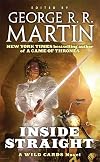
A new generation of aces comes of age as twenty-one of them compete against each other in a series of tasks and stunts on the blockbuster TV reality show "American Hero," and John Fortune, son of the show's creator, discovers his destiny.Tags
Recommendations















Member Reviews
Ah, so this is the volume I missed before the last one I read—it actually gives the story of how the American Idol-esque American Ace competition produced some actual international heroes/colonial imperialists (depending on your perspective). It’s a good enough Wild Cards adventure, but it does make clear that the authors know that sending a bunch of Americans and a German (whose Ace is ghost armor and is known, I kid you not, as Crusader) to the Middle East raises a whole lot of problematic issues; they just don’t care/are on the side of the Americans anyway. I’m sure the earlier Wild Cards books would give me the same kind of conniptions now if I reread them.
Fifty years after the alien virus called "Wild Card" spread across the world, humanity still struggles to define itself. There are part-human jokers and supremely gifted aces. In America, this leads to one inevitable result: a reality game show pitting jokers and aces against each other with the end goal of a million dollars and publicity galore. As the superpowered are eliminated, the backstabbing and cruelty worsen. This is all mild compared to the trauma on the other side of the world, where the assassination of the Caliph has erupted in an all-out slaughter of the entire joker population of Egypt, including the new incarnations of the old gods. For some of the American aces, it's not longer a matter of winning--it's a chance to be a show more real hero.
This was my first foray into the Wild Cards universe, and I must say it's an interesting place to visit and quite different from Martin's Song of Ice and Fire series. Since many authors contributed, I also expected it to feel like a short story anthology and was surprised that it read as a novel. The viewpoints are diverse, each interesting in their own right, though the beginning of the book has a very different vibe than the last half. (Also, the back cover blurb is wildly inaccurate.) I liked the book and its fresh take on the superhero trope, and I would eventually like to read more in the series. show less
This was my first foray into the Wild Cards universe, and I must say it's an interesting place to visit and quite different from Martin's Song of Ice and Fire series. Since many authors contributed, I also expected it to feel like a short story anthology and was surprised that it read as a novel. The viewpoints are diverse, each interesting in their own right, though the beginning of the book has a very different vibe than the last half. (Also, the back cover blurb is wildly inaccurate.) I liked the book and its fresh take on the superhero trope, and I would eventually like to read more in the series. show less
I have a huge interest in shared worlds and Wild Cards is a shared world that I’ve spent a reasonable amount of time in. Wild Cards is a shared world series that is only a few years younger than I am and at this point encompasses 18 volumes, the shared effort of over a dozen writers and the steady editorship of George R. R. Martin, now perhaps better known for his high fantasy series. The basic premise is a world with super-powers (due to an alien virus referred to as the “wild card virus”). It’s a (sometimes quite dark) funhouse mirror of our own history, but filled with heroes (“aces”), villains, a deformed under-class (“jokers”), plague deaths (“black queens”), assassinations and alien invasions.
The series has show more some of the seriousness in tone and literacy of the post-Watchmen era of comics, as if perhaps reading novelized excerpts from some post-modern comic canon. As much as it speaks of our own history, it possibly has more to say as what might pass for a broad comics continuity such as Marvel or DC’s had one been established in the same time period with a copy of Watchmen in hand, smuggled back in time…
This volume serves as a reboot of sorts, hoping to be a conduit to both new and old readers alike. This corresponds with both a new publishing arrangement and an interregnum of several years between it and its predecessors. With my forgetful knowledge of the preceding series I never had a moment where I felt like I needed to reread a previous book or read a book that I may have missed. Certainly there were also a few "mythos" moments where a mention of some previous event sparked a quick "Yeah, I remember that now." I didn't feel like any of those were crucial to the plot.
The structural theme of the first half of the book is very smartly the idea of a "American Hero" reality show based upon open auditions for a new generation of aces. The rules of the reality show run parallel to those that contemporary television has beaten into our heads into a relatively standard form. This provides explicit pathos to the goal of seeking a "new generation of aces" with respect to the earlier parts of the series. The familiar reality show rules provide useful space to reiterate and reinterpret the shared world's own rules. show less
The series has show more some of the seriousness in tone and literacy of the post-Watchmen era of comics, as if perhaps reading novelized excerpts from some post-modern comic canon. As much as it speaks of our own history, it possibly has more to say as what might pass for a broad comics continuity such as Marvel or DC’s had one been established in the same time period with a copy of Watchmen in hand, smuggled back in time…
This volume serves as a reboot of sorts, hoping to be a conduit to both new and old readers alike. This corresponds with both a new publishing arrangement and an interregnum of several years between it and its predecessors. With my forgetful knowledge of the preceding series I never had a moment where I felt like I needed to reread a previous book or read a book that I may have missed. Certainly there were also a few "mythos" moments where a mention of some previous event sparked a quick "Yeah, I remember that now." I didn't feel like any of those were crucial to the plot.
The structural theme of the first half of the book is very smartly the idea of a "American Hero" reality show based upon open auditions for a new generation of aces. The rules of the reality show run parallel to those that contemporary television has beaten into our heads into a relatively standard form. This provides explicit pathos to the goal of seeking a "new generation of aces" with respect to the earlier parts of the series. The familiar reality show rules provide useful space to reiterate and reinterpret the shared world's own rules. show less
 This review was written for LibraryThing Early Reviewers.
Let me start this by saying that I absolutely abhor series books. I want a book to stand on its own – owe nothing to a previous publication; never count on what may happen in an upcoming volume. Put this in perspective. I read 2 and a half books of The Lord of the Rings before I gave up. And I am usually not happy when I get sucked into a series without realizing it. Case in point: Harry Turtledove’s Timeline-191 (Southern Victory) series in which the first book (“How Few Remain”) was a solid alternate history through the eyes of famous people. Then subsequent books took up the lives of regular people. And they just seemed to go on and on. Of course, some series work, as in Card’s Ender Saga which probably works so well show more because it wasn’t intended to be a series.
All these as preface to the fact that the Wild Card series has been an absolute favorite of mine for years. I don’t even know how I got into it, but I was captured from the first book. The scientific explanation of how heroes might exist; the varying, interweaving stories; and the spin on history as seen from this altering event all came together as an immediate success for me. I read all that I could find, but eventually lost track. (That is what happens when there is no internet and all you can do is scan through the used book stores.)
So a new saga begins. And I bought the book as quickly as I could.
And, in spite of the fact that this would never be considered the strongest of the series, it is still a good book and decent read. The Aces are in a reality television competition to find the next American Ace. But, as this is going on, world events in Egypt show that the vapidity of television draws attention from what is important. The novel nicely ties in some of the heroes and stories from previous books (though it is not necessary to know the stories to follow this novel), but is occasionally just a little too cute about bringing those names up.
And therein lies the drawback. The part of the concept that has worked in the past – the various heroes’ stories owned by different authors who bring their own skills to bear on their subject – is still strong. But there is weakness in this book. At times it is too coy, too cute. The authors even seem to realize this. The ending smacks of the end of Star Wars, and the characters even joke about that very fact. No forgiveness given. And, there may be an underlying message here – the story of a war going on that everyone ignores (nice liberal message) or the story of a war that must be fought to protect the innocent no matter what the public feels (nice conservative message). I did not try and read this hard enough to determine which (if either) message was intended. I was just glad to be back in the Wild Cards universe.
No, not the greatest. But good enough for me to look forward to the next book which, I can only hope, will build on the stories that were started for these Aces. show less
All these as preface to the fact that the Wild Card series has been an absolute favorite of mine for years. I don’t even know how I got into it, but I was captured from the first book. The scientific explanation of how heroes might exist; the varying, interweaving stories; and the spin on history as seen from this altering event all came together as an immediate success for me. I read all that I could find, but eventually lost track. (That is what happens when there is no internet and all you can do is scan through the used book stores.)
So a new saga begins. And I bought the book as quickly as I could.
And, in spite of the fact that this would never be considered the strongest of the series, it is still a good book and decent read. The Aces are in a reality television competition to find the next American Ace. But, as this is going on, world events in Egypt show that the vapidity of television draws attention from what is important. The novel nicely ties in some of the heroes and stories from previous books (though it is not necessary to know the stories to follow this novel), but is occasionally just a little too cute about bringing those names up.
And therein lies the drawback. The part of the concept that has worked in the past – the various heroes’ stories owned by different authors who bring their own skills to bear on their subject – is still strong. But there is weakness in this book. At times it is too coy, too cute. The authors even seem to realize this. The ending smacks of the end of Star Wars, and the characters even joke about that very fact. No forgiveness given. And, there may be an underlying message here – the story of a war going on that everyone ignores (nice liberal message) or the story of a war that must be fought to protect the innocent no matter what the public feels (nice conservative message). I did not try and read this hard enough to determine which (if either) message was intended. I was just glad to be back in the Wild Cards universe.
No, not the greatest. But good enough for me to look forward to the next book which, I can only hope, will build on the stories that were started for these Aces. show less
I received a copy of Inside Straight as part of the Early Reviewer program. This was my first Wild Cards novel and foray into the world of George R. R. Martin. Apparently, the world was previously struck by the "Wild Card Virus" and it is latent in the body until triggered. When triggered, the virus gives a small percentage superhero powers ("Aces") and another small percentage are given physical mutations ("Jokers"). I felt this book did not give the reader good summary of the world-building; I had to look up the mythology on Wikipedia. I got the impression that it assumes you have read a previous novel from the series.
This novel started off with unknown Aces participating on a new reality TV show, American Hero. There are four teams show more of Aces who live together in a big house à la Big Brother. At the end of each week, they must complete a heroic challenge and the teams who lose must vote one of their teammates off. This reality TV satire was the half of the novel I really enjoyed. The reader follows a few key Aces as they audition, compete in the show and eventually the fallout from being voted off. The authors capture perfectly how people - whether normals or Aces - can lust after infamy on these shows. I do think it was a pitch-perfect spoof that was both witty and insightful.
However, the second half of the novel shifts to the Aces fighting an intense battle in Egypt. The Egyptian governmental and religious authorities have decided to launch a full offensive against their Jokers who they accuse of assassinating a religious leader. For various reasons, some of the American Heroes decide to fly over there and protect the Jokers. I felt this part of the novel led to blatant Americana, Ameri-centrism and Imperialism. In it, the story narrates the world sitting powerless on its hands when faced with rampant genocide and only the 'Good Guys' (Americans) will be brave enough to try to stop it.
I did not realize until I was 3/4 of the way through the book that the each section was written by different authors and this was an anthology. When I finally comprehended that fact, it made way more sense why the novel was so uneven in tone and viewpoint! There weren't any glaring contradictions between the stories, but I do feel it was obvious that each writer had their own agenda they were pushing in their own stories. In the end, I felt all the writing was pretty solid and each Ace's character was well delineated.
If the story had stuck to the reality TV satire, I would have given this book 4 or 4.5 stars. But I do feel that the "Only Americans Can Save the World" subtext in the second half left me with a sour taste in my mouth. show less
This novel started off with unknown Aces participating on a new reality TV show, American Hero. There are four teams show more of Aces who live together in a big house à la Big Brother. At the end of each week, they must complete a heroic challenge and the teams who lose must vote one of their teammates off. This reality TV satire was the half of the novel I really enjoyed. The reader follows a few key Aces as they audition, compete in the show and eventually the fallout from being voted off. The authors capture perfectly how people - whether normals or Aces - can lust after infamy on these shows. I do think it was a pitch-perfect spoof that was both witty and insightful.
However, the second half of the novel shifts to the Aces fighting an intense battle in Egypt. The Egyptian governmental and religious authorities have decided to launch a full offensive against their Jokers who they accuse of assassinating a religious leader. For various reasons, some of the American Heroes decide to fly over there and protect the Jokers. I felt this part of the novel led to blatant Americana, Ameri-centrism and Imperialism. In it, the story narrates the world sitting powerless on its hands when faced with rampant genocide and only the 'Good Guys' (Americans) will be brave enough to try to stop it.
I did not realize until I was 3/4 of the way through the book that the each section was written by different authors and this was an anthology. When I finally comprehended that fact, it made way more sense why the novel was so uneven in tone and viewpoint! There weren't any glaring contradictions between the stories, but I do feel it was obvious that each writer had their own agenda they were pushing in their own stories. In the end, I felt all the writing was pretty solid and each Ace's character was well delineated.
If the story had stuck to the reality TV satire, I would have given this book 4 or 4.5 stars. But I do feel that the "Only Americans Can Save the World" subtext in the second half left me with a sour taste in my mouth. show less
This review was written for LibraryThing Early Reviewers.I loved the original four or five titles in the long-running Wild Cards series, in which the alien Tachyon unleashes a virus in the Earth's atmosphere that turns some humans into superhumans, either "jokers" (whose "wild card" manifests as terrible mutations) or "aces" (whose mutations are more like comic-book superhero powers). The series, started in the 1980s, began at around the end of WWII and carried on into the then-present, but once it reached that point, I felt it went off the rails with more and more weird beings being thrown into the mix. So I was somewhat relieved when it apparently came to an end sometime in the 1990s. More recently, however, it has returned with new writers and new characters. The premise of the books is show more that numerous authors create joker and ace characters which each author can use in his/her part of the story, creating a "mosiac novel" of many authorial voices. Inside Straight is, I believe, the third of the new series, and features writing by Daniel Abraham, Melinda M. Snodgrass, Carrie Vaughn, Michael Cassutt, Caroline Spector, John Jos. Miller, George R.R. Martin, Ian Tregillis and S.L. Farrell. It starts out amusingly enough, with a bunch of wild card contestants on a reality TV show to find the first "American Hero" ace, which is a set-up tailor-made for satire; I quite enjoyed the characters and their back-biting behaviour during the first part of the book. But then the authors get serious, about a kind of civil war raging in Egypt, where the Caliph has been assassinated and fundamentalist Muslims are working to wipe out all wild card sufferers in the country, many of whom look like (and are worshipped as) the ancient Egyptian gods; some of the discarded "American Hero" contestants decide to join in the fight because they see that innocent people are dying in their thousands. But the battle isn't as simple as it seems....Unfortunately, I felt that the juxtaposition between the funny reality-TV stuff and the serious genocidal war stuff was just too much of a contrast to really work as a coherent story. Don't get me wrong, the writing itself was fine and some of the characters were particularly interesting to me, but I couldn't really get past that broad of a contrast in tone. A shame. show less
This review was written for LibraryThing Early Reviewers.The premise of the Wild Cards novels is that in the recent past, an alien brought a virus to Earth that created mutations in humans. Jokers are mutations with just bodily changes (sometimes drastic) while Aces are mutations with superhero powers. I would have enjoyed this book more except for the major plot element, which is the American Hero tv show. A American Idol for superheroes? I realize the whole point of the book is to rise above the triviality of the made for TV contest and do something real, which some of the characters do, but it felt too contrived. Considering how many superhero TV shows and movies are out at the moment, too, I think I'm saturated on super powers. Typical of a shared world book, there isn't a lot of show more character development either. show less
Members
- Recently Added By
Lists

Superhero Fantasy
81 works; 7 members
Author Information

George R. R. Martin was born on September 20, 1948 in Bayonne, New Jersey. He began writing at an early age, selling monster stories for pennies to neighborhood children. He received B.S. and M.S. degrees in Journalism from Northwestern University. In 1986, he worked as a story editor for the CBS series The Twilight Zone. He was also an executive show more story consultant, producer and co-supervising producer for CBS's Beauty and the Beast. In 1970, he sold the story The Hero to Galaxy magazine. Since becoming a full-time writer in 1979, he has written many novels, stories, and series including A Song for Lya, Portraits of His Children, The Pear-Shaped Man, and the Song of Ice and Fire series. He has won numerous awards including five Locus Awards, three Hugo Awards and two Nebula awards. In 2013 he made The New York Times Best Seller List with his titles A Dance with Dragons and A Game of Thrones: a Clash of Kings, a Storm of Swords, a Feast for Crows. His title's Rogues and The Ice Dragon made the New York Times List in 2014. Martin's title, A Knight of Seven Kingdoms, A Song of Fire and Ice novel, made the New York Times bestseller list in 2015. He is number 4 on the Hollywood Reporter's '25 Most Powerful Authors' 2016 list. (Bowker Author Biography) show less
All Editions
Series


Work Relationships
Common Knowledge
- Canonical title
- Inside Straight
- Original publication date
- 2008-01
- Dedication
- To Kay McKauley, ace agent,
who always deals us
winning hands - Publisher's editor
- Nielsen Hayden, Patrick
- Blurbers
- Grossman, Austin
Classifications
- Genres
- Fiction and Literature, Science Fiction
- DDC/MDS
- 813.0876208 — Literature & rhetoric American literature in English American fiction in English By type Genre fiction Adventure fiction Speculative fiction Science fiction Collections and anthologies Anthologies
- LCC
- PS648 .S3 .I57 — Language and Literature American literature American literature Collections of American literature Prose (General)
- BISAC
Statistics
- Members
- 551
- Popularity
- 53,576
- Reviews
- 31
- Rating
- (3.64)
- Languages
- Dutch, English, German, Hungarian
- Media
- Paper, Ebook
- ISBNs
- 13
- ASINs
- 8