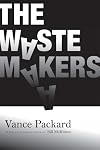
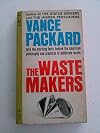
The Waste Makers
by Vance Packard
On This Page
Description
An exposé of "the systematic attempt of business to make us wasteful, debt-ridden, permanently discontented individuals," The Waste Makers is Vance Packard's pioneering 1960 work on how the rapid growth of disposable consumer goods was degrading the environmental, financial, and spiritual character of American society.The Waste Makers was the first book to probe the increasing commercialization of American life—the development of consumption for consumption's sake. Packard outlines the show more ways manufacturers and advertisers persuade consumers to buy things they don't need and didn't know they wanted, including the two-of-a-kind of everything syndrome—"two refrigerators in every home"—and appeals to purchase something because it is more expensive, or because it is painted in a new color. The book also brought attention to the concept of planned obsolescence, in which a "death date" is built into products so that they wear out quickly and need to be replaced. By manipulating the public into mindless consumerism, Packard believed that business was making us "more wasteful, imprudent, and carefree in our consuming habits," which was using up our natural resources at an alarming rate.
A prescient book that predicted the rise of American consumer culture, this all new edition of The Waste Makers features an introduction by best-selling author Bill McKibben.
Vance Packard (1914-1996) was an American journalist, social critic, and best-selling author. Among his other books were The Hidden Persuaders, about how advertisers use psychological methods to get people to buy the products they sell; The Status Seekers, which describes American social stratification and behavior; and The Naked Society, about the threats to privacy posed by new technologies.
. Nonfiction. Sociology. Business. Nature. show less
Tags
Recommendations














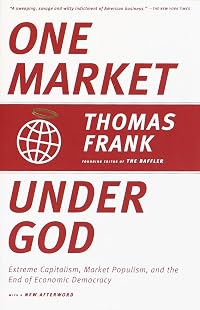
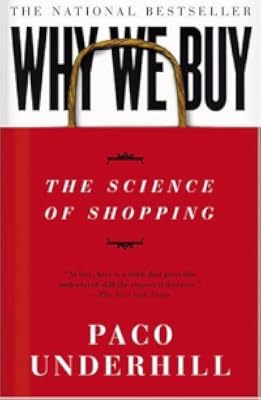

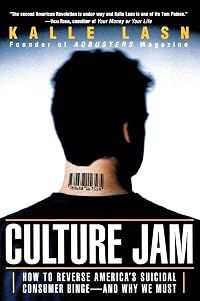


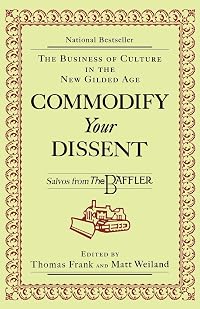







Member Recommendations
P_S_Patrick Highlights many common problems with current industrial society.
Member Reviews
The US economy, and the continued happiness and prosperity of its citizens, rely almost completely on the promotion of wasteful consumption by the ad-men, the corporate executives, and the keeping-up-with-the-Joneses mentality of the super-size-me American Dream. Or so goes the narrative of leaders of the mid-century US economy that comes under the razor-sharp analysis of Vance Packard. It runs us through the consumption patterns of its citizens, and the ongoing foot-on-the-accelerator efforts of advertising industry to make turnover of goods ever faster.
Planned obsolescence of goods as a business model is something difficult to justify either morally (mainly in terms of its damage to the environment), or to the consumer on a show more value-for-money basis (so this relies on them not fully realizing what’s happening). Yet the number of types of obsolescence or encouraged waste (Packard counts nine) employed by the big corporations to boost spending, is staggering, and illustrated in concise yet bountiful detail here. Let me run through these briefly:
1. Encouraging people to buy more of everything (examples – two exhausts on a car that needs one, two cars to a household that needs one, his and hers versions of an item that they could share, two-household homes (with two of every appliance of course),
2. The throw-away spirit (fast-fashion, planned obsolescence of style, single-use or disposable items, non-recyclable food packing etc, goods cheaper to replace than repair)
3. Planned obsolescence (goods designed to break just after expired warranty)
4. Planned obsolescence of desirability (styling cycles)
5. Prevention of economical repair (often by design)
6. Planned chaos
7. Instant money/cash loans (to oil the wheels of spending)
8. Hedonism for the masses (everyone expects more out of life, erosion of spartan/protestant ideals)
9. Proliferation of people (encouragement of reproduction)
The only major things that have changed since this book was written are the exact monetary figures (they’ve only got bigger), that what was said about the US now applies to most of the developed world, and that a proportion of more educated citizens are railing against the wasteful behaviour described herein. This book was ahead of its time in calling out the excesses that were draining the world of its non-renewable resources, and now we are in the metaphorical hangover stage..
Read this. Don't be fooled! show less
Planned obsolescence of goods as a business model is something difficult to justify either morally (mainly in terms of its damage to the environment), or to the consumer on a show more value-for-money basis (so this relies on them not fully realizing what’s happening). Yet the number of types of obsolescence or encouraged waste (Packard counts nine) employed by the big corporations to boost spending, is staggering, and illustrated in concise yet bountiful detail here. Let me run through these briefly:
1. Encouraging people to buy more of everything (examples – two exhausts on a car that needs one, two cars to a household that needs one, his and hers versions of an item that they could share, two-household homes (with two of every appliance of course),
2. The throw-away spirit (fast-fashion, planned obsolescence of style, single-use or disposable items, non-recyclable food packing etc, goods cheaper to replace than repair)
3. Planned obsolescence (goods designed to break just after expired warranty)
4. Planned obsolescence of desirability (styling cycles)
5. Prevention of economical repair (often by design)
6. Planned chaos
7. Instant money/cash loans (to oil the wheels of spending)
8. Hedonism for the masses (everyone expects more out of life, erosion of spartan/protestant ideals)
9. Proliferation of people (encouragement of reproduction)
The only major things that have changed since this book was written are the exact monetary figures (they’ve only got bigger), that what was said about the US now applies to most of the developed world, and that a proportion of more educated citizens are railing against the wasteful behaviour described herein. This book was ahead of its time in calling out the excesses that were draining the world of its non-renewable resources, and now we are in the metaphorical hangover stage..
Read this. Don't be fooled! show less
t's an interesting look at the 1950's (and early 1960's) consumer culture. As with most theses the book starts with a nostalgic assumption that things were better twenty or so years in the past but I bet that in the 1920s or 1930s, there's probably an equivelent book lamenting the excesses of that era and lauding the frugality of the turn of the century. That being said, the book does have some fascinating and chilling examples of how marketing works to build an artificial demand for a product. I worked four years for a marketing department of a high tech software firm and I can say that the tactics haven't changed.
Some of the book's points are disturbingly modern. The chapters on car models is worth a read. In the 1950s the focus was show more on making the cars lower to ground, wider and longer. Wider and longer has certainly come back into fashion with those hideous SUVs but of course now these cars seem to be getting taller which makes roll overs a serious problem. The book mentions that the car manufacturers at the time listed their cars low centers of gravity as an "anti roll over" feature. Funny how those same companies have forgotten this bit of common sense in order to sell tall cars.
Some of the book's points, though, don't hold up to the passage of time. The book expected the U.S. to be far more over populated by now than it is (assuming a continuous baby boom at rates comparible to post WWII), a worse depression than what is currently happening (due to an assumed continued one income family across the board), a worse state of polution (no EPA at all, even one currently weakened by Bush is still better than none), and a far more depleted natural resources (assuming no recycling).
Another bit of the book that struck me as odd is the discussion on product life. The example Packard uses is the television set. Clearly television manufacturers have moved away from changing styles but poor quality to better quality and basically utilitarian styling. Televisions today come in a variety of sizes and shapes but they all seem to work without needing a quarterly visit by a television repairman. The two televisions we own work just as well as when we bought them. One of them is nearly 15 years old. The second one is 7 years old. We had to get it because the older one didn't have the video input needed to play our DVD's signal directly.
One final note, the chapter on making larger purchases on credit really grabbed my attention as a new home buyer. I think Packard would have been mortified at the current home prices across the country, but especially in the more expensive urban areas. Although lending practices of banks and other mortgage brokers is far more conservative now than it was pre Great Depression, some of the sketchy practices are starting to resurface which could easily cause a similar loss of homes in the neaure future as it did in the 1930s. show less
Some of the book's points are disturbingly modern. The chapters on car models is worth a read. In the 1950s the focus was show more on making the cars lower to ground, wider and longer. Wider and longer has certainly come back into fashion with those hideous SUVs but of course now these cars seem to be getting taller which makes roll overs a serious problem. The book mentions that the car manufacturers at the time listed their cars low centers of gravity as an "anti roll over" feature. Funny how those same companies have forgotten this bit of common sense in order to sell tall cars.
Some of the book's points, though, don't hold up to the passage of time. The book expected the U.S. to be far more over populated by now than it is (assuming a continuous baby boom at rates comparible to post WWII), a worse depression than what is currently happening (due to an assumed continued one income family across the board), a worse state of polution (no EPA at all, even one currently weakened by Bush is still better than none), and a far more depleted natural resources (assuming no recycling).
Another bit of the book that struck me as odd is the discussion on product life. The example Packard uses is the television set. Clearly television manufacturers have moved away from changing styles but poor quality to better quality and basically utilitarian styling. Televisions today come in a variety of sizes and shapes but they all seem to work without needing a quarterly visit by a television repairman. The two televisions we own work just as well as when we bought them. One of them is nearly 15 years old. The second one is 7 years old. We had to get it because the older one didn't have the video input needed to play our DVD's signal directly.
One final note, the chapter on making larger purchases on credit really grabbed my attention as a new home buyer. I think Packard would have been mortified at the current home prices across the country, but especially in the more expensive urban areas. Although lending practices of banks and other mortgage brokers is far more conservative now than it was pre Great Depression, some of the sketchy practices are starting to resurface which could easily cause a similar loss of homes in the neaure future as it did in the 1930s. show less
Mr. Packard did not like many of the aspects of American life in the 1950's and early 1960's. This is the discussion of the materialistic impulse in the height of the bigger! Bigger! Bigger! phase. His strictures are entirely correct, and in the light of the information on the Climate Crisis, forethoughtful.
A "Estratégia do Desperdício" (1960), de Vance Packard, denuncia técnicas industriais para forçar o consumo através da obsolescência planejada e artificial. O livro descreve como empresas criam produtos de curta vida útil ou mudam estilos desnecessariamente para incentivar os consumidores a descartar itens funcionais e comprar novos, impulsionando a superprodução e o desperdício.
Jan 24, 2026English (UK)
Ratings
Members
- Recently Added By
Author Information

Some Editions
Awards and Honors
Distinctions
Series
Belongs to Publisher Series
Cardinal Editions [Pocket Books] (77116)
Common Knowledge
- Original publication date
- 1960
- Dedication
- To my Mother and Father who have never confused the possession of goods with the good life
- First words
- What will the world of tomorrow be like?
- Last words
- (Click to show. Warning: May contain spoilers.)The central challenge seems to be this: Americans must learn to live with their abundance without being forced to impoverish their spirt by being damned fools about it.
Classifications
- Genres
- Sociology, Nonfiction, Economics, General Nonfiction, Science & Nature, Business
- DDC/MDS
- 339.4 — Society, government, & culture Economics Macroeconomics and related topics Factors Impacting GDP
- LCC
- HC110 .W3 .P3 — Social sciences Economic history and conditions Economic history and conditions By region or country
- BISAC
Statistics
- Members
- 280
- Popularity
- 115,615
- Reviews
- 4
- Rating
- (3.78)
- Languages
- 6 — Dutch, English, French, German, Hungarian, Swedish
- Media
- Paper, Ebook
- ISBNs
- 7
- UPCs
- 1
- ASINs
- 25