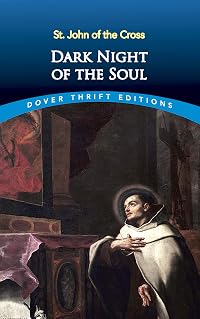
The Dark Night of the Soul
by St. John of the Cross, St. John of the Cross (Author)
On This Page
Description
With His gentle hand He wounded my neck And caused all my senses to be suspended.' Part poetic masterpiece, part mystic treatise, The Dark Night of the Soul by 16th century Carmelite monk, St. John of the Cross, addresses the feeling of being forgotten by the Presence of the Almighty that every Christian desirous of walking more closely with God must pass through in order to learn to walk by faith and not by sight. 'Spiritual persons suffer great reason…of the fear which they have of being show more lost on the road, thinking that all spiritual blessing is over for them and that God has abandoned them since they find no help or pleasure in good things. Then they grow weary, and endeavor to concentrate their faculties with some degree of pleasure upon some object of meditation, thinking that, when they are not doing this and yet are conscious of making an effort, they are doing nothing.' Perhaps one of the most widely recognized of the mystical writings, St. John's classic Dark Night of the Soul is not only practical theology but a beautiful balm of healing to anyone whose heart has ever echoed the words of Christ, 'My God, My God, why hast Thou forsaken me?'. show lessTags
Recommendations










Member Reviews
Upon a darkened night
The flame of love was burning in my breast
And by a lantern bright
I fled my house while all in quiet rest...
I was first introduced to this famous poem by 16th-century mystic St. John of the Cross through Loreena McKennitt's song on her album "The Mask and Mirror." It's a beautiful piece of work describing the soul's union with God, and I was interested to read the theological treatise he wrote later in his life about it. Unfortunately, the poem is much better read by itself than painstakingly expounded.
The "dark night of the soul" is a term that denotes a period of spiritual dryness, when all devotional activities feel particularly flat and stale, and the soul is assailed by doubts and confusion. As a description of show more spiritual drought — something I think every Christian experiences — it's excellent, but where I just don't follow St. John is in his insistence on the details of every stage of the dark night. His wandering, belabored descriptions quickly become tedious, and the result is irrelevant to the vigorous pursuit of holiness taught by the New Testament.
Biblically speaking, is the dark night supposed to be the defining theme of the Christian life? I'm not convinced it is. In the New Testament, Christians are urged to live wisely, serve one another, grow in knowledge and wisdom, work hard, examine themselves, bear fruit, be humble, and love faithfully. One thing we aren't told to do is spend our lives analyzing our spiritual depression and contemplating the vicissitudes of our inner man. Focusing so much energy and time on what's going on inside seems a little narcissistic, even if it is a spiritualized introspection. The Bible doesn't emphasize the experience of spiritual dryness and I think it's a mistake for us to do so. I'm not denying that spiritual dryness exists, but I think wallowing in it encourages a focus on self to the exclusion of other things like serving others and being faithful regardless of our feelings.
St. John's biblical exegesis is weak; he only quotes Scripture when it supports his point (rather than Scripture being the starting point and his point being drawn from it), and he often has to twist it dreadfully to make it mean what he wants it to. Occasionally even the interpretations he wrests from his spare lines of poetry are also a stretch; at times he is extremely literal and other times the meaning is, of course, highly symbolic. There is no consistency in his interpretative principles.
What I'm gathering from the Catholic mystics I've read thus far is that they are just like mystics of any other religion: they spout lots of man-made ideology and structures, they are absorbed in their own spiritual lives to the point of being self centered, and occasionally they say something that is true and beautiful. For the Christian seeking biblical truth, this will not satisfy. show less
The flame of love was burning in my breast
And by a lantern bright
I fled my house while all in quiet rest...
I was first introduced to this famous poem by 16th-century mystic St. John of the Cross through Loreena McKennitt's song on her album "The Mask and Mirror." It's a beautiful piece of work describing the soul's union with God, and I was interested to read the theological treatise he wrote later in his life about it. Unfortunately, the poem is much better read by itself than painstakingly expounded.
The "dark night of the soul" is a term that denotes a period of spiritual dryness, when all devotional activities feel particularly flat and stale, and the soul is assailed by doubts and confusion. As a description of show more spiritual drought — something I think every Christian experiences — it's excellent, but where I just don't follow St. John is in his insistence on the details of every stage of the dark night. His wandering, belabored descriptions quickly become tedious, and the result is irrelevant to the vigorous pursuit of holiness taught by the New Testament.
Biblically speaking, is the dark night supposed to be the defining theme of the Christian life? I'm not convinced it is. In the New Testament, Christians are urged to live wisely, serve one another, grow in knowledge and wisdom, work hard, examine themselves, bear fruit, be humble, and love faithfully. One thing we aren't told to do is spend our lives analyzing our spiritual depression and contemplating the vicissitudes of our inner man. Focusing so much energy and time on what's going on inside seems a little narcissistic, even if it is a spiritualized introspection. The Bible doesn't emphasize the experience of spiritual dryness and I think it's a mistake for us to do so. I'm not denying that spiritual dryness exists, but I think wallowing in it encourages a focus on self to the exclusion of other things like serving others and being faithful regardless of our feelings.
St. John's biblical exegesis is weak; he only quotes Scripture when it supports his point (rather than Scripture being the starting point and his point being drawn from it), and he often has to twist it dreadfully to make it mean what he wants it to. Occasionally even the interpretations he wrests from his spare lines of poetry are also a stretch; at times he is extremely literal and other times the meaning is, of course, highly symbolic. There is no consistency in his interpretative principles.
What I'm gathering from the Catholic mystics I've read thus far is that they are just like mystics of any other religion: they spout lots of man-made ideology and structures, they are absorbed in their own spiritual lives to the point of being self centered, and occasionally they say something that is true and beautiful. For the Christian seeking biblical truth, this will not satisfy. show less
This is one of the most difficult religious treatises I've ever read. The language is somewhat arcane, and the concepts are very esoteric. It sounds like I didn't like the book, but I did; enough to probably reread this some day given how thought provoking it was. The idea that the soul prospers in abandoning everything, paring down even beyond the spiritual action, is counter-intuitive, and somewhat convicting. Highly recommended for the searchers in life.
A beautiful meditation on spiritual progress, primarily aimed at those relatively advanced in the spiritual life. I was surprised to find how much like a modern self-help book the text really is.
This book is a Christian classic. It is somewhat like a commentary on a poem. The reading requires contemplation, and it really should not be rushed. The fact I was in a rush to complete it probably influenced my lower rating. I found the language a bit "stilted" and the sentences too long for most modern readers.
I fear I've understood only a small bit of this book, but I'm glad I worked my way through it. It's a view into a mind and religious worldview that is completely foreign to me but still worth trying to internalize.
This book offers incredible and honest insights into spiritual growth and development. It consists of an explanation of a poem by the same author, also called the Dark Night of the Soul, and although it ends abruptly, the wisdom the reader can draw from it seems unlimited.
Summary from Amazon:
The great Spanish mystic St. John of the Cross became a Carmelite monk in 1563 and helped St. Teresa of Avila to reform the Carmelite order — enduring persecution and imprisonment for his efforts. Both in his writing and in his life, he demonstrated eloquently his love for God. His written thoughts on man's relationship with God were literary endeavors that placed him on an intellectual and philosophical level with such great writers as St. show more Augustine and Thomas Aquinas.
In this work — a spiritual masterpiece and classic of Christian literature and mysticism — he addresses several subjects, among them pride, avarice, envy, and other human imperfections. His discussion of the "dark night of the spirit," which considers afflictions and pain suffered by the soul, is followed by an extended explanation of divine love and the soul's exultant union with God. show less
Summary from Amazon:
The great Spanish mystic St. John of the Cross became a Carmelite monk in 1563 and helped St. Teresa of Avila to reform the Carmelite order — enduring persecution and imprisonment for his efforts. Both in his writing and in his life, he demonstrated eloquently his love for God. His written thoughts on man's relationship with God were literary endeavors that placed him on an intellectual and philosophical level with such great writers as St. show more Augustine and Thomas Aquinas.
In this work — a spiritual masterpiece and classic of Christian literature and mysticism — he addresses several subjects, among them pride, avarice, envy, and other human imperfections. His discussion of the "dark night of the spirit," which considers afflictions and pain suffered by the soul, is followed by an extended explanation of divine love and the soul's exultant union with God. show less
Members
- Recently Added By
Lists

100 Books to Read in a Lifetime (That Are Older Than 200 Years)
415 works; 175 members

Church Times 100 Best Christian Books
106 works; 26 members
25 Books Every Christian Should Read
27 works; 4 members

Saints and Blesseds
74 works; 4 members

The Essential Western Mystics
66 works; 4 members

𓐩hought Daughter ♱♰✟✞✝︎☨†˚₊‧꒰ა ♱ ໒꒱ ‧
38 works; 1 member

el
1,139 works; 1 member
Author Information

364+ Works 8,681 Members
St. John of the Cross represents the pinnacle of Spanish mysticism. In contrast to St. Teresa's works, which refer frequently to things of this world, St. John's poetry works on a purely spiritual, abstract plane. His poems consist of allegorical descriptions of the journey of his spirit through mortification of earthly appetites, illumination, show more and purification of the soul to union with God. In his prose commentaries on his own poems he laments the insufficiency of language to communicate his mystical experiences and his interior life. A disciple of St. Teresa, he became the spiritual director of her convent at Avila in 1572 and was responsible for carrying out many of her rigorous new programs for the Carmelite Order. Objections to his extreme reforms led to a period of imprisonment and torture in Toledo. During this time, according to tradition, he wrote Spiritual Canticle. His concentrated symbolic poetry has been studied with enthusiasm by such modern poets as T. S. Eliot, Paul Valery, and Jorge Guillen. (Bowker Author Biography) show less
Some Editions
Awards and Honors
Series
Belongs to Publisher Series
Work Relationships
Is contained in
Is abridged in
Common Knowledge
- Canonical title
- The Dark Night of the Soul
- Original title
- Noche oscura
- Original publication date
- 1586
- First words
- This treatise deals with the manner in which a soul may prepare itself to attain to union with God.
- Last words
- (Click to show. Warning: May contain spoilers.)And thus on the road of solitude it soars upward to God.
- Original language
- Spanish
Classifications
- Genres
- Religion & Spirituality, Nonfiction
- DDC/MDS
- 248.22 — Religion Christian practice & observance Christian experience, practice, life Religious experience Mystical Christianity
- LCC
- BV5080 .J64413 — Philosophy, Psychology and Religion Practical Theology Practical Theology Practical religion. The Christian life Mysticism
- BISAC
Statistics
- Members
- 2,152
- Popularity
- 9,470
- Reviews
- 13
- Rating
- (4.05)
- Languages
- 8 — Czech, Dutch, English, Finnish, French, Italian, Spanish, Swedish
- Media
- Paper, Audiobook, Ebook
- ISBNs
- 98
- UPCs
- 6
- ASINs
- 46
