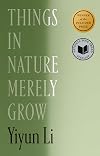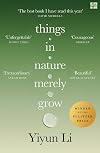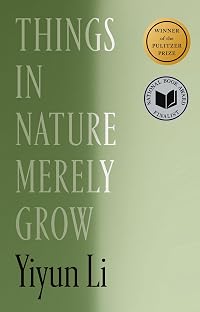
Things in Nature Merely Grow
by Yiyun Li
On This Page
Description
Yiyun Li's remarkable, defiant work of radical acceptance as she considers the loss of her son James."There is no good way to say this," Yiyun Li writes at the beginning of this audiobook.
"There is no good way to state these facts, which must be acknowledged. My husband and I had two children and lost them both: Vincent in 2017, at sixteen, James in 2024, at nineteen. Both chose suicide, and both died not far from home."
There is no good way to say this—because words fall short. It takes show more only an instant for death to become fact, "a single point in a timeline." Living now on this single point, Li turns to thinking and reasoning and searching for words that might hold a place for James. Li does what she can: "doing the things that work," including not just writing but gardening, reading Camus and Wittgenstein, learning the piano, and living thinkingly alongside death.
This is an audiobook for James, but it is not an audiobook about grieving or mourning. As Li writes, "The verb that does not die is to be. Vincent was and is and will always be Vincent. James was and is and will always be James. We were and are and will always be their parents. There is no now and then, now and later, only, now and now and now and now." Things in Nature Merely Grow is a testament to Li's indomitable spirit.
A Macmillan Audio production from Farrar, Straus and Giroux.
. show less
Tags
Recommendations

Member Reviews
Buddhists do not accept the existence of dualities. For them, placing value on phenomena (e.g., good vs. bad; this vs. that) serves no useful purpose. Things just are, and one needs to perceive them that way. Certainly, the sentiment expressed by Li in the title of her memoir aptly reflects that view—"Things in Nature Merely Grow.”
This memoir is not easy to read because of its tragic content. After losing two teenage sons to suicide, Li adopts a coping strategy she calls “radical acceptance.” She realizes that for the rest of her life, she will live in an abyss, a place “where no parent would want to be.” Her approach does not allow for healing. There is no magical thinking here. Instead, it focusses on acknowledgment. She show more rejects the euphemisms about death that people adopt; platitudes are not for her; she even rejects the word “grieve” because it suggests there will be an end. Clearly, her strategy does not offer her readers much in the way of inspiration or consolation.
Alternatively, Li provides a cleareyed guide for thinking about the death of loved ones. She relies on two main strategies. First, she meditates on her two highly gifted sons. Each had a unique personality. Vincent related to life with intense feelings, and she found that he was easy to memorialize through fiction. However, James was the ultimate rationalist. She concludes that he would never accept that approach. So, she struggles with the limitations of writing and language to remember him. Li’s second coping strategy involved emphasizing the quotidian. For her, these are gardening, writing, reading and meditating.
Her writing is honest and unadorned. Despite being filled with heartbreak, it also radiates immense love and devotion for her sons. show less
This memoir is not easy to read because of its tragic content. After losing two teenage sons to suicide, Li adopts a coping strategy she calls “radical acceptance.” She realizes that for the rest of her life, she will live in an abyss, a place “where no parent would want to be.” Her approach does not allow for healing. There is no magical thinking here. Instead, it focusses on acknowledgment. She show more rejects the euphemisms about death that people adopt; platitudes are not for her; she even rejects the word “grieve” because it suggests there will be an end. Clearly, her strategy does not offer her readers much in the way of inspiration or consolation.
Alternatively, Li provides a cleareyed guide for thinking about the death of loved ones. She relies on two main strategies. First, she meditates on her two highly gifted sons. Each had a unique personality. Vincent related to life with intense feelings, and she found that he was easy to memorialize through fiction. However, James was the ultimate rationalist. She concludes that he would never accept that approach. So, she struggles with the limitations of writing and language to remember him. Li’s second coping strategy involved emphasizing the quotidian. For her, these are gardening, writing, reading and meditating.
Her writing is honest and unadorned. Despite being filled with heartbreak, it also radiates immense love and devotion for her sons. show less
A uniquely horrific chronicle of loss that is also a presentation of the lived experience of an existentialist philosophy that is almost pure. Which made me reflect on how thoroughly the social aspect of our existence has been compromised in modernity (this may even be the reason existentialism emerged as a school of thought) - when family and society are toxic, as Li's were, when the once-supremely tight and communitarian web of human relationships is reduced to a few dispersed friendships and professional ties, and the vast web of the living world to a home garden, when the spiritual dimension is non-existent, the individual is left alone to bear the untenable burden of a kind of life that tosses all our ancient evolutionary strengths show more away. That this utter isolation and defeat of the soul should engender madness, even generational madness, seems profoundly sad but perfectly comprehensible. show less
I believe this memoir was written and published far too soon after the author’s 19-year-old son, James, ended his life in 2024. His death occurred a little over six years after Yiyun Li’s firstborn son—James’s brother, Vincent—committed suicide at the age of 16. Both boys killed themselves by stepping in front of oncoming trains. Vincent’s story (or the author’s ongoing conversation with him beyond the grave) appeared a few years back in the form of a novel, which I am not familiar with and have no desire to read. Although the current book focuses on Li’s response to the recent death of her younger son, it unsurprisingly, even inevitably, also considers the suicide of her eldest child. There’s little doubt that the show more first tragedy played a critical role in the second.
There is value in waiting, in allowing one’s understanding—like a plant in the natural world itself (to borrow the author’s metaphor)—to grow before writing a book of this kind. In this case, there could well be wisdom in not sending it out at all. What is the need to display oneself in this way?
I’m an outlier: I did not take to this book, nor did I find it “beautiful” or “wise”, which appears to be the consensus. I had trouble with a number of the author’s views and with the “thinking” bias which she evidently prides herself on. For one thing, I question her assertion that suicide by a young person (and especially troubled young men like her sons) is a reasoned “choice” that needs to be “accepted and respected”. Two such suicides really should give one pause.
The author disdains clichés, but I’m going to use what amounts to one here. (I’d argue that some clichés hold truths.) People experience grief, process loss, differently. I get that. Li’s way of mourning—for example, attending a piano lesson a few days after James’s suicide and working through geometry theorems in subsequent weeks—is certainly an atypical presentation. It is perhaps not surprising, then, that she proclaims that she is in fact “against the word grief.” It is, she writes, a term “cheapened by cliché, by wishful thinking, and by self-centeredness of various kinds—this is another reason I never use the words ‘grief’ or ‘grieving’ when I think about my children.” She informs her young writing students: “Deep pain doesn’t necessarily make a person scream,” adding that it’s her job to tell them “sometimes poetic words about grief and grieving are only husks. It’s their [the students’] good fortune that they haven’t learned that sometimes people don’t have the luxury to wallow in clichés.” Hmm. Wallowing? Is that what it is to express give expression to pain or to cry? Li insinuates that it is. Whatever the case, whether she is “against” the word grief or not, she is experiencing it, and, make no mistake, this book was written in an acute and intense phase of it by a very wounded person. I am not convinced by the “radical acceptance” narrative she puts forward.
It is my perception that there is high degree of emotional inhibition and rigidity in the author. Li seems to suggest that self-possession, psychological restraint, is admirable, a sign of emotional depth—quoting a line of poetry to that effect. (There are literary allusions aplenty in this book, along with a lot of name dropping of well-known contemporary writer “friends”.) The author admits that during her sons’ lives, she hid from them when she wept, writing “Vincent had seen me cry no more than two or three times in his life; James, precisely once.” It’s unclear if emotional control is a badge of honour for the author, but it does seem that way. She minimizes the distress of her loneliness in mourning as a metaphorical “pebble” rather than a boulder. Li also denies feeling anger at all, when it is evident to any attentive reader that she is, for example, enraged by people’s awkward and sometimes self-serving attempts at consoling her. A former friend’s efforts at imposing her Christian views on Li during a hours-long visit to the author’s home after James’s death is treated with particular scorn. No anger? I disagree. Towards the end of the book, there is a lengthy laundry list of deeply resented actions and statements by others. I think time may have provided perspective and tempered some of the author’s understandably raw rage. However, I do wonder if the propensity for and pride in ruminative thought is so entrenched in Li that time would’ve made no difference at all. Going over and over these affronts, may only have cemented them more securely. Forgiveness of others appears not to come easily for her.
At age 13, Vincent, Li’s eldest son who would kill himself at age 16, asked her why she “who knew suffering” had even given “birth to her children.” Avowedly a person who “prefer[s] to live by thinking,” the author admits she “never had a good answer for him.” At the time he asked this penetrating question, she says she herself “had just returned from the bleakest time of my life” (In 2012, she’d been hospitalized on a psych ward for suicidal depression) and “had in my teenage years come close a few times to suicide”. She told him about a belief that “things might change, and sometimes they might change for the better.”
Li writes that several years later, mere weeks before her second son’s suicide: “I had a conversation with James, telling him that by my calculation only ten percent of life is made of things and people we love, and for that ten percent—the real joy of living—we must endure [emphasis mine] the other ninety percent.” That’s quite a ratio (and how she arrived at is not explained). She told him that her “hope was that his temperament—which was calm, dispassionate, self-effacing—combined with his strong intellectual grasp of science, language, philosophy, and logic, would mean that life would remain livable for him” and counselled him to “always think of that ten percent.” James apparently did the math and acted accordingly. Li concludes that he “died as a result of thinking, not feeling, just as in my own case it was thinking, rather than feeling, that had led me to the border between life and death.” She appears to see a certain rightness about James’s action, stating that his suicide had “an element of calm inevitability, the result of long and thorough reflection.” How could she know this? She tells the reader repeatedly that he barely spoke and intimates that it was difficult to know what was going on with him.
Again, I wonder. I wonder about a parent with Li’s biases (in which thinking and feeling are binary orientations)—who’s struggled with her own with suicidality—having such conversations with evidently vulnerable young men. I wonder about the boys’ genetic susceptibilities to mental illness and high-functioning autism. I wonder about their growing up in an environment with a parent with psychiatric problems, some of which obviously stem from frankly horrifying experiences in childhood at the hands of an emotionally unstable and violently physically abusive mother. I wonder about the professional care Li’s sons received—was it adequate? was there real expertise?—and the medications they may have been prescribed. A neuropsychologist showed Li a drawing James made as a child, which communicated his intense aloneness. He himself told his mother how lonely he felt. Was there any response to this by Li? She does not say. Is a person who identifies as a thinker, one who seems quite shut-down emotionally herself, even sensitive to emotional cues from others? The reader is not provided with important information.
Li mentions that a psychiatrist once asked her about the “unreality” she slipped into in 2012, and having listened to her response, he advised that she never ask the question “Is life livable?” again. Providing an analogy of a bird flying quickly through an open room, he observed that we humans “don’t really have the time to form a thorough and thoughtful answer” to that question. Just when this advice was offered to Li—before or after her sons’ suicides— is unclear. If it was delivered prior to their deaths, she wasn’t following it. Was a statistical analysis of suffering versus joy, in which the former outweighs the latter by a massive margin, helpful—life-affirming and hopeful—to a young man like James? How could it be? How wonderful it would have been if someone like Viktor Frankl, who focused on the human search for meaning in the face of suffering, or a child and adolescent psychiatrist like Sami Timimi, who thinks outside the box and approaches patients holistically—considering family context, culture, and personal resilience—could have made a difference with Li’s sons.
The author has determined that she’s been consigned to the abyss, from which she appears to be convinced she will never emerge. It is her “habitat”, she writes. Many memoirs addressing the death of loved ones acknowledge that grief does indeed endure, albeit in an attenuated form, and that the stages that Elizabeth Kübler-Ross identified are not linear—there is no one way to move through them. (Sorrow's Long Road is one recent book that addresses these matters, but there are many others.) While one never “gets over” the loss and indeed continues to grieve for the beloved, the passage of time allows integration—assimilation—the intensity recedes, and acceptance of the loss occurs.
The bereaved person is not delivered into the abyss for good. There is no need to announce a doctrine of radical acceptance. Under the appropriate conditions and with some nurturing, acceptance—like a plant in a garden—naturally grows. It is true that Li has experienced particularly traumatic losses, but I was quite taken aback by her dismissal of the grief of others as somehow being unequal to, less than, her own. How can she know this? Using a book to settle scores with individuals who have angered and annoyed her, no matter how ignorant and insensitive these people may have been, does not strike me as a well-judged move. I perceived an unsettling hubristic, arrogant tone to her book overall. The author appears to view her grief as an entirely special case, occurring in a separate space from others’. One remark—“I am a bereaved mother who happens to teach at an Ivy League university; I don’t work for the admissions office”—sat no better with me than it did with a number of other readers who have commented on this memoir. I want to believe that, given time, Li would have thought twice about lashing out in this way.
While the book likely served a therapeutic function for Li, I reiterate that I do not believe it should have gone out into the world. As calm, controlled, and philosophical as it may seem, this is writing from the wound and not the scar. Yes, it exposes the reader to a different perspective and way of being in the world, but I believe that time would likely have tempered the content and presentation for the better. I hope that time will bring more insight, balance, and wisdom to Li. I do believe it is possible to move out of the abyss that this book describes. show less
There is value in waiting, in allowing one’s understanding—like a plant in the natural world itself (to borrow the author’s metaphor)—to grow before writing a book of this kind. In this case, there could well be wisdom in not sending it out at all. What is the need to display oneself in this way?
I’m an outlier: I did not take to this book, nor did I find it “beautiful” or “wise”, which appears to be the consensus. I had trouble with a number of the author’s views and with the “thinking” bias which she evidently prides herself on. For one thing, I question her assertion that suicide by a young person (and especially troubled young men like her sons) is a reasoned “choice” that needs to be “accepted and respected”. Two such suicides really should give one pause.
The author disdains clichés, but I’m going to use what amounts to one here. (I’d argue that some clichés hold truths.) People experience grief, process loss, differently. I get that. Li’s way of mourning—for example, attending a piano lesson a few days after James’s suicide and working through geometry theorems in subsequent weeks—is certainly an atypical presentation. It is perhaps not surprising, then, that she proclaims that she is in fact “against the word grief.” It is, she writes, a term “cheapened by cliché, by wishful thinking, and by self-centeredness of various kinds—this is another reason I never use the words ‘grief’ or ‘grieving’ when I think about my children.” She informs her young writing students: “Deep pain doesn’t necessarily make a person scream,” adding that it’s her job to tell them “sometimes poetic words about grief and grieving are only husks. It’s their [the students’] good fortune that they haven’t learned that sometimes people don’t have the luxury to wallow in clichés.” Hmm. Wallowing? Is that what it is to express give expression to pain or to cry? Li insinuates that it is. Whatever the case, whether she is “against” the word grief or not, she is experiencing it, and, make no mistake, this book was written in an acute and intense phase of it by a very wounded person. I am not convinced by the “radical acceptance” narrative she puts forward.
It is my perception that there is high degree of emotional inhibition and rigidity in the author. Li seems to suggest that self-possession, psychological restraint, is admirable, a sign of emotional depth—quoting a line of poetry to that effect. (There are literary allusions aplenty in this book, along with a lot of name dropping of well-known contemporary writer “friends”.) The author admits that during her sons’ lives, she hid from them when she wept, writing “Vincent had seen me cry no more than two or three times in his life; James, precisely once.” It’s unclear if emotional control is a badge of honour for the author, but it does seem that way. She minimizes the distress of her loneliness in mourning as a metaphorical “pebble” rather than a boulder. Li also denies feeling anger at all, when it is evident to any attentive reader that she is, for example, enraged by people’s awkward and sometimes self-serving attempts at consoling her. A former friend’s efforts at imposing her Christian views on Li during a hours-long visit to the author’s home after James’s death is treated with particular scorn. No anger? I disagree. Towards the end of the book, there is a lengthy laundry list of deeply resented actions and statements by others. I think time may have provided perspective and tempered some of the author’s understandably raw rage. However, I do wonder if the propensity for and pride in ruminative thought is so entrenched in Li that time would’ve made no difference at all. Going over and over these affronts, may only have cemented them more securely. Forgiveness of others appears not to come easily for her.
At age 13, Vincent, Li’s eldest son who would kill himself at age 16, asked her why she “who knew suffering” had even given “birth to her children.” Avowedly a person who “prefer[s] to live by thinking,” the author admits she “never had a good answer for him.” At the time he asked this penetrating question, she says she herself “had just returned from the bleakest time of my life” (In 2012, she’d been hospitalized on a psych ward for suicidal depression) and “had in my teenage years come close a few times to suicide”. She told him about a belief that “things might change, and sometimes they might change for the better.”
Li writes that several years later, mere weeks before her second son’s suicide: “I had a conversation with James, telling him that by my calculation only ten percent of life is made of things and people we love, and for that ten percent—the real joy of living—we must endure [emphasis mine] the other ninety percent.” That’s quite a ratio (and how she arrived at is not explained). She told him that her “hope was that his temperament—which was calm, dispassionate, self-effacing—combined with his strong intellectual grasp of science, language, philosophy, and logic, would mean that life would remain livable for him” and counselled him to “always think of that ten percent.” James apparently did the math and acted accordingly. Li concludes that he “died as a result of thinking, not feeling, just as in my own case it was thinking, rather than feeling, that had led me to the border between life and death.” She appears to see a certain rightness about James’s action, stating that his suicide had “an element of calm inevitability, the result of long and thorough reflection.” How could she know this? She tells the reader repeatedly that he barely spoke and intimates that it was difficult to know what was going on with him.
Again, I wonder. I wonder about a parent with Li’s biases (in which thinking and feeling are binary orientations)—who’s struggled with her own with suicidality—having such conversations with evidently vulnerable young men. I wonder about the boys’ genetic susceptibilities to mental illness and high-functioning autism. I wonder about their growing up in an environment with a parent with psychiatric problems, some of which obviously stem from frankly horrifying experiences in childhood at the hands of an emotionally unstable and violently physically abusive mother. I wonder about the professional care Li’s sons received—was it adequate? was there real expertise?—and the medications they may have been prescribed. A neuropsychologist showed Li a drawing James made as a child, which communicated his intense aloneness. He himself told his mother how lonely he felt. Was there any response to this by Li? She does not say. Is a person who identifies as a thinker, one who seems quite shut-down emotionally herself, even sensitive to emotional cues from others? The reader is not provided with important information.
Li mentions that a psychiatrist once asked her about the “unreality” she slipped into in 2012, and having listened to her response, he advised that she never ask the question “Is life livable?” again. Providing an analogy of a bird flying quickly through an open room, he observed that we humans “don’t really have the time to form a thorough and thoughtful answer” to that question. Just when this advice was offered to Li—before or after her sons’ suicides— is unclear. If it was delivered prior to their deaths, she wasn’t following it. Was a statistical analysis of suffering versus joy, in which the former outweighs the latter by a massive margin, helpful—life-affirming and hopeful—to a young man like James? How could it be? How wonderful it would have been if someone like Viktor Frankl, who focused on the human search for meaning in the face of suffering, or a child and adolescent psychiatrist like Sami Timimi, who thinks outside the box and approaches patients holistically—considering family context, culture, and personal resilience—could have made a difference with Li’s sons.
The author has determined that she’s been consigned to the abyss, from which she appears to be convinced she will never emerge. It is her “habitat”, she writes. Many memoirs addressing the death of loved ones acknowledge that grief does indeed endure, albeit in an attenuated form, and that the stages that Elizabeth Kübler-Ross identified are not linear—there is no one way to move through them. (Sorrow's Long Road is one recent book that addresses these matters, but there are many others.) While one never “gets over” the loss and indeed continues to grieve for the beloved, the passage of time allows integration—assimilation—the intensity recedes, and acceptance of the loss occurs.
The bereaved person is not delivered into the abyss for good. There is no need to announce a doctrine of radical acceptance. Under the appropriate conditions and with some nurturing, acceptance—like a plant in a garden—naturally grows. It is true that Li has experienced particularly traumatic losses, but I was quite taken aback by her dismissal of the grief of others as somehow being unequal to, less than, her own. How can she know this? Using a book to settle scores with individuals who have angered and annoyed her, no matter how ignorant and insensitive these people may have been, does not strike me as a well-judged move. I perceived an unsettling hubristic, arrogant tone to her book overall. The author appears to view her grief as an entirely special case, occurring in a separate space from others’. One remark—“I am a bereaved mother who happens to teach at an Ivy League university; I don’t work for the admissions office”—sat no better with me than it did with a number of other readers who have commented on this memoir. I want to believe that, given time, Li would have thought twice about lashing out in this way.
While the book likely served a therapeutic function for Li, I reiterate that I do not believe it should have gone out into the world. As calm, controlled, and philosophical as it may seem, this is writing from the wound and not the scar. Yes, it exposes the reader to a different perspective and way of being in the world, but I believe that time would likely have tempered the content and presentation for the better. I hope that time will bring more insight, balance, and wisdom to Li. I do believe it is possible to move out of the abyss that this book describes. show less
“Children die, and the parents go on living in the abyss.”
These haunting words penned by Yiyun Li struck a chord with me. Even though I’ve never been a parent, I witnessed the grief, guilt and feelings of insufferable loss my mom and dad grappled with after my older brother’s death following a seven-year battle with drug addiction.
Li’s losses are almost unfathomable. Both her sons died by suicide seven years apart. Vincent was sixteen. James was nineteen.
This lean but beautifully written memoir captures the unique personalities of Li’s sons while leaving some questions unanswered — perhaps because there are no ironclad answers.
Li’s work has the potential to help some people who suffer from profound grief. She uses her show more personal experiences to demonstrate the benefits of using a thought-based approach to grapple with painful situations as opposed to letting feelings overtake one’s life. Radical acceptance involves accepting reality outside one’s control, without resistance, to ease suffering and re-channel energy for change.
How I wish my late parents had been able to read “Things in Nature Merely Grow.” As the decades passed, I do believe they found their own path to accepting our reality. But I sense Li’s insightful memoir would have made this path less onerous and twist-filled. show less
These haunting words penned by Yiyun Li struck a chord with me. Even though I’ve never been a parent, I witnessed the grief, guilt and feelings of insufferable loss my mom and dad grappled with after my older brother’s death following a seven-year battle with drug addiction.
Li’s losses are almost unfathomable. Both her sons died by suicide seven years apart. Vincent was sixteen. James was nineteen.
This lean but beautifully written memoir captures the unique personalities of Li’s sons while leaving some questions unanswered — perhaps because there are no ironclad answers.
Li’s work has the potential to help some people who suffer from profound grief. She uses her show more personal experiences to demonstrate the benefits of using a thought-based approach to grapple with painful situations as opposed to letting feelings overtake one’s life. Radical acceptance involves accepting reality outside one’s control, without resistance, to ease suffering and re-channel energy for change.
How I wish my late parents had been able to read “Things in Nature Merely Grow.” As the decades passed, I do believe they found their own path to accepting our reality. But I sense Li’s insightful memoir would have made this path less onerous and twist-filled. show less
'There is no good way to say this,' Yiyun Li writes at the beginning of this book.
'There is no good way to state these facts, which must be acknowledged. My husband and I had two children and lost them both: Vincent in 2017, at sixteen, James in 2024, at nineteen. Both chose suicide, and both died not far from home.'
There is no good way to say this – because words fall short. It takes only an instant for death to become fact, 'a single point in a timeline'. Living now on this single point, Li turns to thinking and reasoning and searching for words that might hold a place for James. Li does what she can: including not just writing but gardening, reading Camus and Wittgenstein, learning the piano, and living thinkingly alongside show more death.
This is a book for James, but it is not a book about grieving. As Li writes, 'The verb that does not die is to be. Vincent was and is and will always be Vincent. James was and is and will always be James. We were and are and will always be their parents. There is no now and then, now and later, only, now and now and now and now.' Things in Nature Merely Grow is a testament to Li’s indomitable spirit.
As seen in the New Yorker, Vanity Fair, LA Times, TIME, and the Paris Review.
'To state that this courageous book is a testament to love is an understatement. One is left altered by it' OBSERVER
'A story of loss that is unlike any other book I've read … an unforgettable monument to endurance' SUNDAY TIMES
'Resolutely unsentimental, and yet it might wind you with its emotional force' GUARDIAN
'A memoir unlike others, strange and profound and fiercely determined not to look away' NEW YORK TIMES
'An extraordinary book’ SARAH MOSS
'A manifesto of living, not dying, and of how we endure the most unimaginable things' SINÉAD GLEESON, in THE WEEK
'A profound look at how a parent continues to live in a world without her children’TIME
‘A book unlike any I've read, that brims with rare clarity and intelligence, with love and care. It will stay with me for a long time’ CECILE PIN show less
'There is no good way to state these facts, which must be acknowledged. My husband and I had two children and lost them both: Vincent in 2017, at sixteen, James in 2024, at nineteen. Both chose suicide, and both died not far from home.'
There is no good way to say this – because words fall short. It takes only an instant for death to become fact, 'a single point in a timeline'. Living now on this single point, Li turns to thinking and reasoning and searching for words that might hold a place for James. Li does what she can: including not just writing but gardening, reading Camus and Wittgenstein, learning the piano, and living thinkingly alongside show more death.
This is a book for James, but it is not a book about grieving. As Li writes, 'The verb that does not die is to be. Vincent was and is and will always be Vincent. James was and is and will always be James. We were and are and will always be their parents. There is no now and then, now and later, only, now and now and now and now.' Things in Nature Merely Grow is a testament to Li’s indomitable spirit.
As seen in the New Yorker, Vanity Fair, LA Times, TIME, and the Paris Review.
'To state that this courageous book is a testament to love is an understatement. One is left altered by it' OBSERVER
'A story of loss that is unlike any other book I've read … an unforgettable monument to endurance' SUNDAY TIMES
'Resolutely unsentimental, and yet it might wind you with its emotional force' GUARDIAN
'A memoir unlike others, strange and profound and fiercely determined not to look away' NEW YORK TIMES
'An extraordinary book’ SARAH MOSS
'A manifesto of living, not dying, and of how we endure the most unimaginable things' SINÉAD GLEESON, in THE WEEK
'A profound look at how a parent continues to live in a world without her children’TIME
‘A book unlike any I've read, that brims with rare clarity and intelligence, with love and care. It will stay with me for a long time’ CECILE PIN show less
Author Yiyun Li lost both of her gifted teenage sons to suicide. In this meditative memoir she remembers the two young men, Vincent and James, in hazy ways (others may disagree, but I did not find that either son emerged as a particularly vivid character) and writes about how she has incorporated their memories into her life by reading Shakespeare and Euclid and taking piano and swimming lessons. She’s a thinker, she writes, not a feeler. She does not believe in grief, and she soundly rejects the empty platitudes of religion and polite society. She implies that both of her children chose to end their lives because their brilliance made them unsuited to this world.
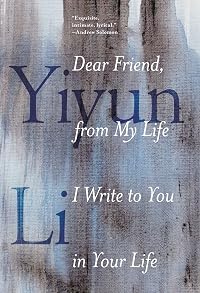
At least that’s how I understood Li’s point of view. As I wrote in show more my review of Li’s previous memoir, Dear Friend…. “I found the author hard to relate to; she takes an opaque approach to storytelling and it is often hard to know just what she is talking about.” show less
At least that’s how I understood Li’s point of view. As I wrote in show more my review of Li’s previous memoir, Dear Friend…. “I found the author hard to relate to; she takes an opaque approach to storytelling and it is often hard to know just what she is talking about.” show less
I liked reading this, even though the subject is pretty heavy. I've only read her fiction prior, but this grabbed me a bit more. A reflection upon both her sons committing suicide. Everyone's grief is different. She articulated what she went through and how her friends and colleagues reacted. I found it interesting how she copes with loss and how she processed it through turning it into art.
What I like also is how we can listen to how she conceives it and compare that to our own assessments which couid (and perhaps are different).
What I like also is how we can listen to how she conceives it and compare that to our own assessments which couid (and perhaps are different).
Members
- Recently Added By
Lists

Llibres que he llegit el 2025
81 works; 2 members

CXB Books read in 2025
16 works; 1 member

Books Read in 2026
1,995 works; 67 members

To Read
140 works; 1 member
Author Information

29+ Works 4,586 Members
Awards and Honors
Awards
Distinctions
Common Knowledge
- Canonical title*
- En la naturaleza las cosas crecen
- Original publication date
- 2025-05-20
- Quotations
- Fiction, one suspects, is tamer than life.
No one commits suicide unthinkingly.
So here's Exhibit A: a new alphabet and a new vocabulary cannot be found to describe how I feel.
Gone are the days when I could afford some degree of automatic living in everyday life… - Original language*
- English
- Canonical DDC/MDS
- 155.937
*Some information comes from Common Knowledge in other languages. Click "Edit" for more information.
Classifications
- Genres
- Biography & Memoir, General Nonfiction, Nonfiction
- DDC/MDS
- 155.937 — Philosophy & psychology Psychology Differential and developmental psychology Environmental psychology Influences of Traumatic Experiences and Bereavement Death and Dying
- LCC
- PS3612 .I16 .T45 — Language and Literature American literature
- BISAC
Statistics
- Members
- 266
- Popularity
- 121,902
- Reviews
- 11
- Rating
- (4.08)
- Languages
- Catalan, English, Spanish
- Media
- Paper, Audiobook, Ebook
- ISBNs
- 10
- ASINs
- 4