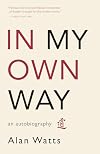
In My Own Way: An Autobiography
by Alan W. Watts
On This Page
Description
In this new edition of his acclaimed autobiography - long out of print and rare until now - Alan Watts tracks his spiritual and philosophical evolution. A child of religious conservatives in rural England, he went on to become a freewheeling spiritual teacher who challenged Westerners to defy convention and think for themselves. Watts's portrait of himself shows that he was a philosophical renegade from early on in his intellectual life. Selftaught in many areas, he came to Buddhism through show more the teachings of Christmas Humphreys and D. T. Suzuki. Told in a nonlinear style, In My Own Way combines Watts's brand of unconventional philosophy with wry observations on Western culture and often hilarious accounts of gurus, celebrities, and psychedelic drug experiences. A charming foreword by Watts's father sets the tone of this warm, funny, and beautifully written story. Watts encouraged readers to "follow your own weird" - something he always did himself, as this remarkable account of his life shows. show lessTags
Recommendations













Member Reviews
In this new edition of his acclaimed autobiography — long out of print and rare until now — Alan Watts tracks his spiritual and philosophical evolution from a child of religious conservatives in rural England to a freewheeling spiritual teacher who challenged Westerners to defy convention and think for themselves. From early in this intellectual life, Watts shows himself to be a philosophical renegade and wide-ranging autodidact who came to Buddhism through the teachings of Christmas Humphreys and D. T. Suzuki. Told in a nonlinear style, In My Own Way wonderfully combines Watts’ own brand of unconventional philosophy and often hilarious accounts of gurus, celebrities, psychedelic drug experiences, and wry observations of Western show more culture. A charming foreword written by Watts’ father sets the tone of this warm, funny, and beautifully written story of a compelling figure who encouraged readers to “follow your own weird” — something he always did himself, as his remarkable account of his life shows. show less
Alan Watts is one of those writers I want to like more than I actually do. On the one hand, I cannot ignore his influence on the rise of understanding of Eastern Thought in America. And I have greatly enjoyed his books on Zen and Taoism. But recently started reading his more philosophical books, and...well they just did not do it for me.
But this book did. I picked it up at a bookstore, and started thumbing through it, which quickly led to me to sitting down to read it more deeply. Watts takes us on a fascinating tour of his childhood and adult life--his interest in Zen and other eastern influences, his ordination and his renounciation of his ordination, and his basic life, thought and influences. He says in the preface, that he is show more writing this book because he finds his life interesting. That is reason enough.
Reading this is a bit like seeing the face of the person you have always heard on the radio. There is little he says here that will make you think differently about his other work, but you will see it differently after reading this.
If you are a fan of Watts, I highly recommend this book. show less
But this book did. I picked it up at a bookstore, and started thumbing through it, which quickly led to me to sitting down to read it more deeply. Watts takes us on a fascinating tour of his childhood and adult life--his interest in Zen and other eastern influences, his ordination and his renounciation of his ordination, and his basic life, thought and influences. He says in the preface, that he is show more writing this book because he finds his life interesting. That is reason enough.
Reading this is a bit like seeing the face of the person you have always heard on the radio. There is little he says here that will make you think differently about his other work, but you will see it differently after reading this.
If you are a fan of Watts, I highly recommend this book. show less
Calling himself "a philosophical entertainer", this autobiography is interesting, entertaining and informative. The footnotes give explanations on Buddhism, sources, the I Ching, and more.
I particularly enjoyed reading about his time in Canterbury (with his friend Patrick Leigh Fermor) and his visits to a coffee shop just outside the school gates (which today is a secondhand charity bookshop), as these places still exist today. Interesting how successful he became with no qualifications, instead he built his reputation on a keen study of his own interests, making friends, writing articles, and captivating audiences with his talks. It is obvious his recorded talks are well worth listening to as well.
Here are my notes:
From his early show more interest in wildlife and limericks the book describes childhood, Chistlehurst, schooling, Kings School, bookshop Cecil Court Charing Cross Road "metaphysical gossip", awareness of self (and knowledge of two others who share his names), transcending religion.
Joining Buddhist Lodge (and working on it's journal)
Admiration for Krishnamurti "one of the most elegant men in the world"
Defending DT Suzuki, who popularized zen, but had a lot of criticism.
Friends with Sokei-an Sasaki.
Footnotes informing the reader, Zen Buddhism arose in China between the sixth and eighth century, passed onto Japan in the 12th, and is the general practice of Buddhism to free the mind by silencing the perpetual chatter in the mind.
I Ching pronounced Ee Jing is a commentary on 64 hexagrams, split into 8 trigrams representing life principles of heaven-earth, fire-water, mountain-lake, thunder-wind.
The Upanishads - "You are THAT"
Amalgamation of Zen meditation, yoga, Christian contemplative prayer, psychotherapy
The Gateway bookshop, Oom the Omnipotent (Pierre)
Sought to become a Priest in America, aged 26
Episcopal Church in Chicago
Seabury-Western Church
Huxley influence over Christian mysticism
Comments, "Surely, if our neurologists are the first to admit that they do not understand the brain, isn't it possible that the brain - and the nervous system as a whole - is wiser than the conscious intellect?"
Friends with Joseph Campbell
Description of Big Sur, sounds Snell's colours
Kenneth Rexroth
Yanko
(Jean Varda)
Influence of Jung on his own works
LSD
Visit to Japan observing two zen masters show less
I particularly enjoyed reading about his time in Canterbury (with his friend Patrick Leigh Fermor) and his visits to a coffee shop just outside the school gates (which today is a secondhand charity bookshop), as these places still exist today. Interesting how successful he became with no qualifications, instead he built his reputation on a keen study of his own interests, making friends, writing articles, and captivating audiences with his talks. It is obvious his recorded talks are well worth listening to as well.
Here are my notes:
From his early show more interest in wildlife and limericks the book describes childhood, Chistlehurst, schooling, Kings School, bookshop Cecil Court Charing Cross Road "metaphysical gossip", awareness of self (and knowledge of two others who share his names), transcending religion.
Joining Buddhist Lodge (and working on it's journal)
Admiration for Krishnamurti "one of the most elegant men in the world"
Defending DT Suzuki, who popularized zen, but had a lot of criticism.
Friends with Sokei-an Sasaki.
Footnotes informing the reader, Zen Buddhism arose in China between the sixth and eighth century, passed onto Japan in the 12th, and is the general practice of Buddhism to free the mind by silencing the perpetual chatter in the mind.
I Ching pronounced Ee Jing is a commentary on 64 hexagrams, split into 8 trigrams representing life principles of heaven-earth, fire-water, mountain-lake, thunder-wind.
The Upanishads - "You are THAT"
Amalgamation of Zen meditation, yoga, Christian contemplative prayer, psychotherapy
The Gateway bookshop, Oom the Omnipotent (Pierre)
Sought to become a Priest in America, aged 26
Episcopal Church in Chicago
Seabury-Western Church
Huxley influence over Christian mysticism
Comments, "Surely, if our neurologists are the first to admit that they do not understand the brain, isn't it possible that the brain - and the nervous system as a whole - is wiser than the conscious intellect?"
Friends with Joseph Campbell
Description of Big Sur, sounds Snell's colours
Kenneth Rexroth
Yanko
(Jean Varda)
Influence of Jung on his own works
LSD
Visit to Japan observing two zen masters show less
Ratings
Members
- Recently Added By
Lists

Used books to buy next
565 works; 1 member

Books Read in 2020
4,379 works; 123 members
Author Information

223+ Works 17,139 Members
Alan Watts (1915-1973) was a renowned lecturer and the author of nearly thirty books, including The Way of Zen and The Book. Born in Chislehurst, England, he moved to the United States in 1938 and began Zen training in New York. He received a master's degree in theology from Seabury-Western Theological Seminary and served as an Episcopal priest show more before leaving the ministry in 1950 to move to California, where he joined the faculty of the American Academy of Asian Studies (now the California Institute of Integral Studies). show less
Classifications
- Genres
- Nonfiction, Religion & Spirituality, Biography & Memoir, Philosophy, General Nonfiction
- DDC/MDS
- 294.3 — Religion Other religions Religions of Indic origin Buddhism
- LCC
- BL1473 .W3 .A34 — Philosophy, Psychology and Religion Religions. Mythology. Rationalism Religions. Mythology. Rationalism History and principles of religions Asian. Oriental By religion
- BISAC
Statistics
- Members
- 354
- Popularity
- 88,597
- Reviews
- 3
- Rating
- (4.00)
- Languages
- English, German
- Media
- Paper, Audiobook, Ebook
- ISBNs
- 8
- ASINs
- 7