Gershon's Monster: A Story for the Jewish New Year
by Eric A. Kimmel
On This Page
Description
When his sins threaten the lives of his beloved twin children, a Jewish man finally repents of his wicked ways.Tags
Recommendations









Member Reviews
Rosh Hashanah, the Jewish New Year, began two days ago - Shanah Tovah to all who celebrated, and may you enjoy a wonderful 5772! - reminding me to take down my copy of Gershon's Monster, Eric A. Kimmel and Jon J. Muth's lovely picture-book retelling of a traditional Hasidic tale related to this important time of the Hebrew calendar. The story of Gershon, a man who, rather than repenting of his various small transgressions, and making amends for them, sweeps them into the basement, collects them, and dumps them into the sea every Rosh Hashanah, it presents the important idea that we are never really free from the consequences of what we do, and how we treat others. In Gershon's case, his growing legacy of unrepented misdeeds eventually show more becomes a monster, and although he has not hitherto cared very much about his behavior, he does care about his children, who are the ones threatened by that monster...
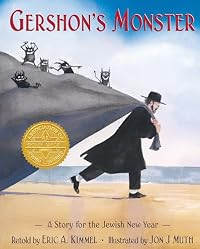
This story offers an interesting perspective on the Jewish custom of tashlich, in which the previous year's sins are symbolically cast off into a body of water, on the first afternoon of Rosh Hashanah (see April Halprin Wayland's New Year at the Pier: A Rosh Hashanah Story for another picture-book about tashlich), in that it implies that the casting off, in and of itself, is not enough. True understanding, of the nature of the transgression, and repentance for it, are also obviously necessary. By the same token, the narrative seems to imply that the ritual (which is not named in the story) cannot be used as an excuse for misdeeds throughout the year (no "Oh, who cares if I break my word? I'll atone for it later" kind of thinking). A thoughtful story, one that can be used to encourage real ethical discussion with children, when it comes to the question of how we deal with our own mistakes and misdeeds, Gershon's Monster is also a beautiful book, with gorgeous watercolor illustrations from Muth, who is best known for his picture-books about Stillwater, a panda-bear Zen instructor.
All in all, this is an immensely evocative, thought-provoking book, one with an engrossing story, and delightful illustrations (not to mention an author's note about source material, which is always welcome!), and I highly recommend it to anyone who is looking for such stories for children, or for anyone in need of Rosh Hashanah selections. show less
This story offers an interesting perspective on the Jewish custom of tashlich, in which the previous year's sins are symbolically cast off into a body of water, on the first afternoon of Rosh Hashanah (see April Halprin Wayland's New Year at the Pier: A Rosh Hashanah Story for another picture-book about tashlich), in that it implies that the casting off, in and of itself, is not enough. True understanding, of the nature of the transgression, and repentance for it, are also obviously necessary. By the same token, the narrative seems to imply that the ritual (which is not named in the story) cannot be used as an excuse for misdeeds throughout the year (no "Oh, who cares if I break my word? I'll atone for it later" kind of thinking). A thoughtful story, one that can be used to encourage real ethical discussion with children, when it comes to the question of how we deal with our own mistakes and misdeeds, Gershon's Monster is also a beautiful book, with gorgeous watercolor illustrations from Muth, who is best known for his picture-books about Stillwater, a panda-bear Zen instructor.
All in all, this is an immensely evocative, thought-provoking book, one with an engrossing story, and delightful illustrations (not to mention an author's note about source material, which is always welcome!), and I highly recommend it to anyone who is looking for such stories for children, or for anyone in need of Rosh Hashanah selections. show less
It's about tashlich, but also about how our thoughtless actions harm others; in this case, the sins of a father are visited on his sons. When I mentioned to a rabbi that I found this troubling, he explained that children are affected by their parents' behavior.
I always warned younger children that it might be a bit scary---a giant monster arises from the water---but they didn't mind.
I always warned younger children that it might be a bit scary---a giant monster arises from the water---but they didn't mind.
A simple story, but both entertaining and profound. [a:Jon J. Muth|12733|Jon J. Muth|https://d.gr-assets.com/authors/1217438951p2/12733.jpg], author of [b:Zen Shorts|140181|Zen Shorts|Jon J. Muth|https://d.gr-assets.com/books/1301850228s/140181.jpg|2015914] and several other wonderful picture-books, created illustrations that are a perfect fit. The demon-like creatures are just scary enough, Gershon is all-too-human, and every character, mood, and scene is exactly as it should be. I have loved many books by Kimmel and always admire the illustrations - he's done a wonderful job of choosing the right artist each time. And the grace and luminosity with which he tells the stories is unparalleled. I will, of course, continue to look for more show more by both of these talented creators, and to highly recommend them to all of you. show less
This is a wonderful and haunting story of how important it is to understand the mistakes you may have made in a year and how to ask to forgiveness. The lesson is a classic one that follows the theme of beginning anew each year. The illustrator does a great job of portraying all of the main character's sins or mistakes as little black monsters that he can't seem to escape from. It also tells how even the smallest, selfish mistakes or sins can deeply effect oneself and the people around you.
A Jewish tale about a man named Gershon who like all people makes mistakes but the difference is he does not fix them. He sweeps them into his cellar untl the new year and throws them out to sea to forget them. He and his wife yearn for a child and are granted twins by the "mircle rabbi" but is told in five years they will be taken away due to his mistakes. Confused and upset Gershon leaves and forgets all that is said by the rabbi. Five years later, he remembers what was said and rushes to save his children for the monster he has created in the sea from his mistakes and self-sacrifices himself to save his children. He finally sees what wrongs he has done and that recognition rids him of the monster. I love the illustrations and details show more of this book. It captures many details about the Jewish culture in the pictures and some text. I think the message is wonderful in teaching us to solve our mistakes and apologize for our wrongdoings. show less
This book is about a traditional Jewish man who does not take responsibility for his wrongdoings. When his wife wont get pregnant he goes to a magical rabbi who supposedly can help. Gershon is rude to the rabbi, as he is with everyone else, and the rabbi says that his wife will have twins in a year but that they will die on their fifth birthday because Gershon is not sorry for the way he treats others. Gershom forgot all about what the rabbi warned him about and suddenly on the twins' fifth birthday he remembers. He runs down to the seashore and a monster made up of all his wrongdoings comes to smite him or his children. Gershon feels sorry and begs for mercy for the first time in his life. Gershon's repentance saves him and his show more children. This is a Mythic tale because it is a religious story with oral origins. This story try's to teach its readers a lesson in treating others the right way. show less
Kimmel, E. A., & Muth, J. J. (2000). Gershon's monster: a story for the Jewish New Year. New York: Scholastic Press.
Grade 2 and up
Gershon has never repented for anything he has even done. Careless and inconsiderate, he sweeps his mistakes and tosses them down the cellar. Once a year, he drags them to ocean, where he tosses them. He and is wife long for a baby, so when Gershon hears that a tzaddik,a wonder rabbi who lives in a nearby town, he travels to meet him and ask for a child. When he arrives at the rabbi’s home, he enters without knocking and demands a child. For the sake of Gershon’s wife, a good woman, the rabbi offers his help. The rabbi urges Gershon to be thankful for what he has, but the man will not hear him. So the show more rabbi blesses the family with twins but warns him that his wayward ways will cost him the lives of his children. The rabbi shares with Gershon a prophecy and sends him on his way. The couple has twins, and Gershon continues with his careless behavior until on the morning on the children’s fifth birthday, the prophecy comes true. The ocean rises as a monster covered in scales, each scale one of Gershon’s misdeeds. He throws himself in front of his children and offers how own in exchange of his children’s. The monster melts into raindrops. Gershon has finally repented, and from then on, he learns to live a righteous life.
Gershon's monster: a story for the Jewish New Year is a cautionary tale to warn those who go through life without repenting that sooner or later, their misdeeds will catch up with them. It represents well the motif of the supernatural being in the monster born of Gershon’s misdeeds. This traditional Hasidic legend for the Jewish New Year reminds readers of the importance of taking responsibility for one’s actions and asking for forgiveness. The illustrations are essential in telling the sorry. Muth is s renowned graphic novel artist, and the pictures he creates are highly influence by this genre, with special attention to the varying perspective that gives the action a dynamic quality. Gershon’s careless ways are represented by the image of the baker sweeping little monsters into the cellar, and the more he sins, the more daring the creatures become. In one illustration, they pull the baker’s hair and beard, big grins on their black faces. The use of different points of view give the story a dynamic character, and the climax of the story is depicted in a two-page spread, the huge black monster of Gershon’s sins looming over his children. The book is a tool to teach readers about the repenting; the last page defines the six steps to be followed for a righteous life. A wonderful book that openly targets the Jewish community but can be enjoyed by all religions. show less
Grade 2 and up
Gershon has never repented for anything he has even done. Careless and inconsiderate, he sweeps his mistakes and tosses them down the cellar. Once a year, he drags them to ocean, where he tosses them. He and is wife long for a baby, so when Gershon hears that a tzaddik,a wonder rabbi who lives in a nearby town, he travels to meet him and ask for a child. When he arrives at the rabbi’s home, he enters without knocking and demands a child. For the sake of Gershon’s wife, a good woman, the rabbi offers his help. The rabbi urges Gershon to be thankful for what he has, but the man will not hear him. So the show more rabbi blesses the family with twins but warns him that his wayward ways will cost him the lives of his children. The rabbi shares with Gershon a prophecy and sends him on his way. The couple has twins, and Gershon continues with his careless behavior until on the morning on the children’s fifth birthday, the prophecy comes true. The ocean rises as a monster covered in scales, each scale one of Gershon’s misdeeds. He throws himself in front of his children and offers how own in exchange of his children’s. The monster melts into raindrops. Gershon has finally repented, and from then on, he learns to live a righteous life.
Gershon's monster: a story for the Jewish New Year is a cautionary tale to warn those who go through life without repenting that sooner or later, their misdeeds will catch up with them. It represents well the motif of the supernatural being in the monster born of Gershon’s misdeeds. This traditional Hasidic legend for the Jewish New Year reminds readers of the importance of taking responsibility for one’s actions and asking for forgiveness. The illustrations are essential in telling the sorry. Muth is s renowned graphic novel artist, and the pictures he creates are highly influence by this genre, with special attention to the varying perspective that gives the action a dynamic quality. Gershon’s careless ways are represented by the image of the baker sweeping little monsters into the cellar, and the more he sins, the more daring the creatures become. In one illustration, they pull the baker’s hair and beard, big grins on their black faces. The use of different points of view give the story a dynamic character, and the climax of the story is depicted in a two-page spread, the huge black monster of Gershon’s sins looming over his children. The book is a tool to teach readers about the repenting; the last page defines the six steps to be followed for a righteous life. A wonderful book that openly targets the Jewish community but can be enjoyed by all religions. show less
Members
- Recently Added By
Lists

Precious People
119 works; 1 member
Author Information

142+ Works 16,852 Members
Eric Kimmel was born in Brooklyn, NY in 1946. He received a bachelor's degree in English Literature from Lafayette College. He also has a Ph.D. in Education from the University of Illinois. He was an elementary school teacher and college professor before becoming a full-time writer. He has published over fifty titles, many of which have won state show more and national awards. His titles "Hershel and the Hanukkah Goblins" won the Caldecott Honor Medal, "The Chanukkah Guest" and "Gershon's Monster" won the Sydney Taylor Picture Book Award and "Anansi and the Talking Melon" won the Utah Children's Choice Award. Kimmel travels nationally and internationally visiting schools and talking about his books and telling stories. (Bowker Author Biography) show less
Some Editions
Awards and Honors
Awards
Distinctions
Common Knowledge
- Canonical title
- Gershon's Monster: A Story for the Jewish New Year
- People/Characters
- Gershon, Fayga, tzaddik,
- Important events
- Rosh Hashanah, Hasidic legend based on Rabbi Israel ben Eliezer (c. 1700-1760)
- Dedication
- To Rosemary and Yair Alroy-E.A.K.
for Allen Spiegel-J.J.M.
Joe Haberer
Classifications
Statistics
- Members
- 340
- Popularity
- 92,439
- Reviews
- 16
- Rating
- (4.38)
- Languages
- English
- Media
- Paper
- ISBNs
- 2
- ASINs
- 3