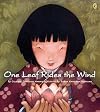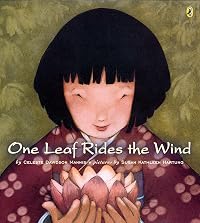
One Leaf Rides the Wind
by Celeste Davidson Mannis
On This Page
Description
In this collection of haiku poems, a young girl walks through a Japanese garden and discovers many delights, from one leaf to ten stone lanterns. Includes notes about Japanese religion and philosophy.Tags
Recommendations













Member Reviews
In her picture book debut, Mannis uses the underlying structure of a little girl in a Japanese garden as the theme for a lyrical counting book with arresting illustrations by Hartung (One Dark Night, 2001, etc.). The author uses haiku as her format to count elements of the garden: one leaf, two carved temple dogs, three bonsai trees, and so on, up to ten lanterns lighting the way into the garden at twilight. The final double-page spread shows all the previously counted items integrated into the idyllic garden, with the little girl catching the leaf that eluded her grasp on the first page. The thoughtful design includes a full-page illustration on the left-hand pages, the appropriate numeral and the haiku in large type on the right-hand show more pages, and a related textual note in smaller type at the bottom of the page. This format imparts additional information about Japanese gardens and culture without intruding on the effectiveness of the haiku. Hartung’s delicate illustrations with varying perspectives effectively complement the haiku and add touches of visual humor throughout. Just as each element of a Japanese garden contributes to a calming, satisfying whole, the elements of this work—poetry, subtly integrated additional text, illustration, design, and even the endpapers—all meld together into a lovely whole that both entertains as successful poetry and educates as an introduction to several aspects of ancient Japanese culture. Teachers in elementary school classrooms will find this volume useful when studying Japan or the haiku format. (author’s note) (Picture book/poetry. 4-10)
-Kirkus Review show less
-Kirkus Review show less
Just about perfect, imo. It's lovely, and educational, but because it's not oversized, and because it has lots of white space, and because it has an active child with whom the young reader can identify, it's accessible and can be simply enjoyed. I see no reason children wouldn't like it just as much as parents and teachers do. Of course I want the garden, or at least most of the elements thereof, but also I want to endpapers as a fabric for curtains or wallpaper!
I recommend encouraging your library to get it, if they don't have it yet, as it hits so many collection goals (multicultural, poetry, art, even a little science).
I recommend encouraging your library to get it, if they don't have it yet, as it hits so many collection goals (multicultural, poetry, art, even a little science).
Counting…one leaf, two temple dogs, three miniature pots. So simple, yet at the same time so rich is the opportunity for enhanced learning and deepened cultural awareness represented in this unique picture book. A predictable pattern emerges with each turn of the glossy paper, characterized by full-page images opposite simple text centered on a white canvas. Written in haiku form, each new number is introduced through a poetic description of a significant feature found in a traditional Japanese garden or teahouse. From one leaf riding the wind to ten lanterns lighting the way, exclamation and emphasis are used to convey sound, movement, and energy. Hartung’s detailed artwork provides realistic portrayals of the elements embedded in show more the text with a palette of rich earth tones accented by deep red hues. Told from the perspective of a young Japanese girl, this book immerses the reader in a multifaceted learning experience. An adult-centered elaboration of the content and imagery is inscribed at the bottom of each text page. The final two-page illustration merges all elements introduced previously, providing a holistic view of the garden and teahouse as well as giving the readers an opportunity to re-count all of the intricate components. Though presented as a book aimed at ages 4-8, it would likely appeal to children both young and old owing to the colorful, elegant images, simple yet prophetic haikus, and supplemental factual information. show less
This is a counting book (1-10) and it is written in haikus, which makes it really fun. The numbers and haikus are used to teach different aspects of traditional Japanese culture. This book could be used in numerous ways. It could be used to teach diversity, and introduce children to a different culture. It could also be used to teach children a form of poetry called “haiku”. And lastly, this book is a counting book, and could help strengthen children’s counting skills. I really loved this book, because I am fascinated by everything related to Japanese culture.
This is a wonderful counting book that celebrates the beauty of nature using haiku poems as the narrative. The book is appropriate for children of all ages
One Leaf Rides the Wind by Celeste Davidson Mannis
This was an ok book, that my child liked more than me. This is a book of haiku poems, which I didn't even realize until reading the description. Most of them seemed a bit weird. However the pictures are very pretty and seem relaxing.
This was an ok book, that my child liked more than me. This is a book of haiku poems, which I didn't even realize until reading the description. Most of them seemed a bit weird. However the pictures are very pretty and seem relaxing.
haiku, counting, lovely book!!
Members
- Recently Added By
Lists

A Child's Book Tour of Japan
58 works; 4 members

Youth: Poetry
124 works; 1 member

Youth: Earth Science
205 works; 1 member

Youth: Reading, Writing, Humor, Satire
63 works; 1 member
Author Information
6 Works 1,568 Members
Awards and Honors
Classifications
Statistics
- Members
- 414
- Popularity
- 74,665
- Reviews
- 10
- Rating
- (4.21)
- Languages
- English
- Media
- Paper
- ISBNs
- 8
- ASINs
- 2