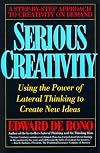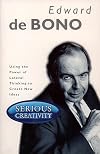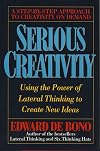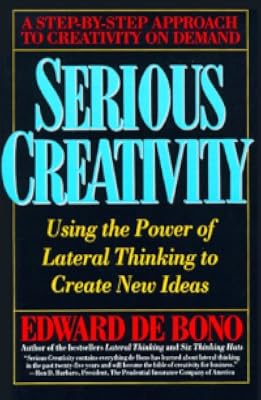
Serious Creativity: Using the Power of Lateral Thinking to Create New Ideas
by Edward de Bono
On This Page
Description
If you want to be the best, focus on your most valuable asset- the power of your creative mind As competition and the pace of change intensify, companies and individuals need to harness their creativity to stay ahead of the field. Under pressure, people often think they can't be creative; many more are convinced they are not creative at all because they have never been 'arty'. Creative genius Edward de Bono debunks these common notions in this remarkable book. He shows how creativity is a show more learnable skill - one that everyone can use to improve their performance. He then explains how you can unlock your own creativity to reap the personal and professional rewards it will bring. Learn how to- be creative on demand with de Bono's step-by-step approach add value to ideas and turn them into financial assets boost creativity with the power of lateral thinking break free from old ways of thinking with creative challenging show lessTags
Recommendations









Member Reviews
I had to think long and hard before I gave this book a five star rating. And, much of this prevarication can be attributed to my ambivalent attitude towards the author, Edward de Bono....public intellectual and the pioneer of teaching creative thinking. I first came across de Bono when I found his book,"Lateral Thinking', in the CSIRO library where I was working in about 1967.. It blew me away. De Bono, made the point that we all tended to think inside the box and he encouraged thinking outside the box. In fact, he claimed that you could actually teach thinking and, whilst we taught our kids mathematics and history,,,we never taught them any techniques for thinking. To me this was totally revolutionary thinking and ever since I've tried show more to apply some of his principles. (I think he might have also given some principles about brainstorming....like don't be negative).I can still remember trying to solve his matches problem...creating triangles out of matchsticks ......when the answer was not to do it in two dimensions but use three.
However, a few years later he came out with another book and then another...and I think I read a couple of them...including the "Six thinking Hats" but was left wondering whether he actually had anything new to say. It all seemed to be a variation on the original themes. Admittedly, the six thinking hats gave clear methodology to coming up with creative ideas but at base it seemed to me more of the same. What I did find with the later books was an increasing tendency for self-promotion: how he'd run courses for various Governments and international agencies etc. etc. and how....until de Bono had come along nobody was doing what he was advocating. And how he had the prescience to suggest mechanisms of the mind way back in the 1950's that were only coming to be recognised in the 2000+ years. In other words, an increasing tendency to self promotion........which actually seems to have served him very well.
But then, I came face to face with the great man himself. In fact, had the challenging role of speaking AFTER de Bono ....but not only after him ....it was at a meeting of the "Professional Speaker's Association of Australia". And I have to admit he was a delightful speaker and enchanted the audience and he was very graceful about my own feeble speaking efforts.......even if his performance was if slightly tainted by that powerful streak of self promotion. But I'd come forewarned. My boss at the time mentioned to me beforehand that she had once had the job of escorting de Bono on a previous speaking tour lasting about a week ...and found him "one of the greatest bores of all time". Apparently because all his conversation was about himself. The same characteristic that comes through in his books.
But onto the present book. Coming with all this baggage about the author, it's really hard (maybe impossible) to be objective about the book. But I'll try. It was first published in 1992 and the sub-title (in some versions) suggests that it's a summary of de Bono's thinking/teaching to that time. And really, it's very good. If you want a book that can give you some techniques for coming up with new ideas or you are trying to run a workshop to find new solutions to old problems, there is a plethora of ideas here.
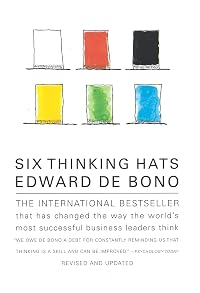
He's got the six coloured thinking hats (red is intuition and thinking); black is caution and what could go wrong).
He's got the creative pause...might there be another way?
The challenge...are we doing something this way because that's always the way it's been done?
Looking for alternatives ...when you don't have to....you already have a perfectly acceptable solution.
Then the concept plan....maybe working backwards from the purpose of the thinking to concepts about how to get there.
Provocation and movement to cut across established patterns: what happens when we drop something that is always taken for granted? Or reversing the normal course of action; or exaggeration, distortion and wishful thinking.
Adding random input....eg from random words...like "unemployment false teeth")
Movement:...this is a bit hard to grasp but I think the essential principle is that it should involve "moving forward" with some idea. (That is, taking some action)
Stratal...putting together 5 unconnected statements about the situation and seeing what emerges.
The filament technique...putting ideas one under the other and drawing connections.
He also suggests techniques for "harvesting " these creative ideas....which all seem pretty reasonable and sensible. After all, not much point having wildly creative ideas if nothing emerges from it.
In fact, critiques of de Bono have been along the line that it's all very well coming up with new and creative ides but have his techniques ever been evaluated against alternatives? The implicit answer being NO.
Much of this creative thinking, at it's foundation, relies on metaphor and the brain's capacity to look for connections ..or make connections ...which is the classic memory....mnemonics technique (making wild stories to help memorise facts or names etc).
I've got a number of books on creative thinking ... all of them written after de Bono's first books and they all seem to be derivative from his work. Even the much vaunted "mind-mapping" ...which I have found pretty useful for group work, can be linked back (more or less) to de Bono's ideas . So he has had tremendous influence and he is a rather extraordinary individual. Credit where credit is due. And this is a seriously good book. In fact, the title is "Serious creativity". So whether or not de Bono, in person, might be a bit "full of himself", I have to give his book five stars. It's beautifully written. Clear and understandable and really delivers to anybody who wants some methods for generating new ideas. show less
However, a few years later he came out with another book and then another...and I think I read a couple of them...including the "Six thinking Hats" but was left wondering whether he actually had anything new to say. It all seemed to be a variation on the original themes. Admittedly, the six thinking hats gave clear methodology to coming up with creative ideas but at base it seemed to me more of the same. What I did find with the later books was an increasing tendency for self-promotion: how he'd run courses for various Governments and international agencies etc. etc. and how....until de Bono had come along nobody was doing what he was advocating. And how he had the prescience to suggest mechanisms of the mind way back in the 1950's that were only coming to be recognised in the 2000+ years. In other words, an increasing tendency to self promotion........which actually seems to have served him very well.
But then, I came face to face with the great man himself. In fact, had the challenging role of speaking AFTER de Bono ....but not only after him ....it was at a meeting of the "Professional Speaker's Association of Australia". And I have to admit he was a delightful speaker and enchanted the audience and he was very graceful about my own feeble speaking efforts.......even if his performance was if slightly tainted by that powerful streak of self promotion. But I'd come forewarned. My boss at the time mentioned to me beforehand that she had once had the job of escorting de Bono on a previous speaking tour lasting about a week ...and found him "one of the greatest bores of all time". Apparently because all his conversation was about himself. The same characteristic that comes through in his books.
But onto the present book. Coming with all this baggage about the author, it's really hard (maybe impossible) to be objective about the book. But I'll try. It was first published in 1992 and the sub-title (in some versions) suggests that it's a summary of de Bono's thinking/teaching to that time. And really, it's very good. If you want a book that can give you some techniques for coming up with new ideas or you are trying to run a workshop to find new solutions to old problems, there is a plethora of ideas here.
He's got the six coloured thinking hats (red is intuition and thinking); black is caution and what could go wrong).
He's got the creative pause...might there be another way?
The challenge...are we doing something this way because that's always the way it's been done?
Looking for alternatives ...when you don't have to....you already have a perfectly acceptable solution.
Then the concept plan....maybe working backwards from the purpose of the thinking to concepts about how to get there.
Provocation and movement to cut across established patterns: what happens when we drop something that is always taken for granted? Or reversing the normal course of action; or exaggeration, distortion and wishful thinking.
Adding random input....eg from random words...like "unemployment false teeth")
Movement:...this is a bit hard to grasp but I think the essential principle is that it should involve "moving forward" with some idea. (That is, taking some action)
Stratal...putting together 5 unconnected statements about the situation and seeing what emerges.
The filament technique...putting ideas one under the other and drawing connections.
He also suggests techniques for "harvesting " these creative ideas....which all seem pretty reasonable and sensible. After all, not much point having wildly creative ideas if nothing emerges from it.
In fact, critiques of de Bono have been along the line that it's all very well coming up with new and creative ides but have his techniques ever been evaluated against alternatives? The implicit answer being NO.
Much of this creative thinking, at it's foundation, relies on metaphor and the brain's capacity to look for connections ..or make connections ...which is the classic memory....mnemonics technique (making wild stories to help memorise facts or names etc).
I've got a number of books on creative thinking ... all of them written after de Bono's first books and they all seem to be derivative from his work. Even the much vaunted "mind-mapping" ...which I have found pretty useful for group work, can be linked back (more or less) to de Bono's ideas . So he has had tremendous influence and he is a rather extraordinary individual. Credit where credit is due. And this is a seriously good book. In fact, the title is "Serious creativity". So whether or not de Bono, in person, might be a bit "full of himself", I have to give his book five stars. It's beautifully written. Clear and understandable and really delivers to anybody who wants some methods for generating new ideas. show less
I totally agree with De Bono in his stating about the paradoxical fact that in the situation when a person knows more, creativity is decreased in his sphere of knowledge. I came to that thought on my own and it's gratifying that someone like De Bono also understood it. A specialist stops to wonder, stops asking questions, knowledge captures him. I think while we are approaching knowledge especially at the beginning of that way when we possess vague coordinates, we predispose to generate our own version of sense of the targeted knowledge.
Ugh. This has been on my TBR list for literally twenty years. I quickly realized that much of what the author had to teach has already been generally learned and widely applied (design thinking, anyone?), but I thought it would be a good background/refresher from a master. Well...perhaps....but he was quite defensive about the need for creativity at all, he was repetitive and technical (and repeated his technical points multiple times), and he focused too much (for me, anyway) on large corporations and large new ideas. I might have allowed this to be my third-ever DNF but because I had held on all this time and was finally reading it I didn't want to allow myself to do that. Sigh. Po: I should be easier on myself....
Ratings
Members
- Recently Added By
Author Information

234+ Works 11,147 Members
Edward De Bono is world famous in the field of creative thinking: he invented the concept of lateral thinking and his advice and ideas on thought and learning have been sought from world leaders and Nobel Laureates for over 50 years. He has written numerous bestsellers, including How to Have a Beautiful Mind and How to Have Creative Ideas. show more Together his books have sold over 1 million copies worldwide. show less
Common Knowledge
- Canonical title*
- Essere creativi: i concetti, gli strumenti e le applicazioni del pensiero creativo
- Original title
- Serious Creativity: Using the Power of Lateral Thinking to Create New Ideas
- Alternate titles*
- Essere creativi: come far nascere nuove idee con le tecniche del pensiero laterale
*Some information comes from Common Knowledge in other languages. Click "Edit" for more information.
Classifications
Statistics
- Members
- 387
- Popularity
- 81,000
- Reviews
- 3
- Rating
- (3.50)
- Languages
- 5 — English, French, German, Italian, Swedish
- Media
- Paper, Audiobook, Ebook
- ISBNs
- 19
- ASINs
- 4