Vertigo
by Lynd Ward
On This Page
Description
A series of woodcut illustrations relate the story of three people coping with the hardships of the Great Depression.Tags
Recommendations












Member Reviews
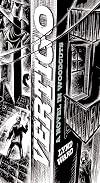
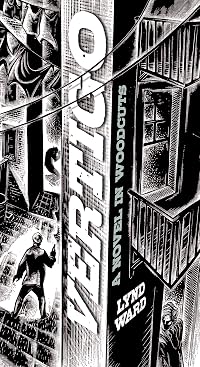
Is this the ultimate graphic novel? It's billed as "A Novel in Woodcuts" and is the final such book Lynd Ward produced. Published in 1937, it was preceded by five other stories told in woodcuts, the first published in 1930. [Vertigo] is apparently considered Ward's best example of the genre. It has 230 woodcuts, which took Ward two years to make. The book was out of print nearly 70 years before Dover reissued it in 2009. For someone exploring graphic stories, [Vertigo] is certainly significant .
The presentation is not wordless. Ward included headings to organize the images and direct the story. Too, quite a number of the woodcuts show newspaper headlines, advertising, and business signs, conveying important information. Viewers are show more going to derive different interpretations of individual woodcuts as well as the aggregate. Despite being printed in only black, subtleties abound: body language, facial expressions, settings and props, point-of-view, lighting, texture. Every picture tells a story.
Against the plans and dreams of a couple of kids, graduating from high school, looking for their first jobs, intending to marry, the storyline sets the harsh reality of the stock market crash and the ruthless response of business and industry to falling profits. Page through the novel, scanning the images, and the story plays out. Study the individual images and experience the emotions that elate, trouble, and ultimately devastate the mass of Americans depicted.
According to the book's introduction, Ward chose to title the book [Vertigo] The title Vertigo, Ward later explained, "was meant to suggest that the illogic of what we saw happening all around us in the thirties was enough to set the mind spinning through space and the emotions hurtling from great hope to the depths of despair."
It is quite unfortunate that images can't be shown in the reviews, for this is a GRAPHIC edition. Images are so important for anyone to get a satisfactory understanding of the book. Here's what I posted to my thread: https://www.librarything.com/topic/337746#7730247 show less
The presentation is not wordless. Ward included headings to organize the images and direct the story. Too, quite a number of the woodcuts show newspaper headlines, advertising, and business signs, conveying important information. Viewers are show more going to derive different interpretations of individual woodcuts as well as the aggregate. Despite being printed in only black, subtleties abound: body language, facial expressions, settings and props, point-of-view, lighting, texture. Every picture tells a story.
Against the plans and dreams of a couple of kids, graduating from high school, looking for their first jobs, intending to marry, the storyline sets the harsh reality of the stock market crash and the ruthless response of business and industry to falling profits. Page through the novel, scanning the images, and the story plays out. Study the individual images and experience the emotions that elate, trouble, and ultimately devastate the mass of Americans depicted.
According to the book's introduction, Ward chose to title the book [Vertigo] The title Vertigo, Ward later explained, "was meant to suggest that the illogic of what we saw happening all around us in the thirties was enough to set the mind spinning through space and the emotions hurtling from great hope to the depths of despair."
It is quite unfortunate that images can't be shown in the reviews, for this is a GRAPHIC edition. Images are so important for anyone to get a satisfactory understanding of the book. Here's what I posted to my thread: https://www.librarything.com/topic/337746#7730247 show less
This largely wordless book is presented through more than 200 prints from engraved woodcuts made by the author. Written in the late 1930s, it tells the story of the Great Depression's effects on three characters - "the girl," "an elderly gentleman," and "the boy," - and how these characters' lives intersect, often without their knowledge.
The girl and the boy are high school sweethearts who want to marry upon graduation. She dreams of being a concert violinist, but her life is turned upside down when her recently unemployed father tries to commit suicide. The boy, who was abused by his father as a child, now seeks to make his own way in the world as a builder. However, he is unable to find a job that doesn't compromise his values of not show more breaking a union strike. Meanwhile, the elderly gentleman is wealthy but suffers from poor health. He is on the board of a business where they decide to cut jobs and wages in order to keep making profits.
The story is tragic and told in a heart-breaking way through the illustrations depicting the characters' angst and troubles. The only words used in the story are the 'chapter' breakers (years for the girl, months for the gentleman, and days of the week for the boy) and those found on signs or notices put up around town. This way of presenting the book allows the reader to interpret what is happening in the plot and how the characters react. It ends with an open-ended illustration that can be construed a number of ways, although it seems to be largely pessimistic. show less
The girl and the boy are high school sweethearts who want to marry upon graduation. She dreams of being a concert violinist, but her life is turned upside down when her recently unemployed father tries to commit suicide. The boy, who was abused by his father as a child, now seeks to make his own way in the world as a builder. However, he is unable to find a job that doesn't compromise his values of not show more breaking a union strike. Meanwhile, the elderly gentleman is wealthy but suffers from poor health. He is on the board of a business where they decide to cut jobs and wages in order to keep making profits.
The story is tragic and told in a heart-breaking way through the illustrations depicting the characters' angst and troubles. The only words used in the story are the 'chapter' breakers (years for the girl, months for the gentleman, and days of the week for the boy) and those found on signs or notices put up around town. This way of presenting the book allows the reader to interpret what is happening in the plot and how the characters react. It ends with an open-ended illustration that can be construed a number of ways, although it seems to be largely pessimistic. show less
Ratings
Members
- Recently Added By
Author Information

31+ Works 4,213 Members
Some Editions
Series
Belongs to Publisher Series
Work Relationships
Is contained in
Common Knowledge
- Canonical title
- Vertigo
- Original publication date
- 1937
Classifications
Statistics
- Members
- 66
- Popularity
- 474,860
- Reviews
- 2
- Rating
- (4.19)
- Languages
- English
- Media
- Paper
- ISBNs
- 1
- UPCs
- 1
- ASINs
- 2