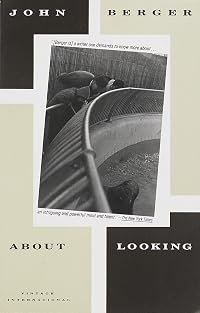
About Looking
by John Berger
On This Page
Description
As a novelist, art critic, and cultural historian, Booker Prize-winning author John Berger is a writer of dazzling eloquence and arresting insight whose work amounts to a subtle, powerful critique of the canons of our civilization. In About Looking he explores our role as observers to reveal new layers of meaning in what we see. How do the animals we look at in zoos remind us of a relationship between man and beast all but lost in the twentieth century? What is it about looking at war show more photographs that doubles their already potent violence? How do the nudes of Rodin betray the threats to his authority and potency posed by clay and flesh? And how does solitude inform the art of Giacometti? In asking these and other questions, Berger quietly -- but fundamentally -- alters the vision of anyone who reads his work. show lessTags
Recommendations




















Member Reviews
Move over, Wendell Berry, John Berger is my new favorite antique Luddite. And, like many of the authors I fall for, he's dead, which is more On Brand than you, Berry, who are still alive. Must be the healthful Kentucky air. Not that I mind; I still have hope of running away to apprentice myself to you and spend my days in those glowing green rolling fields and my nights pecking away at a typewriter, shocking all with my breathtakingly beautiful prose and living out the peak of my ideals. This review is not about you, Mr. Berry, or my escapist daydreams.
I suppose writing a book called "About Looking" (2011) is the natural sequel after releasing a TV series titled "Ways of Seeing" (1972). The content was pleasingly specific, though, in show more comparison to the series' general appeal and wide range.
"Ways of Seeing" was a crash course in lit theory, was a slightly dated (and therefore gloriously costumed) introduction to the same ideas I had in my 2015 theory class that I took from a woman who thought she knew everything and to which I responded with a mixture of curiosity and anger that came from me also thinking I knew everything. Its four parts were worthwhile, not original but useful collections of other theorists' work compiled for the television audience, and if I had more confidence in sharing interests with my friends, I would certainly have recommended it.
"About Looking" is increasingly more specific, in the shape of essays which examine methods of looking and how certain artists have turned observation into art, and has served to me as an introduction to art history and theory. It starts with an essay that made me reconsider owning pets, "Why look at animals?” which sheds light on the relationship between man and animal, which is frequently too close for objectivity, “a companionship offered to the loneliness of man as a species.” Berger places our relation to animals at the beginning of our other cultural discoveries, including painting, metaphor, possibly language. From this beginning, (attempting not to spoil the rewards reaped from the development and growth of the essay on the incredibly tiny chance anyone would both read this and then go on to ready the essay), Berger examines how in reducing animals we have taken away our ability to see them as capable of independence, identity, and their own observation.
From there follow two series of essays, on more abstract concepts of photography and individual artists. I would not read art history in any way other than this personal examination of the work of different artists. The final stroke, “Field,” is almost abstract in its execution and religious in its intent. This book would also have worked well as a larger paperback with exuberant glossy inserts full of the mentioned works, but as it was, it gave my phone’s search function a use, for once. show less
I suppose writing a book called "About Looking" (2011) is the natural sequel after releasing a TV series titled "Ways of Seeing" (1972). The content was pleasingly specific, though, in show more comparison to the series' general appeal and wide range.
"Ways of Seeing" was a crash course in lit theory, was a slightly dated (and therefore gloriously costumed) introduction to the same ideas I had in my 2015 theory class that I took from a woman who thought she knew everything and to which I responded with a mixture of curiosity and anger that came from me also thinking I knew everything. Its four parts were worthwhile, not original but useful collections of other theorists' work compiled for the television audience, and if I had more confidence in sharing interests with my friends, I would certainly have recommended it.
"About Looking" is increasingly more specific, in the shape of essays which examine methods of looking and how certain artists have turned observation into art, and has served to me as an introduction to art history and theory. It starts with an essay that made me reconsider owning pets, "Why look at animals?” which sheds light on the relationship between man and animal, which is frequently too close for objectivity, “a companionship offered to the loneliness of man as a species.” Berger places our relation to animals at the beginning of our other cultural discoveries, including painting, metaphor, possibly language. From this beginning, (attempting not to spoil the rewards reaped from the development and growth of the essay on the incredibly tiny chance anyone would both read this and then go on to ready the essay), Berger examines how in reducing animals we have taken away our ability to see them as capable of independence, identity, and their own observation.
From there follow two series of essays, on more abstract concepts of photography and individual artists. I would not read art history in any way other than this personal examination of the work of different artists. The final stroke, “Field,” is almost abstract in its execution and religious in its intent. This book would also have worked well as a larger paperback with exuberant glossy inserts full of the mentioned works, but as it was, it gave my phone’s search function a use, for once. show less
In an essay from “About Looking” on August Sander’s photography, Berger analyzes the ill fit of fine suits on the European peasantry, concluding that Sander manages to single out, in the clumsy couture of the lower social strata, the historical moment when “the working classes…came to accept as their own certain standards of the class that ruled over them.” Berger’s sensitivity to this exact kind of problem — of the individual relationship to a dominant practice, to put it one way — recurs again and again in the whole collection. Usually it's found in the person of the artist, who works somewhere between a received tradition and their impulse toward original self-expression. This is why Berger believes that Millet’s show more landscape paintings are a failure: they cannot accommodate, in the medium's accommodation of the tourist’s leisurely eye hunting for natural beauty, an emphasis on the peasantry’s hard labor. See also his essays on the puzzle of Seker Ahmet, caught between two cultures, or Romaine Lorquet’s carvings, which exist in “an historical solitude.”
In its most extreme forms, this problem confronts Berger as one of how revolutionary art might loosen the stultifying grip of corporate capitalism, which he thinks has incorporated the art world, at the height of mid-20th-century abstractionism, fully into itself. There are gestures toward the “primitive” artist and a more radical use of photography, as well as the example of Courbet, who used the techniques of the elite to paint works of frightening and stark honesty. His puzzles are still with us, but I’m not sure there are many writers around who can lay them out for us with Berger’s breadth and eloquence.
That said, I have to admit that I still don’t really understand exactly what Berger is talking about in his description of Sandor's three farmers or the band of musicians. Do they seriously appear as “uncoordinated, bandy-legged, barrel-chested, low-arsed, twisted or scalene”? Do the suits actually enhance the look of the four Protestant missionaries? I don’t see it, maybe because I’m looking at the pictures in a time where fashion is even less restrictive, or I have no personal standard to apply to them. Berger’s reading can’t find a grip on me…I find myself looking askance at the photos, wondering if I really am such a philistine, carefully considering the visible length of the farmers’ legs.
These exercises from both writer and reader remind me of a passage from Stanley Cavell, one of the asides in which he defends himself against the sin of reading too much into a screwball comedy: “One might ponder what the motivation, or temptation, to knowledge is. Perhaps it is the temptation to know and say more than we can know and safely say. Perhaps it is the wish to deny that we know all there is to know in order to say what is to be said.” show less
In its most extreme forms, this problem confronts Berger as one of how revolutionary art might loosen the stultifying grip of corporate capitalism, which he thinks has incorporated the art world, at the height of mid-20th-century abstractionism, fully into itself. There are gestures toward the “primitive” artist and a more radical use of photography, as well as the example of Courbet, who used the techniques of the elite to paint works of frightening and stark honesty. His puzzles are still with us, but I’m not sure there are many writers around who can lay them out for us with Berger’s breadth and eloquence.
That said, I have to admit that I still don’t really understand exactly what Berger is talking about in his description of Sandor's three farmers or the band of musicians. Do they seriously appear as “uncoordinated, bandy-legged, barrel-chested, low-arsed, twisted or scalene”? Do the suits actually enhance the look of the four Protestant missionaries? I don’t see it, maybe because I’m looking at the pictures in a time where fashion is even less restrictive, or I have no personal standard to apply to them. Berger’s reading can’t find a grip on me…I find myself looking askance at the photos, wondering if I really am such a philistine, carefully considering the visible length of the farmers’ legs.
These exercises from both writer and reader remind me of a passage from Stanley Cavell, one of the asides in which he defends himself against the sin of reading too much into a screwball comedy: “One might ponder what the motivation, or temptation, to knowledge is. Perhaps it is the temptation to know and say more than we can know and safely say. Perhaps it is the wish to deny that we know all there is to know in order to say what is to be said.” show less
Right away About Looking opens up with a dismal commentary of the relatively modern practice of keeping pets for the sake of companionship. Berger points out that humans sterilize their companions while not allowing them to roam free, socialize with other animals, or eat the foods natural to their diets. I will never look at animals at the zoo in the same way. From the very first essay Berger has found a way to illustrate the title of his book. Berger then moves on to describe the artwork of painters and photographers and the idea of looking at art from the perspective of time and of aging. Similar to reading the same book every ten years, how does the art change with aging? Bergen ends the book with an essay on nature. More show more specifically, he describes an open field of which your perspective changes depending on who or what is in it. The overarching message is how altered reality can reflect your own life. show less
I'm not sure what I expected of this book, but I wasn't getting it. I read about half the essays and bailed out; not because they're bad, but because I'm not interested in the things Berger discusses. He did write well.
YMMV, obviously.
YMMV, obviously.
More on the semiotics of art, photography, visual perception. John Berger is an excellent writer; his books are persuasive, thought-provoking and easy to read.
They say Berger is a writer of dazzling eloquence and arresting insight. For me the book was just a lot of words that signified nothing. I read more than half and realized I was getting nothing out of it, so I finally gave up.
Excellent
Members
- Recently Added By
Lists

culture
320 works; 1 member

1980 great books
63 works; 1 member
Author Information

152+ Works 17,331 Members
John Peter Berger was born in London, England on November 5, 1926. After serving in the British Army from 1944 to 1946, he enrolled in the Chelsea School of Art. He began his career as a painter and exhibited work at a number of London galleries in the late 1940s. He then worked as an art critic for The New Statesman for a decade. He wrote fiction show more and nonfiction including several volumes of art criticism. His novels include A Painter of Our Time, From A to X, and G., which won both the James Tait Black Memorial Prize and the Booker Prize in 1972. His other works include an essay collection entitled Permanent Red, Into Their Labors, and a book and television series entitled Ways of Seeing. In the 1970s, he collaborated with the director Alain Tanner on three films. He wrote or co-wrote La Salamandre, The Middle of the World, and Jonah Who Will Be 25 in the Year 2000. He died on January 1, 2017 at the age of 90. (Bowker Author Biography) show less
Series
Belongs to Publisher Series
Common Knowledge
- Canonical title*
- Konsten att se
- Original title
- About Looking
- Original publication date
- 1980
- Dedication
- To Anthony Barnett, who is always looking.
*Some information comes from Common Knowledge in other languages. Click "Edit" for more information.
Classifications
- Genres
- Art & Design, Nonfiction, General Nonfiction, Religion & Spirituality, History, Philosophy
- DDC/MDS
- 701.15 — Arts & recreation Arts Philosophy and theory of fine and decorative arts Appreciative aspects Psychological principles
- LCC
- N71 .B398 — Fine Arts Visual arts Theory. Philosophy. Aesthetics of the visual arts
- BISAC
Statistics
- Members
- 1,011
- Popularity
- 25,823
- Reviews
- 7
- Rating
- (4.01)
- Languages
- 8 — Chinese, English, French, German, Italian, Polish, Spanish, Swedish
- Media
- Paper, Ebook
- ISBNs
- 21
- ASINs
- 9