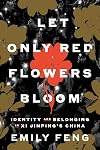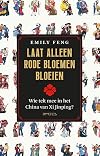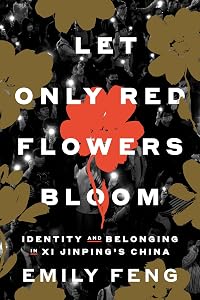
Let Only Red Flowers Bloom: Identity and Belonging in Xi Jinping's China
by Emily Feng
On This Page
Description
"In the hot summer months of 2021, China celebrated the 100th anniversary of the founding of the Communist Party. Authorities held propaganda and education campaigns across the country defining the ideal Chinese citizen: ethnically Han Chinese, Mandarin speaking, solidly atheist, and devoted to the socialist project of strengthening China against western powers. No one can understand modern China-including its response to the pandemic-without understanding who actually lives there, and the show more ways that the Chinese State tries to control its people. Let Only Red Flowers Bloom collects the stories of more than two dozen people who together represent a more holistic picture of Chinese identity. The Uyghurs who have seen millions of their fellow citizens detained in camps; mainland human rights lawyer Ren Quanniu, who lost his law license in a bureaucratic dispute after representing a Hong Kong activist; a teacher from Inner Mongolia, forced to escape persecution because of his support of his mother tongue. These are just a few narratives that journalist Emily Feng reports on, revealing human stories about resistance against a hegemonic state and introducing readers to the people who know about Chinese identity the best. Illuminating a country that has for too long been secretive of the real lives its citizens are living, Feng reveals what it's really like to be anything other than party-supporting Han Chinese in China, and the myriad ways they're trying to survive in the face of an oppressive regime"-- show lessTags
Recommendations


Member Reviews
An extraordinary feat of reporting, telling the story of repression of thought and speech through the stories of individual Chinese people from throughout China (including Hong Kong, Mongolia, Tibet, Taiwan, which may or may not correctly be considered part of China) and the diaspora. Feng's choice of stories is brilliant, and makes comprehensible things I believe are largely incomprehensible to those who are not Chinese and who have not lived under the strictures of Chinese control -- which is not to say they do not remain abhorrent. One thing that became clear as I read was how fully Trump has taken a page from Xi Jinping's playbook. He creates an outward appearance of freedom, foments nationalism, represses dissent, rules through show more fear, and makes "concessions" to those who publicly oppose him to stay popular and appear reasonable while being at all times a despot. Reading this a year ago would have been an entirely different experience.
A personal note on something that made this more special for me, and which I want to highlight because it might nto be immediately apparent to some readers why it matters. The first time I lived in that region was in 1984-1986 (I was 21 when I got there, if you are doing the math -- I really am that old), and I was primarily living in Taiwan, though I spent a great deal of time in Hong Kong and in various parts of Mainland China. Taiwan is enjoying a moment of freedom and growth now, but when I lived there, we were under martial law. There were men with machine guns on most corners in Taipei -- the police and the army were the same. All residents were spied on, threatened, and any speech that did not fully support the Kuomintang was likely to earn you a late-night visit from said gun wielders and, in some cases, imprisonment or deportation. I speak from experience on the late-night visits -- I had two, and I was no political rabble-rouser. Feng addresses this and also talks about the split between the Communists and the Kuomintang and why it matters now. It has been my experience that most people outside the region don't know this history, and it is crucial to understanding modern China. show less
A personal note on something that made this more special for me, and which I want to highlight because it might nto be immediately apparent to some readers why it matters. The first time I lived in that region was in 1984-1986 (I was 21 when I got there, if you are doing the math -- I really am that old), and I was primarily living in Taiwan, though I spent a great deal of time in Hong Kong and in various parts of Mainland China. Taiwan is enjoying a moment of freedom and growth now, but when I lived there, we were under martial law. There were men with machine guns on most corners in Taipei -- the police and the army were the same. All residents were spied on, threatened, and any speech that did not fully support the Kuomintang was likely to earn you a late-night visit from said gun wielders and, in some cases, imprisonment or deportation. I speak from experience on the late-night visits -- I had two, and I was no political rabble-rouser. Feng addresses this and also talks about the split between the Communists and the Kuomintang and why it matters now. It has been my experience that most people outside the region don't know this history, and it is crucial to understanding modern China. show less
In her acknowledgements, Emily Feng thanks NPR for being a place "where creative storytelling and sharp news reporting are valued in equal measure" (274). To be sure, that describes Let Only Red Flowers Bloom. Feng lived in China for seven years and the book gathers together stories, using a tale of one or two to reflect the many. Each chapter has a focus, e.g. "The Lawyer" or "The Businessman" or "The Detained", but certain "characters" become threads that tie the chapters together. Kenny, for example, we meet first in "The Protestor" (Chapter 9) as a youthful idealist who is one of approximately 40K demonstrators in Hong Kong who believe they are peacefully protesting an extradition law. Kenny protests at night, unbeknownst to his show more parents, committing to a highly organized, underground network, that includes volunteer doctors and medics, as injured protestors were getting arrested when taken to the hospital. Kenny then has a new identity in Chapter 10 -- The Fugitive.
These stories serve as a mere primer on just *some* of the basic conflicts in China: the attacks on the Uyghurs and Mongolians, ethnic minorities of all stripes on the mainland, the battle for identity and sovereignty in Hong Kong and Taiwan, and much more. I chose this book because I realized I had a knowledge deficit when it comes to China, and I wanted to know more. Feng's narrative is compelling, well-researched, and wide-reaching--the final chapter, "The Diaspora," pulls back the curtain on the "long-arm" of the Chinese government but also the complexity of more than 5 million Chinese living in the U.S.
There are a few places where more careful editing might have curtailed some unnecessary repetition, especially in Chapter 11, but most of the book skillfully weaves in and out of the present and past, weaving with the cast of characters and their stories to ultimately express large questions. Feng herself had plenty of exposure to danger as well, but she instead choses to center the stories of those she interviewed, and does not inject her own challenges at the border or otherwise with any kind of dramatic hyperbole. If anything, her unadorned self-narrative is all the more chilling, as with her description of a high-speed chase wherein Feng and her driver are tailed after leaving the airport. After being detained, she notes:
"He [the driver] drove me back to the airport in silence. He gestured at his torso, then held a single finger up to his lips, motioning me not to speak. He had been bugged." (152)
The book is a powerful testament to storytelling as truth-telling, and it puts many human faces on complex issues that are reduced to inadequate headlines and social media blurbs in mainstream culture here in the U.S. A worthwhile read to remind us of the human spirit and how it has to endure in all sorts of contexts, all over the world. show less
These stories serve as a mere primer on just *some* of the basic conflicts in China: the attacks on the Uyghurs and Mongolians, ethnic minorities of all stripes on the mainland, the battle for identity and sovereignty in Hong Kong and Taiwan, and much more. I chose this book because I realized I had a knowledge deficit when it comes to China, and I wanted to know more. Feng's narrative is compelling, well-researched, and wide-reaching--the final chapter, "The Diaspora," pulls back the curtain on the "long-arm" of the Chinese government but also the complexity of more than 5 million Chinese living in the U.S.
There are a few places where more careful editing might have curtailed some unnecessary repetition, especially in Chapter 11, but most of the book skillfully weaves in and out of the present and past, weaving with the cast of characters and their stories to ultimately express large questions. Feng herself had plenty of exposure to danger as well, but she instead choses to center the stories of those she interviewed, and does not inject her own challenges at the border or otherwise with any kind of dramatic hyperbole. If anything, her unadorned self-narrative is all the more chilling, as with her description of a high-speed chase wherein Feng and her driver are tailed after leaving the airport. After being detained, she notes:
"He [the driver] drove me back to the airport in silence. He gestured at his torso, then held a single finger up to his lips, motioning me not to speak. He had been bugged." (152)
The book is a powerful testament to storytelling as truth-telling, and it puts many human faces on complex issues that are reduced to inadequate headlines and social media blurbs in mainstream culture here in the U.S. A worthwhile read to remind us of the human spirit and how it has to endure in all sorts of contexts, all over the world. show less
Ratings
Members
- Recently Added By
Lists

History: Asia
103 works; 1 member
Author Information
1 Work 61 Members
Awards and Honors
Classifications
Statistics
- Members
- 61
- Popularity
- 507,356
- Reviews
- 2
- Rating
- (4.36)
- Languages
- Dutch, English
- Media
- Paper, Audiobook, Ebook
- ISBNs
- 4
- ASINs
- 2