On This Page
Description
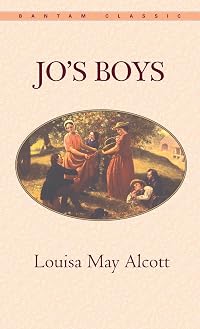
Jo's Boys, and How They Turned Out: A Sequel to "Little Men" is commonly considered to be the last novel in Louisa May Alcott's Little Women series. It takes place ten years after Little Men and follows the children from that book into adulthood. Out in the world they deal with love, ambition, and the snobbery of society..
Tags
Recommendations









Member Recommendations
Member Reviews
Alcott's multi-generational saga of the March family, begun in Little Women and continued in Little Men, is concluded in this third and final volume. Mrs. Jo's "little men" have grown up, and this book follows their various and intertwining adventures as adults...
Leaving aside a few charming passages in which Mrs. Jo must hide from her adoring fans (a snippet of authorial autobiography?), this book has always been a major disappointment to me. While no one would deny that the earlier works have strong moral overtones, they are (thankfully) never overwhelmed by the sort of preaching to be found in Jo's Boys, nor do they suffer from the cloying sentimentality found therein...
I have been haunted, moreover, since first reading this book as show more a child, by a nagging sense of injustice, as it concerns the story of rebellious Dan and his love. It always struck me as horrendously unfair that Alcott should so piously praise Dan's efforts at reforming himself, claiming that those who better themselves will be rewarded, only to deny him the woman he loves (and who loves him), because of his "sordid" past. "If I were a nineteenth-century ex-convict," reasoned my childhood self, "I wouldn't even bother trying to do better..." Oh well - I suppose that one brilliant, and one marvelous book in this series will have to suffice, and compensate for the less-than-stellar one.
As a side note: I read the Illustrated Junior Library edition of Jo's Boys, long out-of-print, and illustrated by Louis Jambor. show less
Leaving aside a few charming passages in which Mrs. Jo must hide from her adoring fans (a snippet of authorial autobiography?), this book has always been a major disappointment to me. While no one would deny that the earlier works have strong moral overtones, they are (thankfully) never overwhelmed by the sort of preaching to be found in Jo's Boys, nor do they suffer from the cloying sentimentality found therein...
I have been haunted, moreover, since first reading this book as show more a child, by a nagging sense of injustice, as it concerns the story of rebellious Dan and his love. It always struck me as horrendously unfair that Alcott should so piously praise Dan's efforts at reforming himself, claiming that those who better themselves will be rewarded, only to deny him the woman he loves (and who loves him), because of his "sordid" past. "If I were a nineteenth-century ex-convict," reasoned my childhood self, "I wouldn't even bother trying to do better..." Oh well - I suppose that one brilliant, and one marvelous book in this series will have to suffice, and compensate for the less-than-stellar one.
As a side note: I read the Illustrated Junior Library edition of Jo's Boys, long out-of-print, and illustrated by Louis Jambor. show less
In the final book of the Annals of the March family, all of the jolly lads Jo teaches grow up and go their separate ways and have adventures. I really love that Louisa gives true to life endings for her characters instead of romanticizing them.
I'm not gonna lie, Dan is my favourite, I would run away to Montana and marry him in a moment, temper and all.
It makes me long for the good ole days, though I know we can make those days ourselves with our own hard work, pure hearts, and cheerfulness. Louisa, you are an inspiration :)
I'm not gonna lie, Dan is my favourite, I would run away to Montana and marry him in a moment, temper and all.
It makes me long for the good ole days, though I know we can make those days ourselves with our own hard work, pure hearts, and cheerfulness. Louisa, you are an inspiration :)
I've been listening to this at night, along with Little Men, for the last few weeks. I haven't a shred of objectivity abou this particular book, as it's one of my all-time favorites. Revisiting it as an adult, I can see more clearly some of its weaknesses, in particular its preachifying and the stilted way some of the character traits (Nan, most notably) are portrayed. However, this matters not the shadow of a whit to me, for these people are so alive, and Plumfield so dear that I hardly notice the flaws. I'm caught up in the stories and delighted all over again. The narration is wonderful here, enough so that I've listened to this multiple times in a few days.
There's so much here. There's the morality of the times, there are the show more impossibly high ideals, there's the reverence for humanity's inherent goodness, there's humor and pathos and heroism and tragedy. This is, without a doubt, one of my desert island books. I rarely re-read Little Women, and hardly a year goes by without I read this one twice. show less
There's so much here. There's the morality of the times, there are the show more impossibly high ideals, there's the reverence for humanity's inherent goodness, there's humor and pathos and heroism and tragedy. This is, without a doubt, one of my desert island books. I rarely re-read Little Women, and hardly a year goes by without I read this one twice. show less
This picks up ten years after the events of Little Men, mostly focusing on the kids of that story figuring out their adult paths.
While Louisa May Alcott is one of the easier classic authors to read, the writing style here isn’t my favorite. There’s a very episodic quality to this which is probably why of all the books in this series I favor Little Women as it did to a greater degree (though not entirely) feel like it had an overarching story continuing from chapter to chapter. Also, this book, like Little Men and to some extent Little Women has a tendency to tell rather than show, many of its potentially compelling moments were somewhat muted by the fact that you’re told about it afterwards instead of being in the moment when the show more event occurs.
I stumbled at times with the characters names, having to occasionally pull myself back and be like nope, that’s that person not this one as there are a number of names that somewhat echo each other, Dan and his dog Don, Tom and Ted, Nat and Nan, Demi who also goes by John (his dad’s name), and Josie who also goes by Jo (her Aunt’s name). I definitely had some confused moments over the names, partly my own fault for waiting too many years after Little Men to read this one, but also, it did feel like this really could have employed a bit more variety in the names.
Certain storylines held my interest more than others. The only Little Woman we truly spend time with is Jo and I found it disappointing that the scant time devoted to her mostly saw her complaining about being a successful author, it doesn’t seem like much of leap to conclude that dealing with her fandom was something Alcott found to be a nuisance so she wrote that into Jo’s story but it’s a high class problem that isn’t nearly as emotionally engaging as I wanted for the character.
I was also disappointed that although Nan had different goals for her life than the other females in the story, we don’t spend much time actually with her working towards those goals, when she’s in a scene it’s more about the guy crushing on her than it is about her.
The shipwreck, the aspiring actress, and the kid living beyond his means, each had moments that caught my interest, but the prison stuff pulled me in most, it felt like the emotional stakes were better established for that character than anyone else and I liked that it had a bittersweet tinge to it even if in order to achieve that bittersweet tinge it compromised how I saw the March sisters (I know their actions to shield a certain someone from ending up with the “wrong” sort of person were era appropriate but I guess I always thought of Jo and Amy as being somewhat rebellious women who wouldn’t be as married to appropriate as say, Meg or Aunt March). show less
While Louisa May Alcott is one of the easier classic authors to read, the writing style here isn’t my favorite. There’s a very episodic quality to this which is probably why of all the books in this series I favor Little Women as it did to a greater degree (though not entirely) feel like it had an overarching story continuing from chapter to chapter. Also, this book, like Little Men and to some extent Little Women has a tendency to tell rather than show, many of its potentially compelling moments were somewhat muted by the fact that you’re told about it afterwards instead of being in the moment when the show more event occurs.
I stumbled at times with the characters names, having to occasionally pull myself back and be like nope, that’s that person not this one as there are a number of names that somewhat echo each other, Dan and his dog Don, Tom and Ted, Nat and Nan, Demi who also goes by John (his dad’s name), and Josie who also goes by Jo (her Aunt’s name). I definitely had some confused moments over the names, partly my own fault for waiting too many years after Little Men to read this one, but also, it did feel like this really could have employed a bit more variety in the names.
Certain storylines held my interest more than others. The only Little Woman we truly spend time with is Jo and I found it disappointing that the scant time devoted to her mostly saw her complaining about being a successful author, it doesn’t seem like much of leap to conclude that dealing with her fandom was something Alcott found to be a nuisance so she wrote that into Jo’s story but it’s a high class problem that isn’t nearly as emotionally engaging as I wanted for the character.
I was also disappointed that although Nan had different goals for her life than the other females in the story, we don’t spend much time actually with her working towards those goals, when she’s in a scene it’s more about the guy crushing on her than it is about her.
The shipwreck, the aspiring actress, and the kid living beyond his means, each had moments that caught my interest, but the prison stuff pulled me in most, it felt like the emotional stakes were better established for that character than anyone else and I liked that it had a bittersweet tinge to it even if in order to achieve that bittersweet tinge it compromised how I saw the March sisters (I know their actions to shield a certain someone from ending up with the “wrong” sort of person were era appropriate but I guess I always thought of Jo and Amy as being somewhat rebellious women who wouldn’t be as married to appropriate as say, Meg or Aunt March). show less
2019 observations:
This book seems less like a story and more like a series of enjoyable vignettes. Alcott pokes fun at authors and their fans, moralizes and lectures in between plots, and wraps things up nicely for most. Nat, who was an effective way to introduce Plumfield, has become a sissy, Franz doesn't show up much, Emil is fun (when he's there), Josie is flashy, Bess is too perfect, Stuffy and Dolly are weathercocks, Tommy is irrepressibly Tom (and, like Emil, doesn't figure much), Dan is predictably trouble, Laurie is admirable, and Teddy is absolutely delightful. Alice Heath, as admirable as she is, seems mostly like an afterthought. It seems as though Alcott largely means Nan and the other women to take the spotlight, but they show more are so varied and spread out that it becomes hard to follow. The literary references are many--making it even more difficult.
In spite of all this, I really enjoyed Alcott's views (probably more than most of the stories). It isn't a perfect book, but I did enjoy her little dig at women expecting to do this and this "until I marry." And I relished her strong voice for the vote.
Several times women were referred to as superfluous. I used to rankle quite a bit at that, but this read I remembered that we're talking post-civil war era about the hundreds of small towns, and larger ones, where companies and companies of soldiers were lost in battles and sickness. Certainly, the large amounts of single (widowed, never-married etc) women would have seemed overwhelming to the towns. Think of the poverty and the helplessness. Of course women would have wanted to vote and one must, and does, admire Nan and her ilk (and wonder what on earth, if anything, was going on in Daisy's mind).
Sadly, Meg and Daisy do not improve with age. I get the feeling that Louisa either a) didn't have a real-life person to base them on (the real "Meg" died relatively early in life) or b) didn't really find much to relate to in either of these characters.
It was interesting to me to view the switch in my experience with the characters. In Little Women I easily swallowed Meg's desire to have a nice home and children. But Daisy's lack of gumption, headaches, and inability to speak for herself left me rather bored with the character.
I still think that Jo March Bhaer is probably one of her best creations. Rose, in [b:Eight Cousins|14570|Eight Cousins (Eight Cousins, #1)|Louisa May Alcott|https://i.gr-assets.com/images/S/compressed.photo.goodreads.com/books/1328864060i/14570._SY75_.jpg|2905864], and Polly in [b:An Old-Fashioned Girl|246546|An Old-Fashioned Girl|Louisa May Alcott|https://i.gr-assets.com/images/S/compressed.photo.goodreads.com/books/1347469119i/246546._SY75_.jpg|3719102] have interesting stories, but their characters lack the vivacity and striking individuality that Jo has. show less
This book seems less like a story and more like a series of enjoyable vignettes. Alcott pokes fun at authors and their fans, moralizes and lectures in between plots, and wraps things up nicely for most. Nat, who was an effective way to introduce Plumfield, has become a sissy, Franz doesn't show up much, Emil is fun (when he's there), Josie is flashy, Bess is too perfect, Stuffy and Dolly are weathercocks, Tommy is irrepressibly Tom (and, like Emil, doesn't figure much), Dan is predictably trouble, Laurie is admirable, and Teddy is absolutely delightful. Alice Heath, as admirable as she is, seems mostly like an afterthought. It seems as though Alcott largely means Nan and the other women to take the spotlight, but they show more are so varied and spread out that it becomes hard to follow. The literary references are many--making it even more difficult.
In spite of all this, I really enjoyed Alcott's views (probably more than most of the stories). It isn't a perfect book, but I did enjoy her little dig at women expecting to do this and this "until I marry." And I relished her strong voice for the vote.
Several times women were referred to as superfluous. I used to rankle quite a bit at that, but this read I remembered that we're talking post-civil war era about the hundreds of small towns, and larger ones, where companies and companies of soldiers were lost in battles and sickness. Certainly, the large amounts of single (widowed, never-married etc) women would have seemed overwhelming to the towns. Think of the poverty and the helplessness. Of course women would have wanted to vote and one must, and does, admire Nan and her ilk (and wonder what on earth, if anything, was going on in Daisy's mind).
Sadly, Meg and Daisy do not improve with age. I get the feeling that Louisa either a) didn't have a real-life person to base them on (the real "Meg" died relatively early in life) or b) didn't really find much to relate to in either of these characters.
It was interesting to me to view the switch in my experience with the characters. In Little Women I easily swallowed Meg's desire to have a nice home and children. But Daisy's lack of gumption, headaches, and inability to speak for herself left me rather bored with the character.
I still think that Jo March Bhaer is probably one of her best creations. Rose, in [b:Eight Cousins|14570|Eight Cousins (Eight Cousins, #1)|Louisa May Alcott|https://i.gr-assets.com/images/S/compressed.photo.goodreads.com/books/1328864060i/14570._SY75_.jpg|2905864], and Polly in [b:An Old-Fashioned Girl|246546|An Old-Fashioned Girl|Louisa May Alcott|https://i.gr-assets.com/images/S/compressed.photo.goodreads.com/books/1347469119i/246546._SY75_.jpg|3719102] have interesting stories, but their characters lack the vivacity and striking individuality that Jo has. show less
Jo’s Boys by Louisa May Alcott is the final volume in her saga about the March sisters. In this book we find all the sisters living close together, with Meg having a small home built on the grounds of Plumfield while Amy and Laurie have built themselves a mansion close by. Plumfield is no longer a small school, but the Professor now is the head of a nearby college and runs it according to his liberal views on education.
We are updated on the lives of all the former pupils, who have become like a family to the Baer’s, returning for visits and staying in touch no matter how their lives grow and change. I was particularly pleased to see that Nan had grown into a strong willed independent woman who is very devoted to her career.
This is a show more sentimental ending to the story. We see as past characters grown-up, learn life lessons, fall in love, get into trouble and have exciting adventures. At the same time the author gives us a glimpse into her own philosophical leanings, and although Jo’s Boys is very idealistic and a touch too preachy, these flaws are easy for me to overlook as I enjoyed getting closure on these beloved characters. show less
We are updated on the lives of all the former pupils, who have become like a family to the Baer’s, returning for visits and staying in touch no matter how their lives grow and change. I was particularly pleased to see that Nan had grown into a strong willed independent woman who is very devoted to her career.
This is a show more sentimental ending to the story. We see as past characters grown-up, learn life lessons, fall in love, get into trouble and have exciting adventures. At the same time the author gives us a glimpse into her own philosophical leanings, and although Jo’s Boys is very idealistic and a touch too preachy, these flaws are easy for me to overlook as I enjoyed getting closure on these beloved characters. show less
This final book in the Little Women series picks up 10 years on from Little Men. Jo's Boys are all venturing out into the world to take their adult roles. For some the rapscallion Dan there are more adventures and troubles to encounter. Several fall in love after successfully accomplishing their educational goals. It was a joy to revisit these characters. I smile to myself. No wonder I was such a romantic in my teenage years given this was my reading fodder just prior.
It portrays such wholesome young people and family life. Perhaps it was these women that made me choose to put children and family first in my life, although she does fly the feminist flag, heralding the importance of book education for young women. I find it surprising show more that these were written in 1860's and 1870's. A far cry from the experience of my own forbears I am sure. show less
It portrays such wholesome young people and family life. Perhaps it was these women that made me choose to put children and family first in my life, although she does fly the feminist flag, heralding the importance of book education for young women. I find it surprising show more that these were written in 1860's and 1870's. A far cry from the experience of my own forbears I am sure. show less
Members
- Recently Added By
Lists

Favorite Childhood Books
1,651 works; 519 members

Childhood Favorites
427 works; 24 members
Honey For a Child's Heart
1,152 works; 25 members

Fiction with Women's Names in the Title
378 works; 15 members

Bibliography for How to be a Heroine
148 works; 12 members

Books About Girls
219 works; 17 members

Best family sagas
244 works; 34 members

American Lit for Eng 11 Research Project
368 works; 6 members

Unmarried women
66 works; 6 members

Books About Boys
175 works; 15 members

Books Read in 2021
5,361 works; 114 members

1970s
657 works; 23 members

Books We Loved As Children
603 works; 252 members
Author Information

474+ Works 109,135 Members
Louisa May Alcott was born in Germantown, Pennsylvania, in 1832. Two years later, she moved with her family to Boston and in 1840 to Concord, which was to remain her family home for the rest of her life. Her father, Bronson Alcott, was a transcendentalist and friend of Ralph Waldo Emerson and Henry David Thoreau. Alcott early realized that her show more father could not be counted on as sole support of his family, and so she sacrificed much of her own pleasure to earn money by sewing, teaching, and churning out potboilers. Her reputation was established with Hospital Sketches (1863), which was an account of her work as a volunteer nurse in Washington, D.C. Alcott's first works were written for children, including her best-known Little Women (1868--69) and Little Men: Life at Plumfield with Jo's Boys (1871). Moods (1864), a "passionate conflict," was written for adults. Alcott's writing eventually became the family's main source of income. Throughout her life, Alcott continued to produce highly popular and idealistic literature for children. An Old-Fashioned Girl (1870), Eight Cousins (1875), Rose in Bloom (1876), Under the Lilacs (1878), and Jack and Jill (1881) enjoyed wide popularity. At the same time, her adult fiction, such as the autobiographical novel Work: A Story of Experience (1873) and A Modern Mephistopheles (1877), a story based on the Faust legend, shows her deeper concern with such social issues as education, prison reform, and women's suffrage. She realistically depicts the problems of adolescents and working women, the difficulties of relationships between men and women, and the values of the single woman's life. (Bowker Author Biography) show less
Some Editions
Series

Belongs to Publisher Series
Work Relationships
Common Knowledge
- Canonical title
- Jo's Boys
- Original title
- Jo's Boys and How They Turned Out: A Sequel to Little Men
- Original publication date
- 1886
- People/Characters
- Josephine "Jo" March; Friedrich Bhaer (professor); Teddy Bhaer; Rob Bhaer; Daisy Brooke; Demi Brooke (show all 9); Dan [Little Women]; Emil; Nat [Little Women]
- Important places
- New England, USA
- Dedication
- To Dr Conrad Wesselhoeft
This very inadequate tribute of affection and respect is gratefully inscribed by his friend and patient,
The Author - First words
- "If anyone were to have told me what wonderful changes were to take place here in ten years, I wouldn't have believed it," said Mrs. Jo to Mrs. Meg, as they sat on the piazza at Plumfield one summer day, looking about them wi... (show all)th faces full of pride and pleasure.
- Quotations
- Nan remained a busy, cheerful, independent spinster, and dedicated her life to her suffering sisters and their children, in which true woman's work she found abiding happiness.
- Last words
- (Click to show. Warning: May contain spoilers.)And now, having endeavoured to suit everyone by many weddings, few deaths, and as much prosperity as the eternal fitness of things will permit, let the music stop, the lights die out, and the curtain fall for ever on the March family.
- Publisher's editor
- Niles, Thomas
- Original language
- English
- Canonical LCC
- 813.4
Classifications
- Genres
- Children's Books, Fiction and Literature
- DDC/MDS
- 813.4 — Literature & rhetoric American literature in English American fiction in English Later 19th Century 1861-1900
- LCC
- PZ7 .A335 .J — Language and Literature Fiction and juvenile belles lettres Fiction and juvenile belles lettres Juvenile belles lettres
- BISAC
Statistics
- Members
- 5,865
- Popularity
- 2,217
- Reviews
- 38
- Rating
- (3.65)
- Languages
- 10 — English, Estonian, Finnish, French, German, Hungarian, Italian, Polish, Serbian, Spanish
- Media
- Paper, Audiobook, Ebook
- ISBNs
- 259
- UPCs
- 3
- ASINs
- 182