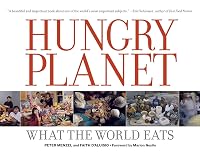
Hungry Planet: What the World Eats
by Peter Menzel
On This Page
Description
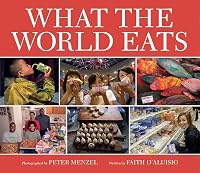
"A photographic collection exploring what the world eats featuring portraits of thirty families from twenty-four countries surrounded by a week's worth of food"--Provided by publisher.Tags
Recommendations



























Member Reviews
Beautifully photographed and organized examination of what families around the world eat in an average week. Reinforces that we live in the land of plenty, which has both good and bad consequences. Most of the world, we find, gets by on very little food each day/week and may be the better for it.
This book is full of beautiful, intricate photographs of families from across the world in their kitchens with a week's worth of food spread around them. Each family is accompanied by a narrative essay, photos of their markets and grocery stores, a detailed list of every item in the photo with accompanying costs, and facts about their country. Totally fascinating, but slow going as there is much to look at and think about. I guarantee you'll be depressed at all the great bread the rest of the world (even by much poorer families) is eating compared to the limp, squooshy stuff on your countertop. A *great* read.
Quite possibly my favorite book. Menzel captures the eating habits of statistically average families from countries around the world by taking photos of what the families eat for one week. He puts ALL the food on a table in front of the family, which makes for stunning photography.
Menzel shows us the world's people and the world's problems by showing us the world's food. We see the starving refugees in Chad, surviving of UN ground mush. We see the American diet filled with pizza and soda. We see two families from China and the differences between urban and suburban life, reflecting globalization.
This book could be used across the curriculum--in Math, children can compare statistics of diabetes or calorie consumption. In Social show more Studies, children can learn about the lifestyles of different countries. Hungry Planet can be used to discuss current events or to learn about making inferences in English class. This would be an ideal book for a Health or Nutrition class.
When used in a sixth grade classroom, my students felt great appreciation for what they had to eat and became activists in the fight to end global hunger. This is an amazing teaching tool that can be used for middle school-college classrooms. show less
Menzel shows us the world's people and the world's problems by showing us the world's food. We see the starving refugees in Chad, surviving of UN ground mush. We see the American diet filled with pizza and soda. We see two families from China and the differences between urban and suburban life, reflecting globalization.
This book could be used across the curriculum--in Math, children can compare statistics of diabetes or calorie consumption. In Social show more Studies, children can learn about the lifestyles of different countries. Hungry Planet can be used to discuss current events or to learn about making inferences in English class. This would be an ideal book for a Health or Nutrition class.
When used in a sixth grade classroom, my students felt great appreciation for what they had to eat and became activists in the fight to end global hunger. This is an amazing teaching tool that can be used for middle school-college classrooms. show less
This is a compelling book following up previous works by Menzel, who travels the world creating photo essays. In this collection, Menzel and D'Aluisio look at the food consumption habits of people from around the world. Progressing from least calories to most calories, they show each person or family with their daily allotment of food, ranging from a few handfuls of grains and beans to extravagant table settings. Not only does this book portray the variety of foods from around the world, it also shows the immense scale difference between those who have little and those who have much.
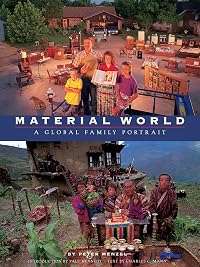
This book is so interesting. Its basic premise is that the author traveled to many, many countries, stayed with a family he felt to be typical of the culture, ate with them and watched them shop, then photographed absolutely every ingredient they would use for an entire week, with a complete catalogue of these foods on the page facing. It's a fascinating look into other cultures - how similar they can be, and how different, from your own. There's another neat one, also by Peter Menzel, called Material World, where he did a similar thing, a photographic catalogue of a family's life. But the photography in this one is better. In MW, the pictures are taken from so far away that it is slightly difficult to see detail, and that detail, for show more me, was what made this one so interesting, like being able to momentarily step into another country and browse someone else's life. Like traveling, without the expense of airfare - you really feel like you know a place when you know what they eat. show less
I had heard about this photo-essay book a little while ago and was interested enough that I decided to buy it. It basically covers a lot of families in countries all over the world and what they eat in a week, how much it costs, etc.
If you live in a first-world country, this book can be incredibly eye-opening. Seeing the sheer amount of soda, fast food, and prepackaged foods an average family in Great Britain, France, the US, Germany, or Australia consumes certainly made me consider a lot about diet. Also, the sad fact that the family whose food costs the least per week (about $1.50 a week) in Darfur is completely separated (in all ways - food choice, food amount, modes of preparation) from the family whose food costs the most per week show more (about $500) in Germany.
I'm probably not explaining it well, but this book not only has beautiful photos of every family with the food they eat in a week, but also contains illuminating essays and commentary, making it a truly wonderful book that I was more than willing to read cover to cover. Highly recommended. show less
If you live in a first-world country, this book can be incredibly eye-opening. Seeing the sheer amount of soda, fast food, and prepackaged foods an average family in Great Britain, France, the US, Germany, or Australia consumes certainly made me consider a lot about diet. Also, the sad fact that the family whose food costs the least per week (about $1.50 a week) in Darfur is completely separated (in all ways - food choice, food amount, modes of preparation) from the family whose food costs the most per week show more (about $500) in Germany.
I'm probably not explaining it well, but this book not only has beautiful photos of every family with the food they eat in a week, but also contains illuminating essays and commentary, making it a truly wonderful book that I was more than willing to read cover to cover. Highly recommended. show less
One of the most fun food books I've read. Unlike others, this one doesn't necessarily inspire me to change my diet (it's already pretty good). Instead, here's what went through my head as I read the book:
1) Wow, the number of different cuisines in the world -- even in today's small world -- is still staggering.
2) Wow, we're incredibly fortunate to live in a world where food is plentiful. Not only is that relatively rare in human history, even in modern times it's not something that can be taken for granted. Yet I do, all the time.
Finally, this is a book that really makes me want to travel. All in all, highly recommended for anyone who thinks about the food he eats.
Full review: show more target="_top">http://www.bdewey.com/2008/01/17/hungry-planet-what-the-world-eats/ show less
1) Wow, the number of different cuisines in the world -- even in today's small world -- is still staggering.
2) Wow, we're incredibly fortunate to live in a world where food is plentiful. Not only is that relatively rare in human history, even in modern times it's not something that can be taken for granted. Yet I do, all the time.
Finally, this is a book that really makes me want to travel. All in all, highly recommended for anyone who thinks about the food he eats.
Full review: show more target="_top">http://www.bdewey.com/2008/01/17/hungry-planet-what-the-world-eats/ show less
Members
- Recently Added By
Lists

Geography Through Photography for Kids
55 works; 1 member

Ambleside Year 5
55 works; 1 member
Author Information
16 Works 4,044 Members
Peter Menzel is an internationally known photojournalist who writes many of his books in collaboration with his wife, Faith D'Aluisio. Titles of some include "Material World: A Global Family Portrait," "Man Eating Bugs: The Art and Science of Eating Insects" (the writing of which required the two to actually devour bugs), and "Women in the show more Material World." (Bowker Author Biography) show less
Common Knowledge
- Canonical title
- Hungry Planet: What the World Eats
- Disambiguation notice
- Please do not combine with the original edition: What the World Eats. This edition has 127 more pages and covers an additional three countries and five families.
Classifications
Statistics
- Members
- 1,137
- Popularity
- 22,205
- Reviews
- 22
- Rating
- (4.58)
- Languages
- English, German
- Media
- Paper
- ISBNs
- 6
- ASINs
- 3
