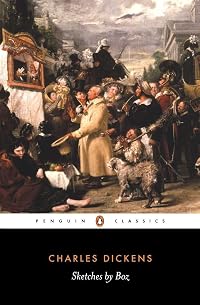
Sketches by Boz
by Charles Dickens
On This Page
Description
The most unique aspect of Charles Dickens' skill as a writer -- and the characteristic that propelled him to unprecedented heights of literary fame -- was his ability to immerse readers in the quotidian details of his characters' lives, loves, and struggles. That strength shines through in this vast collection of short pieces culled from Dickens' tenure as a newspaper columnist.Tags
Recommendations















Member Reviews
As a personal project in Dickens Bi-Centenary year I am trying to read some of his books that I had never got around to and this is one that I have been dipping into for years but somehow never quite connecting with it.
I have finally done so and am glad to have made the effort despite the variable quality of these ‘prentice pieces, originally written for a number of different publications.
In the section titled “Scenes” we see London of the 1830’s through Dickens eyes. He knew his city intimately and here he vividly evokes it’s sights and sounds just before the Victorian era dawns. He shows us pawn shops and the gin-soaked criminal quarter of Seven Dials. He visits Newgate Prison, inaugurating his lifetime interest in penal show more institutions. He takes us inside the London theatres and the cheerful vulgarity of Astley’s Amphitheatre. He sees everything and he also listens. Through him we hear the voices of costermongers and omnibus drivers, prison officers and shoppers, the pleasure seekers at Vauxhall Gardens .
These vibrant pieces are perhaps the best of these early writings. In “Characters” and “Tales” we see his early attempts at imaginative writing. In later life he was critical of many of them, noting the rushed quality they had and seeing many of these short pieces as “crude and ill-considered, and bearing obvious marks of haste and inexperience.” They are interesting though in showing us the development of the writer’s mind and we can see where characters such as Mr Pickwick and Sam Weller came from. I find myself in agreement with Thea Home who wrote the introduction for this ‘Oxford’ edition. She points out that the sketches have a special fascination in both fore-shadowing the work of a writer of genius and also revealing the young Boz . We are surely walking alongside Dickens himself when we encounter the patrons and performers of ‘Private Theatres’ whose proprietors may be “..an ex-scene painter, a low coffee-house keeper, a disappointed eighth-rate actor, a retired smuggler, or uncertificated bankrupt.”
I particularly enjoyed “The Tuggses at Ramsgate”, partly set on a pleasure steamer on the Thames and brimful of vivid characters in a tale of a rise in fortune and social climbing gone sadly awry.
“..the City of London Ramsgate steamer was running gaily down the river. Her flag was flying, her band was playing, her passengers were conversing; everything about her seemed gay and lively,- No wonder- the Tuggses were on board.”
I did come to the conclusion that the ‘dipping’ approach has something to be said for it with this collection, as reading straight through does become tedious. This is particularly the case with some of the weaker sections of this edition such as “The Mudfog Papers” which I would not recommend as the humour is forced and tedious in the extreme. show less
I have finally done so and am glad to have made the effort despite the variable quality of these ‘prentice pieces, originally written for a number of different publications.
In the section titled “Scenes” we see London of the 1830’s through Dickens eyes. He knew his city intimately and here he vividly evokes it’s sights and sounds just before the Victorian era dawns. He shows us pawn shops and the gin-soaked criminal quarter of Seven Dials. He visits Newgate Prison, inaugurating his lifetime interest in penal show more institutions. He takes us inside the London theatres and the cheerful vulgarity of Astley’s Amphitheatre. He sees everything and he also listens. Through him we hear the voices of costermongers and omnibus drivers, prison officers and shoppers, the pleasure seekers at Vauxhall Gardens .
These vibrant pieces are perhaps the best of these early writings. In “Characters” and “Tales” we see his early attempts at imaginative writing. In later life he was critical of many of them, noting the rushed quality they had and seeing many of these short pieces as “crude and ill-considered, and bearing obvious marks of haste and inexperience.” They are interesting though in showing us the development of the writer’s mind and we can see where characters such as Mr Pickwick and Sam Weller came from. I find myself in agreement with Thea Home who wrote the introduction for this ‘Oxford’ edition. She points out that the sketches have a special fascination in both fore-shadowing the work of a writer of genius and also revealing the young Boz . We are surely walking alongside Dickens himself when we encounter the patrons and performers of ‘Private Theatres’ whose proprietors may be “..an ex-scene painter, a low coffee-house keeper, a disappointed eighth-rate actor, a retired smuggler, or uncertificated bankrupt.”
I particularly enjoyed “The Tuggses at Ramsgate”, partly set on a pleasure steamer on the Thames and brimful of vivid characters in a tale of a rise in fortune and social climbing gone sadly awry.
“..the City of London Ramsgate steamer was running gaily down the river. Her flag was flying, her band was playing, her passengers were conversing; everything about her seemed gay and lively,- No wonder- the Tuggses were on board.”
I did come to the conclusion that the ‘dipping’ approach has something to be said for it with this collection, as reading straight through does become tedious. This is particularly the case with some of the weaker sections of this edition such as “The Mudfog Papers” which I would not recommend as the humour is forced and tedious in the extreme. show less
OK, we know these ere written for a magazine in serial form. We know he got paid by the word. But there's not a superfluous word anywhere in there. And we once again realize what a savage wit Dickens was in the guise of a wide-eyed innocent reporting on what he sees. In a few chosen words he makes us see the foolishness and stupidity of people, and yet if you were those people, you'd never know it, he's that clever in his descriptions. His social reformer tendencies also come out in these sketches, especially when he talks about drunkedness, or children being forced into "unspeakable acts" (prostitution). But you turn the page to the next sketch, and you're laughing out loud at the fixes people can get themselves into by deluding show more themselves that they're not "low" or "common". If you've never read it, do it. It will literally open up a whole different world to you. show less
A mixed bag of sketches, with some very funny and moving ones, and a few that were mediocre and forgettable. Some of the best were redolent of Dickens's later distinctive style, though these were his earliest published works, first appearing in magazines between 1833-36. The first seven sketches, grouped under the title The Parish, were good and funny, especially The Election for Beadle and The Four Sisters. The sections headed Scenes and Characters were rather more variable, though as ever Dickens excels when covering the plight of the poor and wretched, for example in Gin-Shops, A Visit to Newgate and The Prisoners' Van. A Christmas Dinner should become a seasonal favourite. The sketches detailing the coming in of the omnibus were show more very good as well.
The latter set of Tales were varied, with a few dull ones, but also some very funny ones, esp The Boarding House, Mr Minns and his Cousin (Dickens's first published piece as A Dinner at Poplar Walk), Horatio Sparkins and The Bloomsbury Christening. The Black Veil and The Drunkard's Death were very haunting.
The illustrations by George Cruikshank were marvellous, better than those by Phiz in my view, with a Hogarthian sort of feel about them. 4/5 show less
The latter set of Tales were varied, with a few dull ones, but also some very funny ones, esp The Boarding House, Mr Minns and his Cousin (Dickens's first published piece as A Dinner at Poplar Walk), Horatio Sparkins and The Bloomsbury Christening. The Black Veil and The Drunkard's Death were very haunting.
The illustrations by George Cruikshank were marvellous, better than those by Phiz in my view, with a Hogarthian sort of feel about them. 4/5 show less
Funny and interesting book about life in London in the early nineteenth century. Mostly humourous sketches with some darker sentimental ones within. Shows Dickens spreading his wings as a writer fortelling the heights to which he would achieve.
George Eliot’s main objection to Dickens, apart from (what she perceived as) his vulgarity and melodrama, was his lack of interiority. In this she is both right and wrong. Dickens’s whole gift is his exteriority. He can sum up in a sentence a whole character that would take Eliot three chapters to describe. However, where she is wrong is in considering that this is a weakness. Eliot surprisingly makes two cardinal critical errors here, not only in judging a work of art, but in judging it in terms other than those provided by itself.
Eliot and Dickens stand at two polar extremes of literature: exteriority and interiority, both of which are based on different conceptions of character. For Eliot, character is the mind communing with show more itself, its impression of the world and reflections on it. It is the mind of someone raised in the country, in the relative isolation of family members, in the company of books. Locke.
Dickens, on the other hand, has a completely different conception of character. Character is what is revealed in our relations with other people and in our actions...
Read the ful review on The Lectern
http://thelectern.blogspot.com/2007/03/sketches-by-boz-charles-dickens.html show less
Eliot and Dickens stand at two polar extremes of literature: exteriority and interiority, both of which are based on different conceptions of character. For Eliot, character is the mind communing with show more itself, its impression of the world and reflections on it. It is the mind of someone raised in the country, in the relative isolation of family members, in the company of books. Locke.
Dickens, on the other hand, has a completely different conception of character. Character is what is revealed in our relations with other people and in our actions...
Read the ful review on The Lectern
http://thelectern.blogspot.com/2007/03/sketches-by-boz-charles-dickens.html show less
I had read a number of these before but had never read Sketches by Boz in its entirety. Dickens first book, published when he was twenty-four and already on his third or fourth career, contains his earliest writings, ranging from semi-fictional sketches to a series of "tales" that range from farce to melodramatic tragedy. They contain much of what one would find throughout his career: walking through the streets of London, middle-class families, clerks, comedy, satire of pretension, tragedy, farce, a preoccupation with prisons, etc. Many of the pieces are excellent, virtually none of them are bad or even seem particularly immature, but for most people Sketches is fairly superseded by the novels which take many of the same types of show more characters and scenes and embed them in a much more compelling and readable format. That said, Sketches was very enjoyable and I would expect to read many of the individual pieces in it again. show less
I had read a number of these before but had never read Sketches by Boz in its entirety. Dickens first book, published when he was twenty-four and already on his third or fourth career, contains his earliest writings, ranging from semi-fictional sketches to a series of "tales" that range from farce to melodramatic tragedy. They contain much of what one would find throughout his career: walking through the streets of London, middle-class families, clerks, comedy, satire of pretension, tragedy, farce, a preoccupation with prisons, etc. Many of the pieces are excellent, virtually none of them are bad or even seem particularly immature, but for most people Sketches is fairly superseded by the novels which take many of the same types of show more characters and scenes and embed them in a much more compelling and readable format. That said, Sketches was very enjoyable and I would expect to read many of the individual pieces in it again. show less
Members
- Recently Added By
Lists

Charles Dickens books
17 works; 1 member
Author Information

2,578+ Works 313,139 Members
Charles Dickens, perhaps the best British novelist of the Victorian era, was born in Portsmouth, Hampshire, England on February 7, 1812. His happy early childhood was interrupted when his father was sent to debtors' prison, and young Dickens had to go to work in a factory at age twelve. Later, he took jobs as an office boy and journalist before show more publishing essays and stories in the 1830s. His first novel, The Pickwick Papers, made him a famous and popular author at the age of twenty-five. Subsequent works were published serially in periodicals and cemented his reputation as a master of colorful characterization, and as a harsh critic of social evils and corrupt institutions. His many books include Oliver Twist, David Copperfield, Bleak House, Great Expectations, Little Dorrit, A Christmas Carol, and A Tale of Two Cities. Dickens married Catherine Hogarth in 1836, and the couple had nine children before separating in 1858 when he began a long affair with Ellen Ternan, a young actress. Despite the scandal, Dickens remained a public figure, appearing often to read his fiction. He died in 1870, leaving his final novel, The Mystery of Edwin Drood, unfinished. (Bowker Author Biography) show less
Some Editions
Awards and Honors
Awards
Series
Belongs to Publisher Series
Work Relationships
Is contained in
Contains
Common Knowledge
- Canonical title
- Sketches by Boz
- Original title
- Sketches by Boz
- Original publication date
- 1836
- Important places
- England, UK
Classifications
Statistics
- Members
- 1,263
- Popularity
- 19,380
- Reviews
- 19
- Rating
- (3.81)
- Languages
- 9 — Chinese, Dutch, English, Esperanto, French, German, Italian, Portuguese, Spanish
- Media
- Paper, Audiobook, Ebook
- ISBNs
- 85
- ASINs
- 89