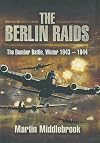
The Berlin Raids: R.A.F. Bomber Command Winter 1943/44
by Martin Middlebrook
On This Page
Description
The Battle of Berlin was the longest, most sustained offensive against a single target, and its merits remain a subject of debate even today. Here is the story behind these costly raids-- including crucial tactical shifts within the R.A.F.-- and month-by-month coverage of the most important runs. Based on over 400 interviews of both British and German aircrews.Tags
Recommendations

















Member Reviews
Martin Middlebrook, a respected British military historian known for his meticulous, participant-driven accounts of major WWII operations (including works like The First Day on the Somme and The Nuremberg Raid), delivers a detailed chronicle of the RAF Bomber Command’s sustained campaign against Berlin. Often called the Battle of Berlin, this was Bomber Command’s most prolonged and costly effort against a single target, stretching from late 1943 into early 1944. Under Sir Arthur Harris, the campaign involved nineteen major raids, over 10,000 aircraft sorties, and more than 30,000 tons of bombs dropped, with the explicit hope of devastating the city so thoroughly that German surrender would become inevitable.
Middlebrook’s strength show more lies in his even-handed approach. He draws on extensive research, including German documents and interviews with over 400 participants from both sides—RAF crews, Luftwaffe defenders, and Berlin civilians. The book unfolds month by month, tracking the “ebb and flow” as longer winter nights favored the bombers, only for German night fighters, improved radar, and defenses to exact a terrible toll. Losses exceeded 600 aircraft and crews, a grim rate that made tours of duty (typically 30 operations, later adjusted) feel like near-suicidal missions. He vividly recounts the technical challenges (navigation at night, Pathfinder marking, H2S radar), the courage and fears of young aircrews in desperate battles, and the Luftwaffe’s increasingly effective countermeasures.
Particularly powerful are the sections on the ground. Middlebrook humanizes the Berliners: families shattered by firestorms, homes reduced to rubble, morale strained but not broken, and war production disrupted yet resilient. The campaign failed to achieve Harris’s strategic goal of knocking Germany out of the war through area bombing. Berlin was battered but not destroyed, and the offensive ultimately wound down after heavy losses, including the disastrous Nuremberg raid that followed.
The book is praised for its balance and detail, though some readers note that covering months of operations (rather than a single raid like in Middlebrook’s other works) can make it feel sprawling at times. It remains a classic reference for understanding the human and operational realities of the bomber war.
A Personal Reflection on the Moral Dimension
While Middlebrook provides a non-partisan military history, reading it reinforces a deeper unease about the ethics of strategic area bombing. The deliberate targeting of civilian population centers—whether German cities like Berlin or earlier German raids on British ones during the Blitz—constituted a war crime by any reasonable standard of proportionality and distinction between combatants and non-combatants. The scale of destruction, the intent to break civilian morale through fire and high explosives, and the immense suffering inflicted on ordinary people cross a line that civilized warfare should not. Yet, no one was ever charged with this particular war crime. The victors wrote the rules at Nuremberg and elsewhere; the Allies’ far greater capacity and execution of such campaigns shielded their leaders (including Harris) from accountability, even as the moral equivalence in terror bombing is hard to ignore. The Germans pioneered it in places like Rotterdam and London, but the Allies industrialized and escalated it dramatically. This hypocrisy does not absolve either side, but it underscores how “victor’s justice” often obscures uncomfortable truths about total war.
Middlebrook’s work doesn’t shy away from the controversy or the human cost on both sides, making it a valuable (if sobering) read. It highlights bravery amid futility: the aircrews’ determination, the defenders’ skill, and the civilians’ endurance. For anyone interested in WWII air power, Bomber Command, or the broader ethical debates of the conflict, The Berlin Raids is essential. It earns a strong recommendation—4.5/5 stars—for its research and fairness, even if it leaves the reader grappling with larger questions the author largely leaves for the audience to ponder. show less
Middlebrook’s strength show more lies in his even-handed approach. He draws on extensive research, including German documents and interviews with over 400 participants from both sides—RAF crews, Luftwaffe defenders, and Berlin civilians. The book unfolds month by month, tracking the “ebb and flow” as longer winter nights favored the bombers, only for German night fighters, improved radar, and defenses to exact a terrible toll. Losses exceeded 600 aircraft and crews, a grim rate that made tours of duty (typically 30 operations, later adjusted) feel like near-suicidal missions. He vividly recounts the technical challenges (navigation at night, Pathfinder marking, H2S radar), the courage and fears of young aircrews in desperate battles, and the Luftwaffe’s increasingly effective countermeasures.
Particularly powerful are the sections on the ground. Middlebrook humanizes the Berliners: families shattered by firestorms, homes reduced to rubble, morale strained but not broken, and war production disrupted yet resilient. The campaign failed to achieve Harris’s strategic goal of knocking Germany out of the war through area bombing. Berlin was battered but not destroyed, and the offensive ultimately wound down after heavy losses, including the disastrous Nuremberg raid that followed.
The book is praised for its balance and detail, though some readers note that covering months of operations (rather than a single raid like in Middlebrook’s other works) can make it feel sprawling at times. It remains a classic reference for understanding the human and operational realities of the bomber war.
A Personal Reflection on the Moral Dimension
While Middlebrook provides a non-partisan military history, reading it reinforces a deeper unease about the ethics of strategic area bombing. The deliberate targeting of civilian population centers—whether German cities like Berlin or earlier German raids on British ones during the Blitz—constituted a war crime by any reasonable standard of proportionality and distinction between combatants and non-combatants. The scale of destruction, the intent to break civilian morale through fire and high explosives, and the immense suffering inflicted on ordinary people cross a line that civilized warfare should not. Yet, no one was ever charged with this particular war crime. The victors wrote the rules at Nuremberg and elsewhere; the Allies’ far greater capacity and execution of such campaigns shielded their leaders (including Harris) from accountability, even as the moral equivalence in terror bombing is hard to ignore. The Germans pioneered it in places like Rotterdam and London, but the Allies industrialized and escalated it dramatically. This hypocrisy does not absolve either side, but it underscores how “victor’s justice” often obscures uncomfortable truths about total war.
Middlebrook’s work doesn’t shy away from the controversy or the human cost on both sides, making it a valuable (if sobering) read. It highlights bravery amid futility: the aircrews’ determination, the defenders’ skill, and the civilians’ endurance. For anyone interested in WWII air power, Bomber Command, or the broader ethical debates of the conflict, The Berlin Raids is essential. It earns a strong recommendation—4.5/5 stars—for its research and fairness, even if it leaves the reader grappling with larger questions the author largely leaves for the audience to ponder. show less
For inexplicable reasons some books simply doesn't 'catch'. Unfortunately this book was a such for me. But, still, I got a bit wiser on RAF Bomber Commands 'Battle for Berlin'. So reading it was no wast of time after all
Group P
Ratings
Members
- Recently Added By
Author Information

18 Works 2,348 Members
Martin Middlebrook has written many other books that deal with important turning-point in the two world wars, including The First Day on the Somme, The Kaiser's Battle, The Peeneminde Raid, The Somme Battlefields (with Mary Middlebrook), The Nuremberg Raid 30-31st March 1944 and Arnhem 1944 (all republished and in print with Pen and Sword).
Series
Belongs to Publisher Series
Common Knowledge
- Original publication date
- 1988
- Important places
- Berlin, Germany
- Important events
- World War II (1939 | 1945)
Classifications
Statistics
- Members
- 137
- Popularity
- 239,283
- Reviews
- 4
- Rating
- (3.81)
- Languages
- English
- Media
- Paper, Ebook
- ISBNs
- 9
- ASINs
- 1