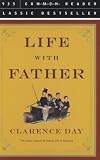
Life with Father
by Clarence Day
On This Page
Description
Life with Father is a humorous autobiographical book of stories compiled in 1935 by Clarence Day, Jr., which was adapted by Lindsay and Crouse in 1939 into the longest running non-musical Broadway play in history, which was, in turn, made into a 1947 movie and a television series..
Tags
Recommendations

















Member Reviews
Having long been a fan of the 1947 movie of the same name, reading this book was long, long overdue for me. While reading along I couldn’t help but imagine the cherished William Powell and Irene Dunne having at each other. It does make me wonder how the story would have struck me without the pretext of the movie to look back on with such strong visuals.
The Clarence Sr. of the movie is tempestuous and cantankerous of nature but fundamentally one is left with a positive impression. The viewer never really doubts that he is a good man at heart but one cannot avoid the conclusion that he would be a royal pain to live with. Perhaps in part this is Powell shining through in the role but no matter how many times Father storms about the house show more at the end of it all you do still rather like him.
Father of the book is just as blustery and just as much of a tempest in a teacup but it costs one quite a bit more effort to like him. The author himself (Clarence Jr) goes to small and periodic effort to endear the reader to his father but the attempts ring rather hollow like a man whose protagonist is watching over his shoulder as he writes. There seems just an edge of boyhood resentment that is very carefully scraped off in the movie’s portrayal of Father.
It is also of note that while the cinematic version is relatively connected and sequential the book takes no such formalities. It seems to jump rather randomly from episode to episode and one is left asking periodically in what decade the particular tidbit is taking place. As such it makes for a very light read but one that requires the reader to throw away any notion of cause and effect.
The thread that I came away with most solidly from this bit of literature was less about the book and more about the movie which came after. Powell’s Clarence is eerily like the Clarence of the text almost as if the role was made for him specifically. The romantic and nostalgic side of me wants to believe that this is because movies in the 40s were a craft and that viewers would notice and object strongly if their beloved characters of fiction are tinkered with even in the slightest. The fact that the plot itself, if you call a disconnected episodic assortment of remembrances a plot, was only remotely similar seems of little import. In these not-entirely-to-be-believed halcyon days of yore it was character that was important to the viewing public. Today all we want is more and bloodier gun battles between larger and more foul-mouthed devotees of thuggery.
If I allow myself to wax realistic for a moment I admit that doubtless my palate has been so repeatedly whitewashed by the movie version of Clarence that I’m not longer intellectually capable of seeing a Clarence Day Sr without seeing William Powell. Psychology of repetition and ordinality aside, Day’s 1920 novel is high on my recommended reading list. show less
The Clarence Sr. of the movie is tempestuous and cantankerous of nature but fundamentally one is left with a positive impression. The viewer never really doubts that he is a good man at heart but one cannot avoid the conclusion that he would be a royal pain to live with. Perhaps in part this is Powell shining through in the role but no matter how many times Father storms about the house show more at the end of it all you do still rather like him.
Father of the book is just as blustery and just as much of a tempest in a teacup but it costs one quite a bit more effort to like him. The author himself (Clarence Jr) goes to small and periodic effort to endear the reader to his father but the attempts ring rather hollow like a man whose protagonist is watching over his shoulder as he writes. There seems just an edge of boyhood resentment that is very carefully scraped off in the movie’s portrayal of Father.
It is also of note that while the cinematic version is relatively connected and sequential the book takes no such formalities. It seems to jump rather randomly from episode to episode and one is left asking periodically in what decade the particular tidbit is taking place. As such it makes for a very light read but one that requires the reader to throw away any notion of cause and effect.
The thread that I came away with most solidly from this bit of literature was less about the book and more about the movie which came after. Powell’s Clarence is eerily like the Clarence of the text almost as if the role was made for him specifically. The romantic and nostalgic side of me wants to believe that this is because movies in the 40s were a craft and that viewers would notice and object strongly if their beloved characters of fiction are tinkered with even in the slightest. The fact that the plot itself, if you call a disconnected episodic assortment of remembrances a plot, was only remotely similar seems of little import. In these not-entirely-to-be-believed halcyon days of yore it was character that was important to the viewing public. Today all we want is more and bloodier gun battles between larger and more foul-mouthed devotees of thuggery.
If I allow myself to wax realistic for a moment I admit that doubtless my palate has been so repeatedly whitewashed by the movie version of Clarence that I’m not longer intellectually capable of seeing a Clarence Day Sr without seeing William Powell. Psychology of repetition and ordinality aside, Day’s 1920 novel is high on my recommended reading list. show less
Having long been a fan of the 1947 movie of the same name, reading this book was long, long overdue for me. While reading along I couldn’t help but imagine the cherished William Powell and Irene Dunne having at each other. It does make me wonder how the story would have struck me without the pretext of the movie to look back on with such strong visuals.
The Clarence Sr. of the movie is tempestuous and cantankerous of nature but fundamentally one is left with a positive impression. The viewer never really doubts that he is a good man at heart but one cannot avoid the conclusion that he would be a royal pain to live with. Perhaps in part this is Powell shining through in the role but no matter how many times Father storms about the house show more at the end of it all you do still rather like him.
Father of the book is just as blustery and just as much of a tempest in a teacup but it costs one quite a bit more effort to like him. The author himself (Clarence Jr) goes to small and periodic effort to endear the reader to his father but the attempts ring rather hollow like a man whose protagonist is watching over his shoulder as he writes. There seems just an edge of boyhood resentment that is very carefully scraped off in the movie’s portrayal of Father.
It is also of note that while the cinematic version is relatively connected and sequential the book takes no such formalities. It seems to jump rather randomly from episode to episode and one is left asking periodically in what decade the particular tidbit is taking place. As such it makes for a very light read but one that requires the reader to throw away any notion of cause and effect.
The thread that I came away with most solidly from this bit of literature was less about the book and more about the movie which came after. Powell’s Clarence is eerily like the Clarence of the text almost as if the role was made for him specifically. The romantic and nostalgic side of me wants to believe that this is because movies in the 40s were a craft and that viewers would notice and object strongly if their beloved characters of fiction are tinkered with even in the slightest. The fact that the plot itself, if you call a disconnected episodic assortment of remembrances a plot, was only remotely similar seems of little import. In these not-entirely-to-be-believed halcyon days of yore it was character that was important to the viewing public. Today all we want is more and bloodier gun battles between larger and more foul-mouthed devotees of thuggery.
If I allow myself to wax realistic for a moment I admit that doubtless my palate has been so repeatedly whitewashed by the movie version of Clarence that I’m not longer intellectually capable of seeing a Clarence Day Sr without seeing William Powell. Psychology of repetition and ordinality aside, Day’s 1920 novel is high on my recommended reading list. show less
The Clarence Sr. of the movie is tempestuous and cantankerous of nature but fundamentally one is left with a positive impression. The viewer never really doubts that he is a good man at heart but one cannot avoid the conclusion that he would be a royal pain to live with. Perhaps in part this is Powell shining through in the role but no matter how many times Father storms about the house show more at the end of it all you do still rather like him.
Father of the book is just as blustery and just as much of a tempest in a teacup but it costs one quite a bit more effort to like him. The author himself (Clarence Jr) goes to small and periodic effort to endear the reader to his father but the attempts ring rather hollow like a man whose protagonist is watching over his shoulder as he writes. There seems just an edge of boyhood resentment that is very carefully scraped off in the movie’s portrayal of Father.
It is also of note that while the cinematic version is relatively connected and sequential the book takes no such formalities. It seems to jump rather randomly from episode to episode and one is left asking periodically in what decade the particular tidbit is taking place. As such it makes for a very light read but one that requires the reader to throw away any notion of cause and effect.
The thread that I came away with most solidly from this bit of literature was less about the book and more about the movie which came after. Powell’s Clarence is eerily like the Clarence of the text almost as if the role was made for him specifically. The romantic and nostalgic side of me wants to believe that this is because movies in the 40s were a craft and that viewers would notice and object strongly if their beloved characters of fiction are tinkered with even in the slightest. The fact that the plot itself, if you call a disconnected episodic assortment of remembrances a plot, was only remotely similar seems of little import. In these not-entirely-to-be-believed halcyon days of yore it was character that was important to the viewing public. Today all we want is more and bloodier gun battles between larger and more foul-mouthed devotees of thuggery.
If I allow myself to wax realistic for a moment I admit that doubtless my palate has been so repeatedly whitewashed by the movie version of Clarence that I’m not longer intellectually capable of seeing a Clarence Day Sr without seeing William Powell. Psychology of repetition and ordinality aside, Day’s 1920 novel is high on my recommended reading list. show less
Humour, no matter how understated, often has a tendency to age poorly. Life with Father is a good case in point, in that the stubborn but lovable central character no longer seems quite so lovable 75 years later, and the humorous anecdotes now seem more like living under the tyrannical decrees of a spoiled and petulant man-child.
There were still flashes of humour and it remains an (albeit exaggerated) window into a bygone age, no doubt, but even the normally sublime and sedated New Yorker style can not stop the march of time and changing mores.
There were still flashes of humour and it remains an (albeit exaggerated) window into a bygone age, no doubt, but even the normally sublime and sedated New Yorker style can not stop the march of time and changing mores.
This memoir of the author’s father is supposedly famous for its gentle humor, but I didn’t find anything at all funny about the bigoted, sexist, selfish ass.
Clarence Day’s memoirs are some of my favorite books. A loving if tumultuous family dynamic and hilarious stories of their clashes.
Clarence Day's Life with Mother and Life with Father are sets of charming stories, detailing some elements of Day's life with his unique parents. The descriptions of the people who appear through the tales are vivid and engaging and the stories flowed well, making them easy to read. I was pleasantly surprised to find myself avidly wishing for more once I finished both of the volumes.
(This review refers to an edition including both 'Life with Father' and 'Life with Mother'.)
(This review refers to an edition including both 'Life with Father' and 'Life with Mother'.)
Something about the tone didn't click with me. . . I have a feeling it could be funnier if it did. All in all, I liked the characters but always felt like I was missing an "in" joke.
One thing that did get through to me: his dad certainly had two favorite expletives. PG rating, probably.
One thing that did get through to me: his dad certainly had two favorite expletives. PG rating, probably.
Members
- Recently Added By
Lists

Best Books of 1926-1935
403 works; 10 members

Books Read in 2009
464 works; 11 members

1930s
262 works; 5 members

EGBERTINA'S List of childhood books worthy of merit or unspeakable delight
155 works; 6 members

Publisher's Weekly NON-Fiction list - 1912 - 1975
486 works; 4 members
Author Information

24+ Works 1,312 Members
All Editions
Awards and Honors
Distinctions
Notable Lists
Series
Belongs to Publisher Series
Work Relationships
Is contained in
Has the adaptation
Is abridged in
Common Knowledge
- Canonical title
- Life with Father
- Original publication date
- 1935
- Related movies
- Life with Father (1947 | IMDb); Life with Father (1953 | IMDb)
- First words
- Once in a long while, as a great treat, Father took me down to his office.
- Last words
- (Click to show. Warning: May contain spoilers.)Mother looked at him, startled but admiring, and whispered to me, "I almost believe he could do it."
Classifications
Statistics
- Members
- 811
- Popularity
- 34,113
- Reviews
- 12
- Rating
- (3.60)
- Languages
- English, German, Italian, Norwegian (Bokmål)
- Media
- Paper, Ebook
- ISBNs
- 16
- ASINs
- 34