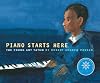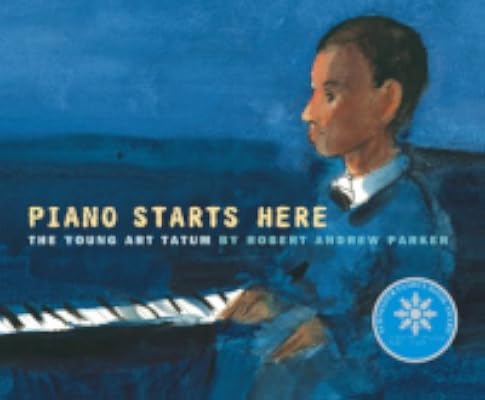
Piano Starts Here: The Young Art Tatum
by Robert Andrew Parker
On This Page
Description
The story of the young Art Tatum, who became one of the all-time greats of jazz piano.Tags
Recommendations



Member Reviews
This story takes the reader on a beautiful journey of pianist Art Tatum’s life through his childhood in Toledo, to success in local bars and restaurants, and eventually into his professional career. I love how Art Tatum’s disability is portrayed as not as a defining factor that held him back, but rather an embraced quality that helped him remember that he has everything he needs. The first person narration of the book really allows the reader to identify with Art Tatum’s journey. This book is great for young students to see that disabilities don’t have to get in the way of reaching goals and pursing dreams.
Regardless of whether they’ve heard of jazz or Art Tatum, young readers will appreciate how Parker uses simple, lyrical storytelling to show the world as young Art Tatum might have seen it. Tatum came from modest beginnings and was nearly blind, but his passion for the piano and his acute memory for any sound that he heard drove him to become a virtuoso who was revered by both classical and jazz pianists alike.
This book discusses Art Tatum's issues with sight and how this never interfered with him achieving his dream of playing the piano. It would be very important in the classroom because it helps to demonstrate the fact that even if you have a disability, it does not need to get in the way of your goals and dreams, especially if you have people that love you and support you. I think that this book has a powerful message and is also informative without coming across as being dry.
The early years of jazz pianist Art Tatum are explored in this lovely picturebook informational literature by Robert Andrew Parker, a self-professed fan of Tatum. Growing up in Toledo in the early 1900s, Tatum's eyesight, which was poor at birth, got progressively worse, despite multiple surgeries. But in spite of this, young Tatum learns to play the piano at an early age and plays for large audiences often, such as his church and at school assemblies. Eventually he starts playing in bars, even though he is too young to be a patron, and his music is recorded and played on the radio. This results in him being asked to play all over the country, becoming a famous jazz legend. Since this book's focus is on his early years, the launch of show more Tatum's career is essentially where the story ends, though there is a wonderful note from the author at the end about his personal connection to Art Tatum as well as some additional information abut Tatum, and credit given to Parker's sources. This book is written in a first-person narrative, so you feel as though the young Art Tatum had in fact been sharing these nuggets of his childhood with you, the reader. show less
This Caldecott Honor Winner picture book is an autobiographical account of jazz legend Art Tatum. The author, also a jazz musician, both wrote and narrated the book. The book takes us from Tatum's childhood in Toledo to success in the local cafes, bars and radio stations to international stardom. As big as Tatum was in his day and as much has his music has persevered through the years, he always seems to me to be one of the lesser known jazz giants. With that said, people often don't know that he was born with terribly limited vision which only worsened throughout his life. The book tells us how Tatum never let this bring him down at any time in his life. If anything, he sharpened his other senses around this, especially his auditory. show more Tatum was known to be able to masterfully play basically anything that he heard. Everything I've ever read about Tatum, including this picture book, always tells of what a kind, generous, great human being that he was, and his friends and family always supported him in everything that he did. For me, this book tells more than just the story of Tatum's life. It speaks on qualities like humility (even with giant success), perseverance, and achieving your dreams no matter what. I think that it would also be a good way to introduce autobiographies to students. The illustrations are as great as the text. All of the pictures are a style that I really like, where watercolor is used as a sort of base for figures and then ink is used to outline and fill in the images to provide detail. It's exactly what I love about jazz-fuzzy, at times blurry improvisation accompanied by more finite structure, creating that beautiful offset balance. show less
So many of the biographies of jazz musicians take on such a far-fetched artistic approach that they lose some of their gravity. This book didn't fall prey to that classic mistake. It was a biography in the truest sense. I enjoyed this. I know that I have no business speaking on the members of the jazz community, but I felt comfortable reading this anyway. The first person point of view was an interesting choice that gave the text a subtle humanized quality. Rather than reading about this musician as though he were someone in a portrait on a wall, he was approachable and identifiable. When the author chose to reference other jazz greats as acquaintances of Art Tatum, I read without knowing who I was reading about, but I didn't feel as show more though I lost a sense of what the story was expressing. This is a great addition to any children's biography collection. The watercolor paint illustrations were distorted and difficult to make out, but I suppose it went with the overall jazzy tone of the story. Though I'm not a big fan of that particular style, there is a fan base for it since Robert Andrew Parker is a Caldecott Honor Winning illustrator. The text was really the strength, with strong word choice and evident research throughout. show less
This is a high quality book and a winner of the “Schneider family book award” which is given to books which find a way, through picture or text to beautifully embody disability. I would use this in grades 1-3. It could be used in a black history unit, a lesson on the Harlem Renaissance, a jazz or music setting. This book could be used in a language lesson on alliteration, or even adapted into a reader’s theatre. It follows a very arty scheme or almost poetry-like language. The illustrations in this book are so abstract and vivid it could even be used as a model in an art class setting.
Members
- Recently Added By
Lists

Jazz Picture Books
36 works; 2 members
Author Information
5+ Works 192 Members
Awards and Honors
Awards
Distinctions
Common Knowledge
- People/Characters
- Art Tatum
Classifications
Statistics
- Members
- 178
- Popularity
- 184,077
- Reviews
- 20
- Rating
- (4.07)
- Languages
- English
- Media
- Paper, Ebook
- ISBNs
- 7
- ASINs
- 2