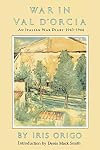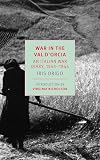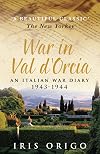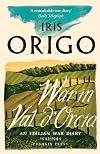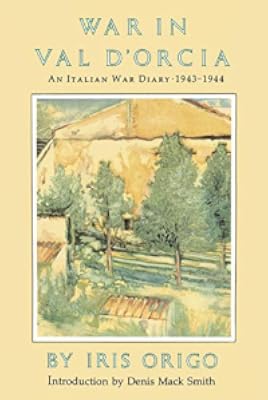
War in Val d'Orcia
by Iris Origo
On This Page
Description
"At the height of the Second World War, Italy was being torn apart by German armies, civil war, and the eventual Allied invasion. In a corner of Tuscany, one woman--born in England, married to an Italian--kept a record of daily life in a country at war. Iris Origo's compellingly powerful diary, War in Val d'Orcia, is the spare and vivid account of what happened when a peaceful farming valley became a battleground. At great personal risk, the Origos gave food and shelter to partisans, show more deserters, and refugees. They took in evacuees, and as the front drew closer they faced the knowledge that the lives of thirty-two small children depended on them. Origo writes with sensitivity and generosity, and a story emerges of human acts of heroism and compassion, and the devastation that war can bring"-- show lessTags
Recommendations
















Member Reviews
Anglo-American Origo, married to an Italian Marchese and living in his country house near a village in Tuscany details in this diary the period January 1943 to June 1944. It's a period of privation during which the couple seek to support their community, whether penniless peasants, partisans, or soldiers on the run. They take in orphans, the homeless, the destitute: and Iris Origo keeps a daily diary of what's going on. The horrifying immediacy builds up as the book goes on, and made me grateful that here in Britain we were protected from the horrors of day-to-day life for many in mainland Europe. Variously subjugated by the Fascists of their own country, and by the Germans, they had little control over their own lives and could only show more await, with increasing desperation, the arrival of the Allies. An eye-opening and involving account. show less
Iris Origo was an Anglo-American woman who married an Italian landowner. In 1943 to 1944 she found herself and her family caught up in the crumbling Italian Fascist state as Mussolini's army was swept away by allied forces which led to Italy seeking an armistice with the Allies. This led to a civil war with Fascists and partisans fighting for control of the country. Mussolini was deposed which led the Germany military to occupy the portion of Italy the allies had not as yet taken.
As the war raged, all essentials such as food, clothing, medicine and heating fuel were in short supply and if you had some you had to hide it from the foraging German troops. Origo was constantly searching for food and clothing for Italian refugees, escaped show more Allied prisoners of war, down fliers and partisans groups who fought an underground war against the Germans and remaining Fascists.
The diary while written by a woman of privilege is a vivid picture of life in war torn Italy as experienced by the people who only wished to look after their crops and animals. show less
As the war raged, all essentials such as food, clothing, medicine and heating fuel were in short supply and if you had some you had to hide it from the foraging German troops. Origo was constantly searching for food and clothing for Italian refugees, escaped show more Allied prisoners of war, down fliers and partisans groups who fought an underground war against the Germans and remaining Fascists.
The diary while written by a woman of privilege is a vivid picture of life in war torn Italy as experienced by the people who only wished to look after their crops and animals. show less
I read this book years ago, but then re-read it after reading that it inspired Chris Bojhalian to write The Light in the Ruins in 2013. The wartime diary of Iris Origo, The English wife of the Marchese Origo who took care of sixties orphans and,with her husband, kept their estate running through the tumult of the Second World War, is a riveting read - even the second time around.
It was a weird experience to read this diary of Tuscany in wartime. It helped me understand the confusing predicament of Italy after the events of 1943, which brought the land under German rules and allied bombing.
might be useful to understand what the Ukrainians are going through now in 2023
great book. near montepulsiano
Een prachtig tijdsdocument dat begint op 30 januari 1943 en loopt tot 5 juli 1944. Iris Origo en haar man Antonio mogen gelden als een voorbeeld van menselijkheid die met hun persoonlijke moed talloze mensen hielpen doorheen een vreselijke tijd, zowel kinderen, wezen, partisanen, deserteurs, kortom iedereen die nood had aan hulp. Haar Italiaans oorlogsdagboek begint in een sfeer van "In the towns, in the country , the keynote is apathy. And everywhere, talk, talk, talk, and no action. Resentment without a sense of responsibility. The fruits of twenty years of Fascism. And on the part of those elder citizens who remember a different Italy, a profound sadness and sense of shame." (p. 35-36) Gaandeweg wordt de sfeer en de oorlogssituatie show more grimmiger. "And even among those who survive, what barriers of constraint and unfamiliarity will have arisen in these years - not only of physical separation, but of experience unshared, of differing feelings and opinions? What ties will survive that strain?" (p. 172-173) Om te eindigen met hoop. "Nevertheless, for the future I am hopeful. The whirlwind has passed, and now, whatever destruction it may have left, we can begin to build again. And it is here that the deepest qualities of the Italian people wil have a chance to show themselves. To speak of the patience and endurance, the industry and resourcefulness of the Italian workman has become almost a commonplace." (p. 290-291) show less
May 13, 2019Dutch
1
Members
- Recently Added By
Lists

Books Set in Italy
167 works; 19 members

Mustich's 1000 Books to Read Before You Die: A Life Changing List
1,001 works; 20 members
Author Information

14+ Works 1,598 Members
She was a well-known biographer. Born in the United States, her mother brought her to live in Italy after her father's death. She married a Marchese & became mistress of an Italian villa, where she helped peasant children during WWII. She is also the author of The Last Attachment, Leopardi: A Study in Solitude & War in Val d'Orcia. (Bowker Author show more Biography) show less
Some Editions
Awards and Honors
Series
Belongs to Publisher Series
Common Knowledge
- Canonical title
- War in Val d'Orcia
- Original publication date
- 1947
- People/Characters
- Iris Origo, Marchesa of Val d'Orcia
- Important places
- Villa La Foce, Tuscany, Italy; Chianciano Terme, Tuscany, Italy; Tuscany, Italy; Montalcino, Tuscany, Italy
- Important events
- World War II
- Dedication
- To
ANTONIO
who shared it all - First words
- 1943
January 30th
The first refugee children have arrived. - Last words
- (Click to show. Warning: May contain spoilers.)Destruction and death have visited us, but now -- there is hope in the air.
- Blurbers
- Linklater, Eric; Wolff, Helen
Classifications
Statistics
- Members
- 417
- Popularity
- 74,399
- Reviews
- 7
- Rating
- (4.38)
- Languages
- 6 — Dutch, English, German, Italian, Russian, Spanish
- Media
- Paper, Audiobook, Ebook
- ISBNs
- 22
- ASINs
- 12