
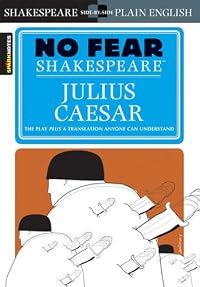
Julius Caesar (New Folger Shakespeare Library)
by William Shakespeare, Barbara A. Mowat (Editor), Paul Werstine (Editor)
On This Page
Description
Presents the annotated text of Shakespeare's tragedy in which Cassius, fearing Julius Caesar's ambition, forms a conspiracy among Roman republicans, including Caesar's trusted friend Brutus, to assassinate him on the Ides of March; and includes scene-by-scene plot summaries, and other reference material.Tags
Recommendations













Member Reviews
This Roman play by Shakespeare is based on Plutarch's [b:Lives of the noble Grecians and Romans|279456|Lives, Vol 2|Plutarch|http://d.gr-assets.com/books/1320436991s/279456.jpg|17046298] (Caesar and Marcus Brutus). One might call it an adapted stage play, since the majority of the plot and dialogues in the play have been incorporated directly from Plutarch. But I noticed a significant difference when comparing the two renditions: Shakespeare failed to capture the complexity, magnificence, and more importantly, the political philosophy and moral mentality of the noble Romans.
Caesar, the title character, is killed midway through the play, and we know next to nothing about him. The words that Shakespeare put into his mouth (apart from show more those recorded by Plutarch) can be said by any self-conceited individual, and do not capture the uniqueness of the Dictator of Rome, his personal charisma, magnanimity, industry, calculation and ambition, as attested by Plutarch and Cicero.
Brutus, a man of moral integrity and Stoic virtue, and respected by all, was accused as a traitor by Mark Antony, in the famous speech "I come to bury Caesar, not to praise him" and the climax of the entire play. This same Antony, according to Cicero and Plutarch, was "the Helen of Troy", unrestrained in lust and passion but deficient in moral character, and brought destruction upon the Roman Republic, but he came away a manipulative demagogue, nay, a popular hero, in Shakespeare's play.
It is worth noting that Brutus was condemned as a traitor by Dante as well, and assigned to the lowest circle of the Inferno, gorged by Satan for eternity. However, Dante was not quite consistent in his judgment, since he brought Caesar and Cicero together in Limbo as virtuous pagans, perhaps not realizing that there was bitter enmity of ideals between the two, and the latter "rejoiced at the slaughter" of the former.
From the perspective of the Roman Republic, the assassination of Caesar was not an act of betrayal or murder, but a continuation of the Civil War between the declining Republic and the emerging Empire, a struggle between freedom and tyranny. Brutus fought with the Republic forces led by Pompey against Caesar, and after Pompey's defeat and death, he was pardoned by Caesar. On the one hand, he was indebted to Caesar for sparing his life, on the other hand, he was robbed by Caesar of his freedom as a citizen of the Republic, i.e., he was enslaved by Caesar along with the rest of the Romans. Therefore, the assassination was not a preemptive strike against Caesar's ambition, as Shakespeare depicted it, but a struggle/rebellion against a de facto tyrant. To give a modern parallel, who would not have rejoiced if Hitler had been assassinated?
The nuances of moral and political thought in ancient Rome are lost in Shakespeare's play. As if to compensate for the lack of depth in thought, he expands a great deal on the relationship between Brutus and Cassius, who was mentioned by Plutarch only in passing. Their relationship occupies the center stage throughout, akin to that between Bassanio and Antonio in [b:The Merchant of Venice|24128|The Merchant of Venice|William Shakespeare|http://d.gr-assets.com/books/1327871054s/24128.jpg|2682703]--it's not mere coincidence that Brutus' wife and Bassanio's fiance share the same name. Shakespeare almost seems to insinuate that Cassius instigated the assassination of Caesar, not because of his hatred of the tyrant and desire for freedom, but because of his jealousy of Brutus' love for Caesar, the same reason Harmodius and Aristogeiton assassinated the tyrant Hipparchus in ancient Greece, according to some accounts.
P.S.
I met Brutus three years ago, and still vividly remember the encounter. I was crossing the street, when a lady behind me called out, "Brutus!" I looked around, and saw a black retriever run past me, with a red shopping bag dangling from his jaw. I stared at him in amusement, wondering what had become of the Roman hero/assassin. In hindsight, Antony would have been a more fitting name for the lady's personal shopping assistant. show less
Caesar, the title character, is killed midway through the play, and we know next to nothing about him. The words that Shakespeare put into his mouth (apart from show more those recorded by Plutarch) can be said by any self-conceited individual, and do not capture the uniqueness of the Dictator of Rome, his personal charisma, magnanimity, industry, calculation and ambition, as attested by Plutarch and Cicero.
Brutus, a man of moral integrity and Stoic virtue, and respected by all, was accused as a traitor by Mark Antony, in the famous speech "I come to bury Caesar, not to praise him" and the climax of the entire play. This same Antony, according to Cicero and Plutarch, was "the Helen of Troy", unrestrained in lust and passion but deficient in moral character, and brought destruction upon the Roman Republic, but he came away a manipulative demagogue, nay, a popular hero, in Shakespeare's play.
It is worth noting that Brutus was condemned as a traitor by Dante as well, and assigned to the lowest circle of the Inferno, gorged by Satan for eternity. However, Dante was not quite consistent in his judgment, since he brought Caesar and Cicero together in Limbo as virtuous pagans, perhaps not realizing that there was bitter enmity of ideals between the two, and the latter "rejoiced at the slaughter" of the former.
From the perspective of the Roman Republic, the assassination of Caesar was not an act of betrayal or murder, but a continuation of the Civil War between the declining Republic and the emerging Empire, a struggle between freedom and tyranny. Brutus fought with the Republic forces led by Pompey against Caesar, and after Pompey's defeat and death, he was pardoned by Caesar. On the one hand, he was indebted to Caesar for sparing his life, on the other hand, he was robbed by Caesar of his freedom as a citizen of the Republic, i.e., he was enslaved by Caesar along with the rest of the Romans. Therefore, the assassination was not a preemptive strike against Caesar's ambition, as Shakespeare depicted it, but a struggle/rebellion against a de facto tyrant. To give a modern parallel, who would not have rejoiced if Hitler had been assassinated?
The nuances of moral and political thought in ancient Rome are lost in Shakespeare's play. As if to compensate for the lack of depth in thought, he expands a great deal on the relationship between Brutus and Cassius, who was mentioned by Plutarch only in passing. Their relationship occupies the center stage throughout, akin to that between Bassanio and Antonio in [b:The Merchant of Venice|24128|The Merchant of Venice|William Shakespeare|http://d.gr-assets.com/books/1327871054s/24128.jpg|2682703]--it's not mere coincidence that Brutus' wife and Bassanio's fiance share the same name. Shakespeare almost seems to insinuate that Cassius instigated the assassination of Caesar, not because of his hatred of the tyrant and desire for freedom, but because of his jealousy of Brutus' love for Caesar, the same reason Harmodius and Aristogeiton assassinated the tyrant Hipparchus in ancient Greece, according to some accounts.
P.S.
I met Brutus three years ago, and still vividly remember the encounter. I was crossing the street, when a lady behind me called out, "Brutus!" I looked around, and saw a black retriever run past me, with a red shopping bag dangling from his jaw. I stared at him in amusement, wondering what had become of the Roman hero/assassin. In hindsight, Antony would have been a more fitting name for the lady's personal shopping assistant. show less
Not my favorite Shakespeare play, but mainly because this is one where the Bard was more concerned with moving the pieces around than creating those great Shakespearean moments of pathos. His audience-goers would have all been familiar with the details of Caesar's death, along with its central irony: that Octavius Caesar becomes the dictator that Brutus and Cassius were trying to stop by murdering Julius.
Contemporary audiences don't necessarily know this context, and I would have liked to see more character development: at the end of the play, I didn't have a good handle on the personalities of the conspirators.
After another reading, I agree with some commentators that what is key is the skill of the Roman orators and their attempts to show more convince each other (and themselves) of the justice of their cause. Especially interesting is the use of (and lapses in) iambic pentameter. show less
Contemporary audiences don't necessarily know this context, and I would have liked to see more character development: at the end of the play, I didn't have a good handle on the personalities of the conspirators.
After another reading, I agree with some commentators that what is key is the skill of the Roman orators and their attempts to show more convince each other (and themselves) of the justice of their cause. Especially interesting is the use of (and lapses in) iambic pentameter. show less
“The fault, dear Brutus, is not in our stars, but in ourselves.”
Wow. Being a history major and just all around history nerd I know a lot of Julius Caesar and what caused everyone and their mother to turn against him which led to his assassination by some accounts believe is at least 60 men. I always read that in history books and wondered at the men who decided to go forth with this and how did the conspirators think things would go for them afterwards. Shakespeare takes this event and writes this play showcasing many of the names most of us are familiar with from history class, we have Julius Caesar, Octavius Caesar (who would become Emperor Augustus, the first Roman Emperor), Marc Antony, and dumb Brutus.
The setup of the play is show more really those around Brutus trying their best to turn him against Caesar who up until that moment hadn't done one thing (in the play mind you) to have everyone turn against him and have so many people out for his blood. Reading how Brutus slowly but surely gets turned against Caesar was sad. Especially because part of me believes that he didn't really believe in what he was doing, but was doing it because everyone else was down for it.
In the end Caesar is assassinated, and throws a really girl line of shade at Brutus and then things fall apart. Which if I had been part of this little group I would have pointed out, of course this was going to end badly for all of you.
I love the dialogue in this play. The best part of the play is the speech that Brutus gives trying to explain why he and others did what he did and Marc Antony's response to it.
"Be patient till the last.
Romans, countrymen, and lovers! hear me for my
cause, and be silent, that you may hear: believe me
for mine honour, and have respect to mine honour, that
you may believe: censure me in your wisdom, and
awake your senses, that you may the better judge.
If there be any in this assembly, any dear friend of
Caesar's, to him I say, that Brutus' love to Caesar
was no less than his. If then that friend demand
why Brutus rose against Caesar, this is my answer:
--Not that I loved Caesar less, but that I loved
Rome more. Had you rather Caesar were living and
die all slaves, than that Caesar were dead, to live
all free men? As Caesar loved me, I weep for him;
as he was fortunate, I rejoice at it; as he was
valiant, I honour him: but, as he was ambitious, I
slew him. There is tears for his love; joy for his
fortune; honour for his valour; and death for his
ambition. Who is here so base that would be a
bondman? If any, speak; for him have I offended.
Who is here so rude that would not be a Roman? If
any, speak; for him have I offended. Who is here so
vile that will not love his country? If any, speak;
for him have I offended. I pause for a reply.
Marc Antony's speech:
“Friends, Romans, countrymen, lend me your ears;
I come to bury Caesar, not to praise him;
The evil that men do lives after them,
The good is oft interred with their bones,
So let it be with Caesar ... The noble Brutus
Hath told you Caesar was ambitious:
If it were so, it was a grievous fault,
And grievously hath Caesar answered it ...
Here, under leave of Brutus and the rest,
(For Brutus is an honourable man;
So are they all; all honourable men)
Come I to speak in Caesar's funeral ...
He was my friend, faithful and just to me:
But Brutus says he was ambitious;
And Brutus is an honourable man….
He hath brought many captives home to Rome,
Whose ransoms did the general coffers fill:
Did this in Caesar seem ambitious?
When that the poor have cried, Caesar hath wept:
Ambition should be made of sterner stuff:
Yet Brutus says he was ambitious;
And Brutus is an honourable man.
You all did see that on the Lupercal
I thrice presented him a kingly crown,
Which he did thrice refuse: was this ambition?
Yet Brutus says he was ambitious;
And, sure, he is an honourable man.
I speak not to disprove what Brutus spoke,
But here I am to speak what I do know.
You all did love him once, not without cause:
What cause withholds you then to mourn for him?
O judgement! thou art fled to brutish beasts,
And men have lost their reason…. Bear with me;
My heart is in the coffin there with Caesar,
And I must pause till it come back to me.”
Yeah Brutus, you done messed up. Antony's little speech was enough to get people to say hmmm.
The flow of the play is very good. And as I have said for all of Shakepeare's plays, the setting of his plays does not really come into play so to speak while you are reading the play. For most of these plays I would say watching them on stage or in a movie would be the best part in order to see how people are dressed, carry themselves, interact with each other and their surroundings.
The play comes to an end with the ghost of Caesar haunting Brutus with Brutus and Cassius deciding they will challenge Marc Antony and Octavius Casear in battle. Of course they lose to Marc Antony and in the end Brutus is the only one left that is praised by them for doing what he did for Rome and not because he was jealous of Caesar like the others were. show less
William Shakespeare obviously had a fondness for Classical history and literature. Here's a[n] (incomplete?) list of antiquity-themed works he wrote:
-Antony and Cleopatra
-Coriolanus
-The Phoenix and Turtle
-Julius Caesar
-Pericles
-Cymbeline
-Timon of Athens
-Troilus and Cressida
-Venus and Adonis
-The Rape of Lucrece
-Titus Andronicus
-Midsummer Night's Dream
But the Bard left school at age fourteen, so how'd he learn so much history of antiquity? Was British schooling in the 1570's that good, or is this another triumph of homeschooling? ;) Haha! It seems likely Shakespeare was an autodidact, but what references did he have at his disposal? The introduction to the Penguin edition of Plutarch's The Fall of the Roman Republic: Six Lives claims show more Shakespeare was profoundly influenced by that book. I can believe it. It's very engaging, and covers the rise and fall of Julius Caesar extensively. It's a great reference for the place-and-date historical details of who killed Caesar, when, where, and how. But of course any historical record going that far back will have its limits; there are a lot of details about Caesar's fall that will never be known: what did Caesar and his wife talk about at breakfast the morning of his assassination? What reservations did Brutus have about the success of the assassination plot? What was going through Cassius' head as he fled Octavius and Marc Antony? There's no written record to tell us, but Shakespeare fills these moments with inspired dialogue, nonetheless. He makes Julius Caesar an enjoyable drama, without taking excessive factual liberties. Only a talented writer with a genuine love for the subject could do this- and thank God he did, because the end product is not a flat schedule of historical events, it's a gripping drama of human foibles.
Consider Caesar: at once a megalomaniacal dictator but also very human. He was an accomplished general, but prior to the Roman civil war, his reputation couldn't touch Pompey's. Pompey was the popular favorite to come out on top when the First Triumvirate fell apart. Only through a combination of bold tactics and luck did Caesar prevail. Fortune favors the bold. Imagine what that victory did for Caesar's ego... no wonder he started to believe hype that he was a god! Coasting forward on such success, he tried to replay his audacious strategy in the political arena: he arranged for the weak and corrupt Roman Senate to declare him dictator for life.
On one hand, Shakespeare delivers a convincing sense of Caesar's hubris; showing him ignore the soothsayer's warnings to "Beware the Ides of March", and dismissing his wife Calphurnia's foreboding dream. On the other hand, Caesar is human, and subject to insecurities. He ought to be, considering his steady decline in popularity, once he started to implement his domestic agenda. Playing on these insecurities, Calphurnia manages to convince JC to stay at home, until the day of his prophecized doom passes. It is only Decius' malevolent intervention that turns JC back around, and gets him out of the house. Big mistake. Caesar is powerful and cunning, but not perfect. He's not a great a judge of character, and he's easily manipulated by appeals to his vanity. Like I said: he's human.
Now let's examine the lead conspirator, Brutus: He comes across every bit as three-dimensional as Caesar. Why does he want Caesar dead? For one thing, he knows Caesar's nature: cruel, arrogant and ambitious; and he knows dictatorship for life will only exacerbate these. Brutus tells Lucius:
"It must be by his death, and for my part
I know no personal cause to spurn him
But for the general. He would be crowned.
How that might change his nature, there's the question.
It is the bright day that brings forth the adder
And that craves wary walking. Crown him that.
And then I grant we put a sting in him
That at his will he may do danger with."
Star Wars fans will see shades of this dialogue in Mace Windu's words to Anakin, (~3:07) regarding Palpatine. Master Windu is a bit more idealistic than Brutus, though. The real Brutus- Marcus Junius Brutus was not so selfless. He had been a top aide to Pompey. Had Pompey won the Roman civil war, Brutus would probably been groomed as his successor. It's a nice touch on Shakespeare's part that Brutus put the final blade into Caesar, and then let him fall at the base of Pompey's statue. One of Caesar's fatal errors was failing to recognize what a conniver Brutus was. When Caesar is slain, it is Brutus who magnanimously allows Marc Antony to eulogize him. Clearly Brutus' is on the pathway to greater power at this point, as he no doubt intended. If the cold-blooded motive isn't dramtic enough for you, cosider the hot-blooded motive: jealousy. Cascus plants this seed in the first act, telling Brutus:
"Why, man, [Caesar] doth bestride the narrow world
Like a Colossus, and we petty men
Walk under his huge legs and peep about
To find ourselves dishonorable graves.
Men at some time are masters of their fates.
The fault, dear Brutus, is not in our stars
But in ourselves, that we are underlings.
Brutus and Caesar- what should be in the "Caesar"?
Why should that name be sounded more than yours?
Write them together, yours is as fair a name.
Sound them, it doth become the mouth as well.
Weight them, it is as heavy. Conjure with 'em,
"Brutus" will start a spirit as soon as "Caesar".
...So by Act II, there's a whole stew of emotions simmering in Brutus' brain. Who can say which single motive drove him hardest? People are complex, and Shakespeare had that rare gene, or synaptic arrangement, which allowed him to capture that.
On to Marc Antony: also very human, and in a way, a negative image of Brutus. Antony loves Caesar. He's enamored with the larger-than-life military superman, who vanquishes all enemies, foreign and domestic, with his ever-confident blade. A typical Roman, MA believes a strong military man at Rome's helm can only be a good thing for the Republic, naively failing to understand that the Republic is imperiled by the very selfsame arrogance he admires. It's a lot like Republicans who admired the flight suit-clad George W. Bush, thinking he stood as a symbol of a strong America, instead of an internal threat to the nation. When Antony turns the crowd against the conspirators with his speech, it is a fortuitous political move, but was not necessarily intended as such. I think it's really more about revenge. Marc Antony is genuinely angry at Brutus, and maybe pained, as well. It depends on how an actor plays this part, but the line, oft repeated, could be either sarcastic or pleading: "Brutus is a good and honorable man". In his mourning, with his personal hero torn down before his eyes, and with the fate of Great Rome hanging in the balance, Antony could be crying out: "Please! Somebody show me that Brutus is a good and honorable man! Show me that these terrible deeds had a virtuous design, and that Caesar's fall was an inescapable price of Rome's continued glory!" I could buy that interpretation. What a play! Without altering a single word, a skilled actor could play these words either way. See? That's the good stuff, right there. Marlon Brando does a fantastic job with the role in the 1953 film, by the way.
(Confession: my wife and I saw it this weekend, and I'm sure I breezed through the re-read faster because of that.)
Naturally, Shakespeare always liked to season these dramas with a hint of the supernatural. The blind soothsayer does nicely in this capacity. "Beware the Ides of March" It's sort of religion without the religion. It reminds the audience with a sense of humility, that we aren't in complete control of our fates, without pouring on the religious propaganda that surely would have been required, had Shakespeare been writing two or three hundred years earlier. It's an all-purpose religiosity that works well for drama.
Hey, I wrote all this so far, and I'm only half-way through? How can that be? I can remember reading this play for the first time. I figured once Caesar fell, that would be the closing act. What more is there to tell, once the title character has been felled? I wasn't until I read [author:Plutarch|31015], and Gibbon's [book:History of the Decline and Fall of the Roman Empire|377965] that I got a better sense of how much history pivots on the assassination of Julius Caesar. His untimely death gives Octavius (aka Augustus) an opportunity to seize power, to establish legitimacy to rule, and to lead troops in battle (an important box to check, for any would-be Emperor). He and Marc Antony join forces effectively (later to be Yoko Ono-ized apart by Cleopatra), and rapidly eliminate many obstacles Octavius would have had to overcome later, had Caesar lived. These are all part of constructing the foundation for Empire. Had Caesar avoided assassination, he may have become a petty dictator, but who knows? Between corruption and decadence, there's any number of ways he could have been removed from power without being succeeded by Octavius. It's really Octavius who founded the enduring Roman Empire we all know. Shakespeare saw what I didn't: that the story of Julius Caesar loses most of its significance unless it is bridged to Octavius, and in turn the modern world. In this sense, Acts III-V really show off the Bard's broad view of history. On a more minor note, Shakespeare lets some cynicism show about Brutus and politics in general, during the fourth act: Octavius, Marc Antony and Lepidus have formed the Second Triumvirate; their first act is to assemble a list of political enemies to be executed. This is one of the abuses which made Julius Caesar so unpopular. "Meet the new boss, same as the old boss." This play is full of stuff like that. It's one of Shakespeare's best, and an absolute must, if you've got an interest in Roman history. show less
-Antony and Cleopatra
-Coriolanus
-The Phoenix and Turtle
-Julius Caesar
-Pericles
-Cymbeline
-Timon of Athens
-Troilus and Cressida
-Venus and Adonis
-The Rape of Lucrece
-Titus Andronicus
-Midsummer Night's Dream
But the Bard left school at age fourteen, so how'd he learn so much history of antiquity? Was British schooling in the 1570's that good, or is this another triumph of homeschooling? ;) Haha! It seems likely Shakespeare was an autodidact, but what references did he have at his disposal? The introduction to the Penguin edition of Plutarch's The Fall of the Roman Republic: Six Lives claims show more Shakespeare was profoundly influenced by that book. I can believe it. It's very engaging, and covers the rise and fall of Julius Caesar extensively. It's a great reference for the place-and-date historical details of who killed Caesar, when, where, and how. But of course any historical record going that far back will have its limits; there are a lot of details about Caesar's fall that will never be known: what did Caesar and his wife talk about at breakfast the morning of his assassination? What reservations did Brutus have about the success of the assassination plot? What was going through Cassius' head as he fled Octavius and Marc Antony? There's no written record to tell us, but Shakespeare fills these moments with inspired dialogue, nonetheless. He makes Julius Caesar an enjoyable drama, without taking excessive factual liberties. Only a talented writer with a genuine love for the subject could do this- and thank God he did, because the end product is not a flat schedule of historical events, it's a gripping drama of human foibles.
Consider Caesar: at once a megalomaniacal dictator but also very human. He was an accomplished general, but prior to the Roman civil war, his reputation couldn't touch Pompey's. Pompey was the popular favorite to come out on top when the First Triumvirate fell apart. Only through a combination of bold tactics and luck did Caesar prevail. Fortune favors the bold. Imagine what that victory did for Caesar's ego... no wonder he started to believe hype that he was a god! Coasting forward on such success, he tried to replay his audacious strategy in the political arena: he arranged for the weak and corrupt Roman Senate to declare him dictator for life.
Aside: "dictator" in this sense was a specific, heretofore temporary, office. It was intended to streamline executive decision-making in emergencies, by removing need of Senate approval. The whole rise of Palpatine in Star Wars III has strong Caesarian overtones. Usually dictatorship was only granted for 6 month intervals, however, and was never intended to be a lifetime office.
On one hand, Shakespeare delivers a convincing sense of Caesar's hubris; showing him ignore the soothsayer's warnings to "Beware the Ides of March", and dismissing his wife Calphurnia's foreboding dream. On the other hand, Caesar is human, and subject to insecurities. He ought to be, considering his steady decline in popularity, once he started to implement his domestic agenda. Playing on these insecurities, Calphurnia manages to convince JC to stay at home, until the day of his prophecized doom passes. It is only Decius' malevolent intervention that turns JC back around, and gets him out of the house. Big mistake. Caesar is powerful and cunning, but not perfect. He's not a great a judge of character, and he's easily manipulated by appeals to his vanity. Like I said: he's human.
Now let's examine the lead conspirator, Brutus: He comes across every bit as three-dimensional as Caesar. Why does he want Caesar dead? For one thing, he knows Caesar's nature: cruel, arrogant and ambitious; and he knows dictatorship for life will only exacerbate these. Brutus tells Lucius:
"It must be by his death, and for my part
I know no personal cause to spurn him
But for the general. He would be crowned.
How that might change his nature, there's the question.
It is the bright day that brings forth the adder
And that craves wary walking. Crown him that.
And then I grant we put a sting in him
That at his will he may do danger with."
Star Wars fans will see shades of this dialogue in Mace Windu's words to Anakin, (~3:07) regarding Palpatine. Master Windu is a bit more idealistic than Brutus, though. The real Brutus- Marcus Junius Brutus was not so selfless. He had been a top aide to Pompey. Had Pompey won the Roman civil war, Brutus would probably been groomed as his successor. It's a nice touch on Shakespeare's part that Brutus put the final blade into Caesar, and then let him fall at the base of Pompey's statue. One of Caesar's fatal errors was failing to recognize what a conniver Brutus was. When Caesar is slain, it is Brutus who magnanimously allows Marc Antony to eulogize him. Clearly Brutus' is on the pathway to greater power at this point, as he no doubt intended. If the cold-blooded motive isn't dramtic enough for you, cosider the hot-blooded motive: jealousy. Cascus plants this seed in the first act, telling Brutus:
"Why, man, [Caesar] doth bestride the narrow world
Like a Colossus, and we petty men
Walk under his huge legs and peep about
To find ourselves dishonorable graves.
Men at some time are masters of their fates.
The fault, dear Brutus, is not in our stars
But in ourselves, that we are underlings.
Brutus and Caesar- what should be in the "Caesar"?
Why should that name be sounded more than yours?
Write them together, yours is as fair a name.
Sound them, it doth become the mouth as well.
Weight them, it is as heavy. Conjure with 'em,
"Brutus" will start a spirit as soon as "Caesar".
...So by Act II, there's a whole stew of emotions simmering in Brutus' brain. Who can say which single motive drove him hardest? People are complex, and Shakespeare had that rare gene, or synaptic arrangement, which allowed him to capture that.
On to Marc Antony: also very human, and in a way, a negative image of Brutus. Antony loves Caesar. He's enamored with the larger-than-life military superman, who vanquishes all enemies, foreign and domestic, with his ever-confident blade. A typical Roman, MA believes a strong military man at Rome's helm can only be a good thing for the Republic, naively failing to understand that the Republic is imperiled by the very selfsame arrogance he admires. It's a lot like Republicans who admired the flight suit-clad George W. Bush, thinking he stood as a symbol of a strong America, instead of an internal threat to the nation. When Antony turns the crowd against the conspirators with his speech, it is a fortuitous political move, but was not necessarily intended as such. I think it's really more about revenge. Marc Antony is genuinely angry at Brutus, and maybe pained, as well. It depends on how an actor plays this part, but the line, oft repeated, could be either sarcastic or pleading: "Brutus is a good and honorable man". In his mourning, with his personal hero torn down before his eyes, and with the fate of Great Rome hanging in the balance, Antony could be crying out: "Please! Somebody show me that Brutus is a good and honorable man! Show me that these terrible deeds had a virtuous design, and that Caesar's fall was an inescapable price of Rome's continued glory!" I could buy that interpretation. What a play! Without altering a single word, a skilled actor could play these words either way. See? That's the good stuff, right there. Marlon Brando does a fantastic job with the role in the 1953 film, by the way.
(Confession: my wife and I saw it this weekend, and I'm sure I breezed through the re-read faster because of that.)
Naturally, Shakespeare always liked to season these dramas with a hint of the supernatural. The blind soothsayer does nicely in this capacity. "Beware the Ides of March" It's sort of religion without the religion. It reminds the audience with a sense of humility, that we aren't in complete control of our fates, without pouring on the religious propaganda that surely would have been required, had Shakespeare been writing two or three hundred years earlier. It's an all-purpose religiosity that works well for drama.
Hey, I wrote all this so far, and I'm only half-way through? How can that be? I can remember reading this play for the first time. I figured once Caesar fell, that would be the closing act. What more is there to tell, once the title character has been felled? I wasn't until I read [author:Plutarch|31015], and Gibbon's [book:History of the Decline and Fall of the Roman Empire|377965] that I got a better sense of how much history pivots on the assassination of Julius Caesar. His untimely death gives Octavius (aka Augustus) an opportunity to seize power, to establish legitimacy to rule, and to lead troops in battle (an important box to check, for any would-be Emperor). He and Marc Antony join forces effectively (later to be Yoko Ono-ized apart by Cleopatra), and rapidly eliminate many obstacles Octavius would have had to overcome later, had Caesar lived. These are all part of constructing the foundation for Empire. Had Caesar avoided assassination, he may have become a petty dictator, but who knows? Between corruption and decadence, there's any number of ways he could have been removed from power without being succeeded by Octavius. It's really Octavius who founded the enduring Roman Empire we all know. Shakespeare saw what I didn't: that the story of Julius Caesar loses most of its significance unless it is bridged to Octavius, and in turn the modern world. In this sense, Acts III-V really show off the Bard's broad view of history. On a more minor note, Shakespeare lets some cynicism show about Brutus and politics in general, during the fourth act: Octavius, Marc Antony and Lepidus have formed the Second Triumvirate; their first act is to assemble a list of political enemies to be executed. This is one of the abuses which made Julius Caesar so unpopular. "Meet the new boss, same as the old boss." This play is full of stuff like that. It's one of Shakespeare's best, and an absolute must, if you've got an interest in Roman history. show less
'Tis happened upon chance that mine eyes have read the tale of Julius Caesar. For sooth, a great tragedy were 't. Yet happiness was clutch't betwixt mine hands that such wordsmithings are imbued into my corpus of knowledge. Brutus was not a noble understood, know that I now. It has cometh to pass that Royal Antony's quotes sitteth in upon my vernacular at the ready. What pleasure shall I give mine eyes to scan upon next? Be it, I prayeth, one of Sir William's comedies, for these tragedic readings have ravaged vexings upon my soul. Twelfth Night? Much Ado About Nothing? Instruct me, fellow plebeians.
Forgive me that it took me eight months to finish Shakespeare's shortest play. I kept picking it up, reading the first act, and then forgetting.
It's strange reading about Roman history through compound filters: dramatization, Shakespearean England, what we know of the Roman Republic, modern norms. One gets so twisted around that nary an eyebrow is raised in Act 2 when Caesar asks "What is't o'clock?" (Brutus: "Caesar, 'tis strucken eight.
") Such a tangle that it might not jump immediately to mind that there were probably not a whole lot of chiming clocks in the first century BC. We've got Centurions herein acting like they're on Queen Elizabeth's court. Strange.
This play is brief. Brief enough that it doesn't feel like a story so much show more as a string of exchanges. Brutus (who refers to himself in the third person and thus puts me in the mind of Tarzan or other deep-voiced simpleton) seems instantly swayed to subterfuge. Caesar is full of lofty exaltations but kind of amounts to nothing when you think about it. Marc Antony does show a bit of craftiness, and Cassius is devious.
I do like the way Casca responds to Cassius' invitation to dinner and I hope I can use it myself sometime: "Ay, if I be alive, and your mind hold, and your dinner worth the eating."
I do feel like that sometimes. show less
It's strange reading about Roman history through compound filters: dramatization, Shakespearean England, what we know of the Roman Republic, modern norms. One gets so twisted around that nary an eyebrow is raised in Act 2 when Caesar asks "What is't o'clock?" (Brutus: "Caesar, 'tis strucken eight.
") Such a tangle that it might not jump immediately to mind that there were probably not a whole lot of chiming clocks in the first century BC. We've got Centurions herein acting like they're on Queen Elizabeth's court. Strange.
This play is brief. Brief enough that it doesn't feel like a story so much show more as a string of exchanges. Brutus (who refers to himself in the third person and thus puts me in the mind of Tarzan or other deep-voiced simpleton) seems instantly swayed to subterfuge. Caesar is full of lofty exaltations but kind of amounts to nothing when you think about it. Marc Antony does show a bit of craftiness, and Cassius is devious.
I do like the way Casca responds to Cassius' invitation to dinner and I hope I can use it myself sometime: "Ay, if I be alive, and your mind hold, and your dinner worth the eating."
I do feel like that sometimes. show less
Not as good as Hamlet or Macbeth, but it made me laugh and think enough that I would highly recommend it to someone who has enjoyed any of Shakespeare's other works.
Members
- Recently Added By
Lists

1001 Books You Must Read Before You Die
1,448 works; 1,132 members

Historical Fiction
889 works; 91 members

Best Historical Fiction
620 works; 261 members

Read the book and saw the movie
1,170 works; 192 members

Books Featured on Gilmore Girls
307 works; 21 members

once upon a time ~ ancient world
46 works; 7 members
Favourite Books
1,817 works; 310 members

Blue Pyramid 1,276 Best Books of All Time
1,248 works; 32 members

Revolutions
72 works; 5 members

1964 College Preparatory Reading List
202 works; 8 members

1970s
657 works; 23 members

Greatest Books, allegedly
484 works; 9 members

My Favourite Books
86 works; 5 members
Fate vs. Free Will
63 works; 8 members

DELETE
48 works; 2 members

Rory Gilmore Book Club
193 works; 5 members
Books in Riverdale
123 works; 3 members
Out of Copyright
244 works; 14 members

Books Read in 2003
255 works; 7 members

Book Titles Mentioned In Newberry Medal And Honor Books
884 works; 3 members
Works in the game of Authors
44 works; 2 members

AP Lit
363 works; 6 members

Recommended Reading : 600 Classics Reviewed, Editors of Salem Press, 2015
634 works; 6 members

'Books You Can't Live Without: The Top 100', The Guardian, 2007
156 works; 7 members

Ryan Holiday's Books To Base Your Life On
97 works; 2 members

Books Read in 2004
196 works; 7 members
Essential/Recognized Stage Plays
115 works; 4 members
Classical Conversations Challenge III Exposition
8 works; 1 member

Books Read in 2023
5,547 works; 145 members

Mustich's 1000 Books to Read Before You Die: A Life Changing List
1,001 works; 18 members

Favorite Shakespeare plays?
37 works; 44 members
Stage Plays/Screenplays/Dialogues/Anything Dialogue-Storytelling Related
81 works; 2 members

GreatBooks Worldview Academy Lists
133 works; 4 members

Books You Read During High School (For School)
301 works; 53 members

One Book, Many Authors
441 works; 39 members

Childhood Favorites
427 works; 24 members

Merrill's English Texts
59 works; 3 members
Great Books Favorites
71 works; 6 members

Historical Figures in Fiction
51 works; 5 members

Ambleside Books
459 works; 18 members

100 Books to Read in a Lifetime (That Are Older Than 200 Years)
415 works; 173 members

University literature
145 works; 5 members
Generation Joshua
115 works; 3 members

Books Set in Rome
98 works; 2 members

100 World Classics
99 works; 15 members
Early Modern (Shakesperean)
64 works; 2 members

Western World's Greatest Books - Project Gutenberg
295 works; 15 members
Books I've Read More Than Once
602 works; 49 members

Alphabetical Books
211 works; 3 members
Five star books
1,755 works; 108 members

Books About Murder
313 works; 7 members
Plays I Like
230 works; 31 members
Books available on Open Library
171 works; 4 members
My Play Collection
769 works; 3 members
Author Information

5,942+ Works 439,792 Members
William Shakespeare, 1564 - 1616 Although there are many myths and mysteries surrounding William Shakespeare, a great deal is actually known about his life. He was born in Stratford-Upon-Avon, son of John Shakespeare, a prosperous merchant and local politician and Mary Arden, who had the wealth to send their oldest son to Stratford Grammar School. show more At 18, Shakespeare married Anne Hathaway, the 27-year-old daughter of a local farmer, and they had their first daughter six months later. He probably developed an interest in theatre by watching plays performed by traveling players in Stratford while still in his youth. Some time before 1592, he left his family to take up residence in London, where he began acting and writing plays and poetry. By 1594 Shakespeare had become a member and part owner of an acting company called The Lord Chamberlain's Men, where he soon became the company's principal playwright. His plays enjoyed great popularity and high critical acclaim in the newly built Globe Theatre. It was through his popularity that the troupe gained the attention of the new king, James I, who appointed them the King's Players in 1603. Before retiring to Stratford in 1613, after the Globe burned down, he wrote more than three dozen plays (that we are sure of) and more than 150 sonnets. He was celebrated by Ben Jonson, one of the leading playwrights of the day, as a writer who would be "not for an age, but for all time," a prediction that has proved to be true. Today, Shakespeare towers over all other English writers and has few rivals in any language. His genius and creativity continue to astound scholars, and his plays continue to delight audiences. Many have served as the basis for operas, ballets, musical compositions, and films. While Jonson and other writers labored over their plays, Shakespeare seems to have had the ability to turn out work of exceptionally high caliber at an amazing speed. At the height of his career, he wrote an average of two plays a year as well as dozens of poems, songs, and possibly even verses for tombstones and heraldic shields, all while he continued to act in the plays performed by the Lord Chamberlain's Men. This staggering output is even more impressive when one considers its variety. Except for the English history plays, he never wrote the same kind of play twice. He seems to have had a good deal of fun in trying his hand at every kind of play. Shakespeare wrote 154 sonnets, all published on 1609, most of which were dedicated to his patron Henry Wriothsley, The Earl of Southhampton. He also wrote 13 comedies, 13 histories, 6 tragedies, and 4 tragecomedies. He died at Stratford-upon-Avon April 23, 1616, and was buried two days later on the grounds of Holy Trinity Church in Stratford. His cause of death was unknown, but it is surmised that he knew he was dying. (Bowker Author Biography) show less
Barbara A. Mowat is director of academic programs at the Folger Shakespeare Library, senior editor of Shakespeare quarterly, chair of the Folger Institute, and author of The Dramaturgy of Shakespeare's Romances as well as essays on Shakespeare's plays and the editing of them. (Bowker Author Biography)
Paul Westine is a professor of English at King's College and the Graduate School of the University of Western Ontario, Canada. He is general editor of the New Variorum Shakespeare and author of many papers and articles on the printing and editing of Shakespeare's plays. (Bowker Author Biography)
Series
Belongs to Publisher Series
Work Relationships
Contains
Is a commentary on the text of
Common Knowledge
- Canonical title
- Julius Caesar (New Folger Library Shakespeare) (New Folger Library Shakespeare); Julius Caesar (New Folger Shakespeare Library) (New Folger Shakespeare Library)
- Disambiguation notice
- Do not combine with play: This version includes the text of the play along with discussions of Shakespeare's life and world, dramatic criticism, and textual commentaries.
Classifications
- Genres
- Poetry, Fiction and Literature, Historical Fiction
- DDC/MDS
- 822.33 — Literature & rhetoric English & Old English literatures English drama Elizabethan 1558-1625 Shakespeare, William 1564–1616
- LCC
- PR2808 .A2 .M69 — Language and Literature English English Literature English renaissance (1500-1640)
- BISAC
Statistics
- Members
- 2,811
- Popularity
- 6,431
- Reviews
- 22
- Rating
- (3.67)
- Languages
- English
- Media
- Paper
- ISBNs
- 1
