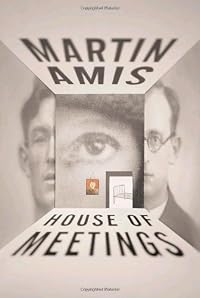
House of Meetings
by Martin Amis
On This Page
Description
There were conjugal visits in the slave camps of the USSR. Valiant women would travel continental distances, over weeks and months, in the hope of spending a night, with their particular enemy of the people, in the House of Meetings. The consequences of these liaisons were almost invariably tragic. House of Meetings is about one such liaison. It is a triangular romance: two brothers fall in love with the same girl, a nineteen-year-old Jewess, in Moscow, which is poised for massacre in the show more gap between the war and the death of Stalin. Both brothers are arrested, and their rivalry slowly complicates itself over a decade in the slave camp above the Arctic Circle.. show less
Tags
Recommendations




































Member Recommendations
Member Reviews
I didn't think a book as slim and quick to read as this one could be as powerful and epic as this. Condensing the turmoil and strife of Russian history with a parallel love triangle doomed to the same pain and repeated collapsings, Amis tells a masterful story with a narrative completely free of superfluity, sentimentalism, cliche, and woodenness.
The story runs fast and cuts deep with little recourse to clean cut resolution or apology. Horrific tragedy and the facelessness of state power are shown to the reader as hand in hand, with their simultaneous dehumanizing of the many and deification of the few (or more like the one)and the erroding of the individual in the acidic tides of totalitarian regime under different guises and faces show more and labels.
Basically, I'm now a Martin Amis fan because of this book, and as such I can't wait to read his other works.
This story can be read in so many different ways and under so many different lights, the point of it all, just read it, it's excellent. show less
The story runs fast and cuts deep with little recourse to clean cut resolution or apology. Horrific tragedy and the facelessness of state power are shown to the reader as hand in hand, with their simultaneous dehumanizing of the many and deification of the few (or more like the one)and the erroding of the individual in the acidic tides of totalitarian regime under different guises and faces show more and labels.
Basically, I'm now a Martin Amis fan because of this book, and as such I can't wait to read his other works.
This story can be read in so many different ways and under so many different lights, the point of it all, just read it, it's excellent. show less
Prior to picking up "House of Meetings," "Dead Babies" was the only Amis I'd read. I found that novel almost offensively terrible, a shallow, sophomoric exercise in provocation for its own sake. I'm glad I gave Amis another chance, though. While Amis hasn't lost his taste for the grotesque, "House of Meetings" is a fearless novel that isn't afraid to describe some of the twentieth century's worst moments or to tackle it's thorniest ethical problems. It is also, to Amis's credit, compulsively readable and unwilling to waste time or space on sentimentality. The voice of Amis's now-aged narrator rings out clear as a bell from the book's pages, a remarkable achievement in so brief a book that covers so much ground.
"House of Meetings" tells show more the story of two brothers, both of whom are what the Soviet authorities used to call "politicals," attempting to survive incarceration in the Soviet gulags where millions of prisoners met their deaths. It's also an exploration of how different characters might behave when faced with an interminable, society-wide catastrophe. Even the novel's narrator, his brother, Lev, and his sister-in-law, Zoya do their best to survive emotionally and economically in post-war Russia, they are constantly reminded that their deaths - from starvation, the state, or the unforgiving Russian cliimate - might come at any time. Worst of all, they knew their fate may not be tied to any of their decisions, since the Soviet system often doled out punishment and reward in unpredictable and capricious ways. The novel asks whether one can remain human, concerned with love or art or morality, under such circumstances, and whether meaningful resistance is even possible when people must fight so hard to survive. It manages to turn the entertaining, and sometimes bitterly funny, story of three individuals into an effective elegy for the million now-nameless Russians that perished under Stalin.
Amis has clearly done his research here. For millions of Soviet citizens, these weren't just academic questions, and it's discouraging to note that most of the degrading scenes in this novel were most probably drawn from the historical record. He also takes us on a very comprehensive tour of gulag life, describing in careful detail the and subtle hierarchies and bizarre economies that existed among the prisoners. After Stalin dies and the brothers are freed, Amis offers a description of the marginal economic and cultural undergrounds that provided a necessary counterpoint to a drab, unhappy society drowning in bureaucracy. He even takes time to ruminate on the nature of the Russian soul, and, even though he's an Englishman by birth, he manages to tie these familiar generalizations in with his developing narrative so that they seem both accurate and trenchantly sad. Mixed up somewhere in all of this mess, life happens to these characters. Our narrator and his two companions meet, fall in love, have sex, work and grow, even if they're sometimes forced to make terrible compromises in order to do keep themselves from perishing. "House of Meetings," is, in its own way, a testament to human survival under the harshest conditions, evidence that a good story can emerge from even the darkest chapters of history. show less
"House of Meetings" tells show more the story of two brothers, both of whom are what the Soviet authorities used to call "politicals," attempting to survive incarceration in the Soviet gulags where millions of prisoners met their deaths. It's also an exploration of how different characters might behave when faced with an interminable, society-wide catastrophe. Even the novel's narrator, his brother, Lev, and his sister-in-law, Zoya do their best to survive emotionally and economically in post-war Russia, they are constantly reminded that their deaths - from starvation, the state, or the unforgiving Russian cliimate - might come at any time. Worst of all, they knew their fate may not be tied to any of their decisions, since the Soviet system often doled out punishment and reward in unpredictable and capricious ways. The novel asks whether one can remain human, concerned with love or art or morality, under such circumstances, and whether meaningful resistance is even possible when people must fight so hard to survive. It manages to turn the entertaining, and sometimes bitterly funny, story of three individuals into an effective elegy for the million now-nameless Russians that perished under Stalin.
Amis has clearly done his research here. For millions of Soviet citizens, these weren't just academic questions, and it's discouraging to note that most of the degrading scenes in this novel were most probably drawn from the historical record. He also takes us on a very comprehensive tour of gulag life, describing in careful detail the and subtle hierarchies and bizarre economies that existed among the prisoners. After Stalin dies and the brothers are freed, Amis offers a description of the marginal economic and cultural undergrounds that provided a necessary counterpoint to a drab, unhappy society drowning in bureaucracy. He even takes time to ruminate on the nature of the Russian soul, and, even though he's an Englishman by birth, he manages to tie these familiar generalizations in with his developing narrative so that they seem both accurate and trenchantly sad. Mixed up somewhere in all of this mess, life happens to these characters. Our narrator and his two companions meet, fall in love, have sex, work and grow, even if they're sometimes forced to make terrible compromises in order to do keep themselves from perishing. "House of Meetings," is, in its own way, a testament to human survival under the harshest conditions, evidence that a good story can emerge from even the darkest chapters of history. show less
I don't think anyone can deny that Amis' writerly powers are extraordinary; sentence by sentence he's one of the finest English stylists ever. He wins the war against cliche--nukes cliche to dust--and I would scrounge through his trash to read his grocery list.
Yet I want to trot out cliches about his books: his vision is keen, incisive, crystal clear...yet terribly fucking bleak. I wonder where his heart is in all of this. So I could say that the blood is clearly infused into the rhythms of his sentences, the Nabokovian brilliance of his imagery, the structure of his paragraphs. But where's the love? It can't all be tied up in language and black humor.
But if love were chinks of sunshine pressing through the clouds, he has a place to show more hide behind through 240-odd pages: a character to hide behind genius language, as if avoiding that sunshine in the guise of a novel. Confessing everything to his privileged daughter of the west, the main character is a gulag-survivor, a professional rapist, a soldier of WWII, an older brother. But dare I say it may be easy for Amis to hide here, in this grotto of depravity, considering that subject matter. House of Meetings attempts to swallow the entire Russian character, as if Russia were the main character, and her victims were her people, and all that was and is a literary creation, from Pushkin to Amis, are her victims as well; Amis, through his confessional, seems to say: Russia did this to our characters, to her people. It made us live a nightmare and we are the wandering ghosts of that fatal nightmare.
This is a cruel book. If you get through it to the end, the letter from his brother lets the light in. But it's brief and blinding. show less
Yet I want to trot out cliches about his books: his vision is keen, incisive, crystal clear...yet terribly fucking bleak. I wonder where his heart is in all of this. So I could say that the blood is clearly infused into the rhythms of his sentences, the Nabokovian brilliance of his imagery, the structure of his paragraphs. But where's the love? It can't all be tied up in language and black humor.
But if love were chinks of sunshine pressing through the clouds, he has a place to show more hide behind through 240-odd pages: a character to hide behind genius language, as if avoiding that sunshine in the guise of a novel. Confessing everything to his privileged daughter of the west, the main character is a gulag-survivor, a professional rapist, a soldier of WWII, an older brother. But dare I say it may be easy for Amis to hide here, in this grotto of depravity, considering that subject matter. House of Meetings attempts to swallow the entire Russian character, as if Russia were the main character, and her victims were her people, and all that was and is a literary creation, from Pushkin to Amis, are her victims as well; Amis, through his confessional, seems to say: Russia did this to our characters, to her people. It made us live a nightmare and we are the wandering ghosts of that fatal nightmare.
This is a cruel book. If you get through it to the end, the letter from his brother lets the light in. But it's brief and blinding. show less
This is a dark and frighteningly tender book. Amis masterfully crafts his narrator's voice and the surrounding characters, and his poetic prose makes even the most violent sections of the book both horrifying and brilliantly realized. Certainly, this isn't a book for everyone--the depictions of violence and work camps, not to mention hate, are too realistic to be taken easily. Amis' explorations here, though, are powerful and unrelenting. Yes, this is a dark and violent book built to explore darker issues. It is also a masterpiece, beautifully and written and perfectly conceived.
This book poses a lot of important question about uncomfortable realities - the prevalence of rape in wartime, the greediness of a passive nature, the chance for morality in dire conditions. Overall, I guess this book shows us the dangers of going along with the flow, and the opposite challenges of letting your morality dictate your actions. I struggled giving this book a rating--- there are so many great things about this work. However, except the sections with the Lev character-- I didn't really like it. Written well, engaging characters, leading questions. A lot of good things, but it didn't really come together in a satisfying way.
I had almost given up on Amis doing Amis over and over again. But the prospect of his writing a russian novel intrigued me. I'm a sucker for those slavs. So glad I took the bait, if you can be glad of reading a book so monstrously depressing. Well realized, well crafted, well done. Perfect tone. Hadn't ever reflected so much on the culture of the gulag. Glad my grandfather got the hell out of Russia.
The 4th or 5th of Amis's books that I've read, and it reminds me of many familiar patterns, themes and tones in his work. The prose is beautiful, though more concise in books like London Fields. The narrator is bitter and jealous, in conflict and competition with his brother. Their paths crisscross, one ascending as the other plummets. However, unlike other of his novels that I've read, this book is set in another place and time—in the Russian work camps, which Amis has researched very thoroughly. The book brought this setting and period of Russian history alive for me better than any other work I have read, including A Day in the Life of Ivan Denisovich. The grimness and hardship of Russians both inside and outside the camps is very show more well portrayed and while the characters are not cozy and lovable by any means, the book ends up being very affecting. show less
Members
- Recently Added By
Published Reviews
ThingScore 58
House of Meetings is short, the prose is controlled, the humor sparse, while the characters strike us as real, or at least possible, people. It is a remarkable achievement, a version of the great Russian novel done in miniature, with echoes throughout of its mighty predecessors.
added by jburlinson
Mr. Amis depicts these characters' lives with an economy of language and detail, choosing, after the debacle of the overwritten ''Yellow Dog,'' to rely on an almost fablelike minimalism to evoke the horrors of Norlag.
added by MikeBriggs
And the result, more often than not, comes to read like a wicked parody of the Amis style. Sometimes, indeed, it appears that the author has wholly abdicated in favour of Craig Brown.
added by MikeBriggs
Lists

Arctic novels
35 works; 5 members
Author Information

58+ Works 29,679 Members
Martin Amis, son of the novelist Kingsley Amis, was born August 25, 1949. His childhood was spent traveling with his famous father. From 1969 to 1971 he attended Exeter College at Oxford University. After graduating, he worked for the Times Literary Supplement and later as special writer for the Observer. Amis published his first novel, The Rachel show more Papers, in 1973, which received the prestigious Somerset Maugham Award in 1974. Other titles include Dead Babies (1976), Other People: A Mystery Story (1981); London Fields (1989), The Information (1995), and Night Train (1997). Martin Amis has been called the voice of his generation. His novels are controversial, often satiric and dark, concentrating on urban low life. His style has been compared to that of Graham Greene, Philip Larkin and Saul Bellow, among others. He is currently Professor of Creative Writing at the Centre for New Writing at the University of Manchester. In 2008, The Times named him one of the 50 greatest British writers since 1945. (Bowker Author Biography) show less
Some Editions
Awards and Honors
Awards
Distinctions
Notable Lists
Common Knowledge
- Original title
- House of Meetings
- Original publication date
- 2006
- People/Characters
- Lev; Zoya; Venus
- Important places
- Moscow, Russia; Predposylov; Siberia, Russia
- Important events
- Middle School Number 1 kidnapping, North Ossetia
- Dedication
- Again to my mother
- First words
- Dear Venus,
If what they say is true, and my country is dying, then i think I may be able to tell them why. - Last words
- (Click to show. Warning: May contain spoilers.)And I'm glad.
- Blurbers
- Macfarlane, Robert; Lichtig, Toby; Battersby, Eileen; Kennedy, Douglas; Shriver, Lionel
- Original language
- English
Classifications
Statistics
- Members
- 1,032
- Popularity
- 24,949
- Reviews
- 31
- Rating
- (3.48)
- Languages
- 14 — Catalan, Czech, Danish, Dutch, English, French, German, Galician, Greek, Italian, Portuguese, Romanian, Slovenian, Spanish
- Media
- Paper, Audiobook, Ebook
- ISBNs
- 32
- ASINs
- 6