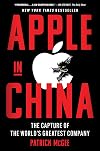
Apple in China: The Capture of the World's Greatest Company
by Patrick McGee
On This Page
Description
"After struggling to build its products on three continents, Apple was lured by China's seemingly inexhaustible supply of cheap labor. Soon it was sending thousands of engineers across the Pacific, training millions of workers, and spending hundreds of billions of dollars to create the world's most sophisticated supply chain. These capabilities enabled Apple to build the 21st century's most iconic products--in staggering volume and for enormous profit. Without explicitly intending to, Apple show more built an advanced electronics industry within China, only to discover that its massive investments in technology upgrades had inadvertently given Beijing a power that could be weaponized. In Apple in China, journalist Patrick McGee draws on more than two hundred interviews with former executives and engineers, supplementing their stories with unreported meetings held by Steve Jobs, emails between top executives, and internal memos regarding threats from Chinese competition. The book highlights the unknown characters who were instrumental in Apple's ascent and who tried to forge a different path, including the Mormon missionary who established the Apple Store in China; the "Gang of Eight" executives tasked with placating Beijing; and an idealistic veteran whose hopes of improving the lives of factory workers were crushed by both Cupertino's operational demands and Xi Jinping's war on civil society. Apple in China is the sometimes disturbing and always revelatory story of how an outspoken, proud company that once praised "rebels" and "troublemakers"--the company that encouraged us all to "Think Different"--devolved into passively cooperating with a belligerent regime that increasingly controls its fate." -- show lessTags
Recommendations












Member Reviews
Thorough and clear eyed. McGee avoids the fawning Steve Jobs worship that characterizes most discussions of this era. Instead he paints a chilling picture of another sector of American innovation that allowed itself to be undermined and replaced in pursuit of immediate profit. Like manufacturing before it, it makes me skeptical that we won't say the same thing about AI in a few years.
I enjoyed this book immensely. I had just finished Imperial Twilight—a history of the lead-up to the Opium War—and this was suggested as a possible follow-up. Given my interest in Apple, it sounded intriguing. Which it was. I was impressed with some of the connections between the two stories, honestly.
This isn’t just a history of Apple in China, truthfully. It is a well researched and insightful history of that specific development, and McGee keeps his focus pretty tightly on that. But as such, it’s also an emblematic analysis of the kind of ravenous, hyper-efficient capitalism that Apple represents. And also, by the way, a compelling look at the ways that the West deeply, fundamentally misunderstands China—and the show more vulnerability that arises from it (which is where I saw so many parallels with that earlier history).
McGee does an excellent job illuminating the very fine details of Apple’s internal workings and, to a lesser extent, the internal politics of China. These he weaves together into a textured, full depiction of the precarious position Apple now finds itself in, and how it ended up there. The decision-making doesn’t come across as careless, or even especially conflicted. Apple’s systematic—I would say obsessive—pursuit of efficiency and control led them to create a brittle, vertically integrated system in a part of the world that operates under rules the company barely even sees, much less understands. It’s an approach that served them extremely well in the short term, but left them dependent and vulnerable in the long. (Along the way, incidentally, it also led them to treat human costs as entirely negligible—or at best, negotiable.)
I don’t tend to restrain myself when I’m talking about this stuff, as I’m sure you’re noticing. But credit to the author—his approach and tone are measured throughout the book. He’s carefully examining the case, trying to piece together the enigmatic situation of today’s Apple in today’s China. If anything, McGee lets Apple (and especially Tim Cook) off easy. He wants us to see the systemic nature of this geopolitical predicament, the ways that Washington stumbled into China, with Apple following in its wake. He’s not necessarily wrong, but Apple’s own hubris and greed were critical elements in producing the situation they now face. show less
This isn’t just a history of Apple in China, truthfully. It is a well researched and insightful history of that specific development, and McGee keeps his focus pretty tightly on that. But as such, it’s also an emblematic analysis of the kind of ravenous, hyper-efficient capitalism that Apple represents. And also, by the way, a compelling look at the ways that the West deeply, fundamentally misunderstands China—and the show more vulnerability that arises from it (which is where I saw so many parallels with that earlier history).
McGee does an excellent job illuminating the very fine details of Apple’s internal workings and, to a lesser extent, the internal politics of China. These he weaves together into a textured, full depiction of the precarious position Apple now finds itself in, and how it ended up there. The decision-making doesn’t come across as careless, or even especially conflicted. Apple’s systematic—I would say obsessive—pursuit of efficiency and control led them to create a brittle, vertically integrated system in a part of the world that operates under rules the company barely even sees, much less understands. It’s an approach that served them extremely well in the short term, but left them dependent and vulnerable in the long. (Along the way, incidentally, it also led them to treat human costs as entirely negligible—or at best, negotiable.)
I don’t tend to restrain myself when I’m talking about this stuff, as I’m sure you’re noticing. But credit to the author—his approach and tone are measured throughout the book. He’s carefully examining the case, trying to piece together the enigmatic situation of today’s Apple in today’s China. If anything, McGee lets Apple (and especially Tim Cook) off easy. He wants us to see the systemic nature of this geopolitical predicament, the ways that Washington stumbled into China, with Apple following in its wake. He’s not necessarily wrong, but Apple’s own hubris and greed were critical elements in producing the situation they now face. show less
Merely an hour after finishing this book, the Wall Street Journal ran a story on a new Foxconn-operated Mac Mini facility in the US.
Thanks to the insights I’d just read in the book, I could immediately place the news in context: the facility is too small and its mission too simple to be a genuine effort by Apple to diversify or move its supply chain. In short: it’s a political move.
That’s how good this book truly is.
It offers a surprisingly intimate view of the world of Apple’s production logistics, backed by internal documents (some reported for the first time) and interviews with top managers from both Apple and its partners.
The book starts in the company's early years, tracing its evolution from a firm that once cherished show more its own American factories to one that is now completely beholden to a complex, multi-layered network of Chinese suppliers.
What I really liked is how the book meticulously tracks this transition at every stage. It doesn’t just explain the "how" and "why" of the shift to outsourcing; it also focuses on the "who." By also reporting on the backgrounds and motivations of the people behind these moves, McGee provides a unique look at the logic—and the missteps—that built the modern Apple machine.
I also particularly appreciated the judgment-free analysis of Chinese corporate culture and how those differences fundamentally shaped Apple’s strategy. show less
Thanks to the insights I’d just read in the book, I could immediately place the news in context: the facility is too small and its mission too simple to be a genuine effort by Apple to diversify or move its supply chain. In short: it’s a political move.
That’s how good this book truly is.
It offers a surprisingly intimate view of the world of Apple’s production logistics, backed by internal documents (some reported for the first time) and interviews with top managers from both Apple and its partners.
The book starts in the company's early years, tracing its evolution from a firm that once cherished show more its own American factories to one that is now completely beholden to a complex, multi-layered network of Chinese suppliers.
What I really liked is how the book meticulously tracks this transition at every stage. It doesn’t just explain the "how" and "why" of the shift to outsourcing; it also focuses on the "who." By also reporting on the backgrounds and motivations of the people behind these moves, McGee provides a unique look at the logic—and the missteps—that built the modern Apple machine.
I also particularly appreciated the judgment-free analysis of Chinese corporate culture and how those differences fundamentally shaped Apple’s strategy. show less
A consideration of the existential risk that Apple has helped China to become. Starts with a summary of how Apple became what IT is today. Then a history of Apple’s off shoring to China and all of the technology Apple introduced to China. Thoughts about what the destruction of Taiwan semiconductor would mean.
A study of how how capitalism's relentless pursuit of efficiency (for short-term profit maximisation) had led to a longer term loss in resilience for Apple.
Apple wants to keep working in China because they are so cheap, so they give away all their engineering and technical knowledge to the Chinese. At one point, many years later, when they try to open a similar plant in Texas, they have to bring in Chinese workers to train them. Ugh.
Now the Chinese have the engineering knowledge and are starting to successfully compete with Apple.
Now the Chinese have the engineering knowledge and are starting to successfully compete with Apple.
Saturday Extra 31May 2025
American engineers are teaching whole Chinese factories how to be a factory
American engineers are teaching whole Chinese factories how to be a factory
Members
- Recently Added By
Published Reviews
ThingScore 100
A well-argued, eye-opening look at the dark side of globalism, and those who win and lose because of it.
added by srdr
...persuasive exposé of the trillion-dollar company’s uncomfortably close relationship with the global power. China may have enabled Apple to become one of the most profitable companies in the world, but the exploitation goes both ways: This is not just a story of China making Apple, but of Apple making China. Given Xi’s authoritarian hold on power, what began as a feat of manufacturing show more has troubling consequences for the entire world. show less
added by srdr
Lists

Globe and Mail | Canadian Non-Fiction: May 24, 2025
10 works; 1 member
Globe and Mail | Canadian Non-Fiction: May 31, 2025
10 works; 1 member
Globe and Mail | Canadian Non-Fiction: June 7, 2025
10 works; 1 member

Globe and Mail | Canadian Non-Fiction: June 14, 2025
10 works; 1 member
Globe and Mail | Canadian Non-Fiction: June 21, 2025
10 works; 1 member
Globe and Mail | Canadian Non-Fiction: July 5, 2025
10 works; 1 member

Top Five Books of 2025
954 works; 303 members
Author Information

11 Works 295 Members
Patrick McGee is Professor of English at Louisiana State University
Awards and Honors
Awards
Distinctions
Common Knowledge
- Canonical DDC/MDS
- 382.3
Classifications
- Genres
- Economics, Technology, Business, Nonfiction, General Nonfiction
- DDC/MDS
- 382.3 — Society, government, & culture Commerce, communications & transportation regulations International Trade (Commerce) Commercial policy
- LCC
- HD9696.2 .U64 .A6745 — Social sciences Industries. Land use. Labor Industries. Land use. Labor Special industries and trades Mechanical industries
- BISAC
Statistics
- Members
- 246
- Popularity
- 132,153
- Reviews
- 8
- Rating
- (4.40)
- Languages
- English
- Media
- Paper, Audiobook, Ebook
- ISBNs
- 9
- ASINs
- 5