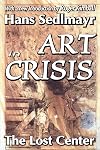
Art in Crisis: The Lost Center
by Hans Sedlmayr
On This Page
Description
The history of art from the early nineteenth century on- ward is commonly viewed as a succession of conflicts between innovatory and established styles that culminated in the formalism and aesthetic autonomy of high modernism. In Art and Crisis, first published in 1948, Hans Sedlmayr argues that the aesthetic disjunctures of modern art signify more than matters of style and point to much deeper processes of cultural and religious disintegration. As Roger Kimball observes in his informative show more new introduction,Art in Crisisis as much an exercise in cultural or spiritual analysis as it is a work of art history. Sedlmayr's reads the art of the last two centuries as a fever chart of the modern age in its greatness and its decay. He discusses the advent of Romanticism with its freeing of the imagination as a conscious sundering of art from humanist and religious traditions with the aesthetic treated as a category independent of human need. Looking at the social purposes of architecture, Sedlmayr shows how the landscape garden, the architectural monument, and the industrial exhibition testified to a new relationship not only between man and his handiwork but also between man and the forces that transcend him. In these institutions man deifies his inventive powers with which he hopes to master and supersede nature. Likewise, the art museum denies transcendence purposes of architecture, Sedlmayr shows how the landscape garden, the architectural monument, and the industrial exhibition testified to a new relationship not only between man and his handiwork but also between man and the forces that transcend him. In these institutions man deifies his inventive powers with which he hopes to master and supersede nature. Likewise, the art museum denies transcendence through a cultural leveling in which "Heracles and Christ become brothers" as objects of aesthetic contemplation. At the center of Art in Crisisis the insight that, in art as in life, the pursuit of unqualified autonomy is in the end a prescription for disaster, aesthetic as well as existential. Sedlmayr writes as an Augustinian Catholic. For him, the underlying motive for the pursuit of autonomy is pride. The "lost center" of his subtitle is God. The dream of autonomy, Sedlmayr argues, is for finite, mortal creatures, a dangerous illusion. The book invites serious analysis from art critics and theological thinkers alike. show lessTags
Recommendations





















Member Reviews
Published in 1957, you'd think it would be dated, but it isn't. Recommend not reading from start to finish. Start in the middle and try to piece together his idealization of art. Probably the collective creation of Chartres over centuries, but transposed into something more naturalistic. As Yeats said, "the center does not hold." Did it ever? So many ways for figmentary centers to fray. That's the fun of it, from an unabashedly decadent viewpoint. Architecture is at the center of his argument: buildings are the holograms of who we are. Lostness and sadness permeate Sedlmayr's analysis like the lost vowels in his name. Hieronymous Bosch popped up from nowhere into the 20th century. Will something or someone new, from hell or perhaps from show more heaven this time, pop or pixelate into ours? show less
Ratings
Members
- Recently Added By
Author Information

20+ Works 147 Members
Hans Sedlmayr (1896-1984) was a founding member of the New Vienna School of art historians
Some Editions
Awards and Honors
Notable Lists
Series
Belongs to Publisher Series
Common Knowledge
- Canonical title
- Art in Crisis: The Lost Center
- Original title
- Verlust der Mitte
- Original publication date
- 1948
Classifications
Statistics
- Members
- 57
- Popularity
- 539,715
- Reviews
- 1
- Rating
- (3.88)
- Languages
- 5 — English, German, Italian, Russian, Spanish
- Media
- Paper, Ebook
- ISBNs
- 8
- ASINs
- 2