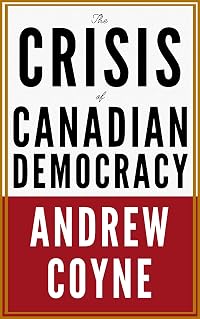
The Crisis of Canadian Democracy
by Andrew Coyne
On This Page
Description
Andrew Coyne, one of Canada's most esteemed political thinkers, delivers a powerful exposé of the nation's crumbling democratic institutions. With characteristic wit, insight, and rigor, Coyne dismantles the comforting myths Canadians tell themselves about their political system, revealing a parliamentary structure eroded by unaccountable leaders, disempowered MPs, manipulated elections, and systemic dysfunction. The Crisis of Canadian Democracy is both a wake-up call and a call to show more action, offering compelling solutions to restore genuine self-government to Canadian politics. Essential reading for leaders, citizens, and anyone who cares about the future of democracy in Canada--or anywhere else. show lessTags
Member Reviews
This was a very interesting and thought-provoking book. It looks at the state of democracy in Canada. True democracy -- beyond the right to vote. The author does a very good job of showing how other countries have made reforms to increase democracy; reforms that making voting better reflect the will of the people, that ensure representatives have meaningful roles and other improvements. More sadly, for me, he shows the decline in democracy within Canada itself. Never mind looking elsewhere, things used to be much more democratic here.
He presents several suggestions for improvement to get people more engaged, to attract the best and brightest to politics, to foster meaningful, inclusive debate. His ideas are realistic and workable, in show more theory. The biggest problem, as the author points out, is that the people who benefit most from concentration of power are the very ones who need to approve any changes. Likely?
What I especially liked in this book is that the author spells out why it matters that our democracy is in decline. A hard sell as things are pretty good here, especially compared to many other parts of the world. For me, the strongest reason why change is necessary is the increasing number of younger Canadians who don't see our processes and institutions as legitimate. As that section of the population ages and grows, we are facing a serious deficit of political engagement -- a true loss of democracy.
This book is well researched and written in an engaging style. If you care about Canadian politics and governance, read this! show less
He presents several suggestions for improvement to get people more engaged, to attract the best and brightest to politics, to foster meaningful, inclusive debate. His ideas are realistic and workable, in show more theory. The biggest problem, as the author points out, is that the people who benefit most from concentration of power are the very ones who need to approve any changes. Likely?
What I especially liked in this book is that the author spells out why it matters that our democracy is in decline. A hard sell as things are pretty good here, especially compared to many other parts of the world. For me, the strongest reason why change is necessary is the increasing number of younger Canadians who don't see our processes and institutions as legitimate. As that section of the population ages and grows, we are facing a serious deficit of political engagement -- a true loss of democracy.
This book is well researched and written in an engaging style. If you care about Canadian politics and governance, read this! show less
4.5 stars
Andrew Coyne does political commentary on CBC News Network (at least that’s where I “know” him from). In this book, he describes what democracy in Canada is supposed to look like and explains that it has degraded so much as to almost no longer resemble democracy. He compares it to how it used to look in Canada and also to other democratic countries and how different is is (or has become).
I learned a lot. In high school I had no interest in politics. Once I could vote, I at least did enough research to know who I wanted to vote for. It was only in the past decade or so my interest started increasing and it has gained traction just this calendar year (despite so many others turning away from the news and politics, I’ve show more been more drawn in, “train-wreck” though it might be!).
So, I learned a lot about what things are supposed to look like in our government and how it has gone downhill. This includes the massive amount of power in the Prime Minister’s hands alone (and his staffers, not even his Cabinet, etc); MPs really only are there to vote alongside the rest of the party – no one can bring forward any other ideas, vote against, etc. The way our governments (and candidates and party leaders) are elected is not very democratic (yes, proportional representation is the way to go, and that’s something I’ve thought for a long time now, living in a place where my politics don’t seem to agree with the majority). And these are just a few of the issues (as big as these issues are!) discussed.
Might this be of interest to someone not in Canada? Maybe, if they are super-interested in politics and democracy, I suppose, but definitely of interest to anyone in Canada with an interest in politics. show less
Andrew Coyne does political commentary on CBC News Network (at least that’s where I “know” him from). In this book, he describes what democracy in Canada is supposed to look like and explains that it has degraded so much as to almost no longer resemble democracy. He compares it to how it used to look in Canada and also to other democratic countries and how different is is (or has become).
I learned a lot. In high school I had no interest in politics. Once I could vote, I at least did enough research to know who I wanted to vote for. It was only in the past decade or so my interest started increasing and it has gained traction just this calendar year (despite so many others turning away from the news and politics, I’ve show more been more drawn in, “train-wreck” though it might be!).
So, I learned a lot about what things are supposed to look like in our government and how it has gone downhill. This includes the massive amount of power in the Prime Minister’s hands alone (and his staffers, not even his Cabinet, etc); MPs really only are there to vote alongside the rest of the party – no one can bring forward any other ideas, vote against, etc. The way our governments (and candidates and party leaders) are elected is not very democratic (yes, proportional representation is the way to go, and that’s something I’ve thought for a long time now, living in a place where my politics don’t seem to agree with the majority). And these are just a few of the issues (as big as these issues are!) discussed.
Might this be of interest to someone not in Canada? Maybe, if they are super-interested in politics and democracy, I suppose, but definitely of interest to anyone in Canada with an interest in politics. show less
Ratings
Members
- Recently Added By
Lists

Globe and Mail | Canadian Non-Fiction: May 10, 2025
10 works; 1 member
Globe and Mail | Canadian Non-Fiction: May 17, 2025
10 works; 1 member
Globe and Mail | Canadian Non-Fiction: May 24, 2025
10 works; 1 member
Globe and Mail | Canadian Non-Fiction: May 31, 2025
10 works; 1 member
Globe and Mail | Canadian Non-Fiction: June 7, 2025
10 works; 1 member

Globe and Mail | Canadian Non-Fiction: June 14, 2025
10 works; 1 member
Globe and Mail | Canadian Non-Fiction: June 21, 2025
10 works; 1 member

Top Five Books of 2025
954 works; 303 members
Author Information
1 Work 17 Members
Awards and Honors
Common Knowledge
- Dedication
- For Shannon
- First words
- One of the things Canadians think they know about Canada is that it is a democracy: among the greatest democracies on earth, in fact.
- Last words
- (Click to show. Warning: May contain spoilers.)The same approach, if memory serves, was responsible for our founding.
Classifications
Statistics
- Members
- 17
- Popularity
- 1,451,225
- Reviews
- 2
- Rating
- (4.10)
- Languages
- English
- Media
- Paper, Ebook
- ISBNs
- 3
- ASINs
- 1