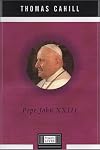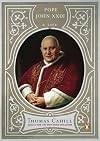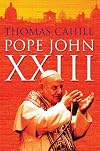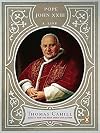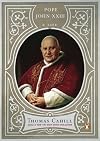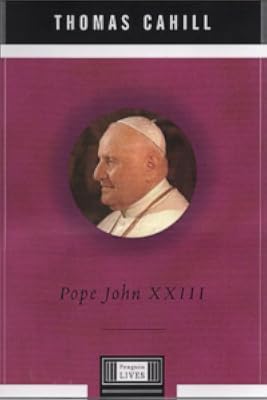
Pope John XXIII: A Penguin Life (Penguin Lives)
by Thomas Cahill
On This Page
Description
Biography & Autobiography. Religion & Spirituality. Nonfiction. HTML:From the bestselling author of How the Irish Saved Civilization.Elected to the papacy at the age of 76, Pope John XXIII was to have a brief but important reign. Although he had a doctorate in theology, his gifts were pastoral—reaching out to the people of the Church. After his doctorate, he spent nine years working for the socially-minded bishop of Bergamo, acquiring a broad understanding of the problems of the show more working class. This sympathy for ordinary people was brought out in his papacy. Vatican II, which he convened, brought forth the idea of a church as a community, in which all God's people are a sign of redemption for the human race. Thomas Cahill, in his short biography, gives us the sense of enduring importance of John XXIII's idea. show less
Tags
Recommendations









Member Reviews
I decided I wanted to read it when Cahill referenced it in the last book I read by him, Mysteries of the Middle Ages : the rise of feminism, science, and art from the cults of Catholic Europe. In that book, (and this one), he says some pretty harsh things about popes, and I wanted to see what he had to say about Pope John XXIII.
I was 11 and attending Catholic school when the first phase of the Ecumenical Council was going on, so I heard about it, though not in great detail - mostly, I recall, in terms of a re-approachment of Roman Catholic and Greek Orthadox, and in more openness towards Protestant religions. After sixth grade, I was not in Catholic school again, and I don't remember any mention of the continuing council in CCD show more (Saturday religion) classes. I didn't realize all the preparation for the council, and that Pope John the XXIII barely had a change to participate since he died after the first session.
I enjoyed this book for a lot of reason, one being the view of church politics John (called Angelo early in the book, and then Roncalli later before becoming pope) developed within. This included the very repressive regime of Pius X. Cahill obviously has a lot of respect for John, and he shows his seeming slow development of his philosophy, alongside an always present humanness and compassion for and openness to others. During World War II, Paul was in Turkey, and it was his reaching out to others who might be seen as enemies that allowed him to get the help of the German ambassador in smuggling out thousands of Jews from Europe. It also helped him get Khrushchev's cooperation for Russian Orthodox bishops being able to attend the ecumenical council.
The also helped me appreciate just how remarkable the ecumenical council was in the context of the church, for it was the first time, in a long time, that there was a meeting of bishops that had not been pre-scripted.
In his encyclical Pacem in Terris - Peace on Earth - John gave three reasons for feeling hopeful about the direction of humanity. He says that he sees everywhere signs of a heightened appreciation of human dignity, especially in three areas "a progressive improvement in the economic and social conditions of workers", "the part women are now playing in political life everywhere" and their "increasing awareness of their natural dignity"; and the demise of imperialism, which "is fast becoming an anachronism." (I'm quoting Cahill here, who is quoting the encyclical).
Of course, this progress that John XXIII saw is uneven and easy for us to despair about, so it is helpful to know that he saw it so clearly. To give it some perspective I am also reading a book about the spice trade. I am in the part of the book where De Gama, first, and then other Portuguese, sail around Africa and reach India and the islands nearby, Sumatra, Java. Basically, they are ready to take control by force, and they deal extremely harshly with anyone who opposes them, however mildly, and with many innocent bystanders. By harshly I mean slicing off the hands, ears and noses of some, and then setting them adrift in a burning boat, or burning up a ship of 800 Muslim pilgrims who had done nothing to them. Perhaps we have evolved a bit since then. show less
I was 11 and attending Catholic school when the first phase of the Ecumenical Council was going on, so I heard about it, though not in great detail - mostly, I recall, in terms of a re-approachment of Roman Catholic and Greek Orthadox, and in more openness towards Protestant religions. After sixth grade, I was not in Catholic school again, and I don't remember any mention of the continuing council in CCD show more (Saturday religion) classes. I didn't realize all the preparation for the council, and that Pope John the XXIII barely had a change to participate since he died after the first session.
I enjoyed this book for a lot of reason, one being the view of church politics John (called Angelo early in the book, and then Roncalli later before becoming pope) developed within. This included the very repressive regime of Pius X. Cahill obviously has a lot of respect for John, and he shows his seeming slow development of his philosophy, alongside an always present humanness and compassion for and openness to others. During World War II, Paul was in Turkey, and it was his reaching out to others who might be seen as enemies that allowed him to get the help of the German ambassador in smuggling out thousands of Jews from Europe. It also helped him get Khrushchev's cooperation for Russian Orthodox bishops being able to attend the ecumenical council.
The also helped me appreciate just how remarkable the ecumenical council was in the context of the church, for it was the first time, in a long time, that there was a meeting of bishops that had not been pre-scripted.
In his encyclical Pacem in Terris - Peace on Earth - John gave three reasons for feeling hopeful about the direction of humanity. He says that he sees everywhere signs of a heightened appreciation of human dignity, especially in three areas "a progressive improvement in the economic and social conditions of workers", "the part women are now playing in political life everywhere" and their "increasing awareness of their natural dignity"; and the demise of imperialism, which "is fast becoming an anachronism." (I'm quoting Cahill here, who is quoting the encyclical).
Of course, this progress that John XXIII saw is uneven and easy for us to despair about, so it is helpful to know that he saw it so clearly. To give it some perspective I am also reading a book about the spice trade. I am in the part of the book where De Gama, first, and then other Portuguese, sail around Africa and reach India and the islands nearby, Sumatra, Java. Basically, they are ready to take control by force, and they deal extremely harshly with anyone who opposes them, however mildly, and with many innocent bystanders. By harshly I mean slicing off the hands, ears and noses of some, and then setting them adrift in a burning boat, or burning up a ship of 800 Muslim pilgrims who had done nothing to them. Perhaps we have evolved a bit since then. show less
Though the history is interesting, the writing is highly slanted and one-sided.
Excellent book on Papal Politics and the Politics of the 20th and 21st century
church
church
Amusing typo, because so obvious and therefore embarrassing: the title page has Pope John "XXII", though the cover is correct with "XXIII".
Ratings
Members
- Recently Added By
Author Information

Series
Belongs to Publisher Series
Common Knowledge
- Canonical title*
- Giovanni XXIII
- Original title
- Pope John XXIII
- Original publication date
- 2002
- People/Characters
- Pope John XXIII
- Important places
- Rome, Italy; Turkey
- Dedication
- To Sister Helen Prejean
For the good are always the merry - First words
- Vatican propaganda notwithstanding, Peter was never 'Bishop of Rome.'
*Some information comes from Common Knowledge in other languages. Click "Edit" for more information.
Classifications
- Genres
- Religion & Spirituality, Nonfiction, Biography & Memoir, General Nonfiction, History
- DDC/MDS
- 282.092 — Religion Christian denominations Roman Catholic Church Catholic Biography And History Biography
- LCC
- BX1378.2 .C24 — Philosophy, Psychology and Religion Christian Denominations Christian Denominations Catholic Church History
- BISAC
Statistics
- Members
- 246
- Popularity
- 132,553
- Reviews
- 4
- Rating
- (3.43)
- Languages
- English, French, Italian, Spanish
- Media
- Paper, Audiobook, Ebook
- ISBNs
- 10
- ASINs
- 4