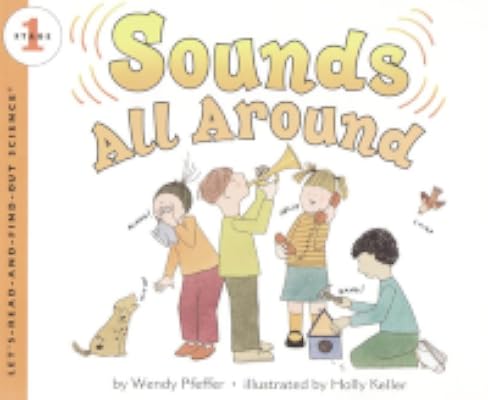
Sounds All Around
by Wendy Pfeffer
On This Page
Description
Explains how sounds are made and the purposes they serve for both humans and other animals.Tags
Recommendations









Member Reviews
Sounds All Around is a great book to use when introducing the concept of sound to students. This book describes different sounds we make and hear all around us. It also describes how our vocal cords vibrate in order to produce sounds and then details what is happening inside of our ear in order for us to hear sound. The book also puts into perspective how loud certain sounds are that hear frequently. One thing I really loved about this book was its diversity. The book uses sounds from multiple different cultures and animals and I love that.
I love love love the illustrations in this book! This book is an interactive story that discusses sounds, sound waves, vocal cords, hearing, sonar, and decibels. For only having 34 pages, this book is jam-packed with informational text, but it is presented in such a fun way. I love that this book includes a glossary for the different scientific terms. The book also includes several different activities that can be used to discover various sounds such as a sound matching game, listen to the sounds around you, and listen to the sound travel through water. I also enjoyed the fact that this book is leveled.
This is a fun interactive book on sound. The words grab the reader right away since they can snap their fingers or clap their hands to make sound. They are familiar with the sounds of crunching leaves or splashing in a puddle. The adult reader may also have objects available to let the child make the same sound as the book is discussing (i.e. shake a can of marbles or pencils). The reader is asked to feel their throat when they sing, talk, or hum. This is easy and lets the reader learn about vibration. The author and illustrator use space well to let the reader see and read the words. Students learn about how animals use sound to communicate, how sound is measured, and reminds the reader to protect their ears. The last pages include show more activities for the reader to learn about sound and more information on sound. The back flap includes short biographies on the author and illustrator but there is no bibliography.
The version I read was an older version and there is a new version that may address some of my concerns related to the illustrations. I could tell the book was old when the older style home telephone was used to discuss a ringing phone. Some young children do not relate to the square telephone. The diversity in the book was not done well since the African American looking boy looked gray and his curly hair looked odd. The African tribe that seemed to be portrayed also did not look realistic. show less
The version I read was an older version and there is a new version that may address some of my concerns related to the illustrations. I could tell the book was old when the older style home telephone was used to discuss a ringing phone. Some young children do not relate to the square telephone. The diversity in the book was not done well since the African American looking boy looked gray and his curly hair looked odd. The African tribe that seemed to be portrayed also did not look realistic. show less
The book begins with children enjoying all the sounds around them. The book then shifts to discuss how a person forms sounds in their throat, with a helpful diagram on page 12. The book then goes on explaining how our ears pick up sounds from vibrations. Different sounds can alert different messages both for humans and animals. The book uses the howler monkey as a example for an animal that uses sound to keep predators away. The book also explains how bats use high pitch frequencies to move in the dark, even though they cannot see. We learn how sound waves travel through solid ground, air, and water. A mother whale also uses sound waves to to locate her baby in the ocean. This is very similar to how humans use sonar in submarines. The show more book goes into explaining how sounds are measured in decimals and gives many examples. The book concludes with explaining how we should be sure to protect our ears from loud, hard noises.
This book contains a lot of information on sound. I learned some new facts from reading this book, and I know students could benefit from this too. This book could be used as a supplement in a science lesson on sound waves, or could also be integrated in a music lesson discussing pitch and vibrations. As a bonus, I also enjoyed the fun and informative illustrations. show less
This book contains a lot of information on sound. I learned some new facts from reading this book, and I know students could benefit from this too. This book could be used as a supplement in a science lesson on sound waves, or could also be integrated in a music lesson discussing pitch and vibrations. As a bonus, I also enjoyed the fun and informative illustrations. show less
Exploration of hearing and making sound. Five children including one young toddler move through the indoors and outdoors making noise withe their bodies and other objects found in nature and in their homes. The history lesson on drums was placed in the mddle of the book, maybe to add more diversity, but awkward. Overall it is easy to read and more difficult, detail reading that describes functions of the body are available without interupting the flow of the book.
Another good "Let's-Read-And-Find-Out About" book, this one on the science of sound and hearing. This is a basic but fun for the child introduction into the concepts of how sound is created and how our ears are able to hear for the younger child. It K-2
This is a good book to teach children about sound, sound waves, decibels, and the anatomy of the throat and ear. This book holds good information on the science of all these topics. This book includes a section in the back of the book with a few experiments as well as a glossary of the terminology. I would use this book in my instruction on sound waves. I would also suggest this book to other teachers. I feel as though students would enjoy this book because the information is worded so that students can easily understand it.
Members
- Recently Added By
Lists

Sonlight Books
1,487 works; 25 members

CC Cycle 2 Hands-on Science Resources
10 works; 1 member
Author Information

48 Works 10,687 Members
Series
Belongs to Publisher Series
Let's-Read-and-Find-Out Science (Level 1)
Common Knowledge
- Canonical title
- Sounds All Around
Classifications
- Genres
- Nonfiction, Picture Books
- DDC/MDS
- 534 — Natural sciences & mathematics Physics Sound
- LCC
- QC225.5 .P49 — Science Physics Physics Acoustics. Sound
- BISAC
Statistics
- Members
- 897
- Popularity
- 30,092
- Reviews
- 17
- Rating
- (3.87)
- Languages
- English
- Media
- Paper, Ebook
- ISBNs
- 11
- ASINs
- 8