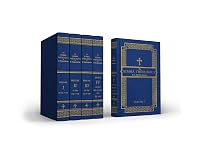
Summa Theologiae
by Thomas Aquinas
On This Page
Description
The Summa Theologiae ranks among the greatest documents of the Christian Church, and is a landmark of medieval western thought. It provides the framework for Catholic studies in systematic theology and for a classical Christian philosophy, and is regularly consulted by scholars of all faiths and none, across a range of academic disciplines. This paperback reissue of the classic Latin/English edition first published by the English Dominicans in the 1960s and 1970s, in the wake of the Second show more Vatican Council, has been undertaken in response to regular requests from readers and librarians around the world for the entire series of 61 volumes to be made available again. The original text is unchanged, except for the correction of a small number of typographical errors. show lessTags
Recommendations

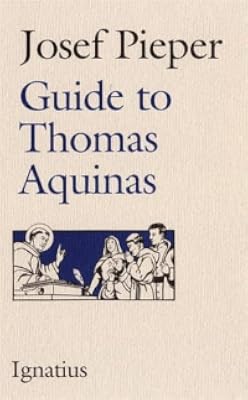
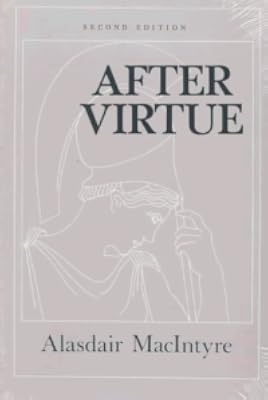
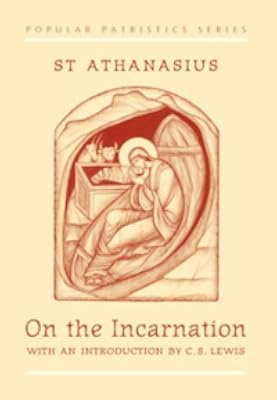
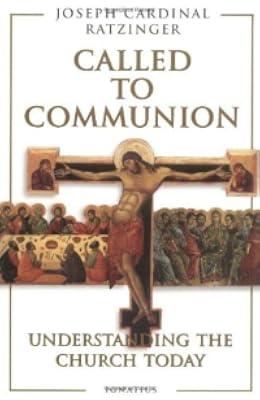


Member Recommendations

TedWitham Most of us read only excerpts from the Summa Theologica, and gain the impression that Aquinas was primarily an abstract philosopher applying Aristotlean ideas to Christianity. While this has some truth, Matthew Fox's overview shows Aquinas' strength as a Biblical scholar.

Member Reviews
This giant work is worthy of the Great Ideas. However, if there's one entry for which a well-chosen sampling is sufficient, this is it. Aquinas lived in the middle part of the 1200's. He was born to better-than-average means and was often offered high places within the church. He declined the latter in order to teach. He was a defender of the Dominican sect, bringing a new rigor to the form of religious "science" and also great reputation for himself. He brings the dialectic format of Socrates and the precision of Aristotle to the ongoing refinement of religious doctrine. Within that context, his ideas and style were novel and for this he did indeed offer a new, great idea. He falls short, however, of offering the type of religious show more truth one might hope for. His premise begins with the Bible, existing Catholic doctrine, and a number of philosophers, those other than Aristotle primarily religious. He quotes the vulgate and Aristotle most frequently. With this base of "facts," it is hard for his great format to proceed to build anything other than a solid castle built on that which might not be. The new leap he made was the setting of a hypothesis, along with supporting evidence, followed by rejection based more evidence. He also argues a lot of points that, while surely important at the time, strike me as something I could just as well wait to find out (Whether God is the Same as His Essense, Whether the Human Soul Was Produced Before the Body, Whether the Body of Man was Given a Fitting Disposition, How Angels Move). I'm sure the church felt differently, having a strong scholarly drive and a need to be able to project a doctrine consistent within itself. show less
1
This is perhaps the best edition of Saint Thomas Aquinas's famous magnum opus. I was given this set as a very expensive, very generous gift from a friend, and I could not believe how exquisite it was. The original Latin is a nice touch, it offers a more intimate study simply by being present, even if one cannot understand the text. I truly love my eight-volume Summa Theologiæ, and it is the most prized book in my collection.
The best one-volume Latin Summa Theologiae. It is finely crafted, with high quality paper, clear type, and well spaced columns. It has excellent footnotes and cross-references with scholarship up to the 1950s. It can only be purchased new from Rome.
The Summa Theologica (Latin: "Summary of Theology" or "Highest Theology") is the most famous work of Thomas Aquinas (1225–1274). It was intended as a manual for beginners as a compilation of all of the main theological teachings of the time. It summarizes the reasoning of all points of Christian theology, which before the Protestant Reformation subsisted solely in the Roman Catholic Church. The Summa's topics follow a cycle: the existence of God; God's creation, Man; Man's purpose; Christ; the Sacraments; and back to God. It is famous for its five arguments for the existence of God, the Quinquae viae (Latin: five ways). Throughout his work, Aquinas cites Augustine of Hippo, Aristotle, and other Christian, Jewish, Muslim and ancient show more pagan scholars.
This is an electronic edition of the complete book and includes an author biography. This book features a table of contents linked to every chapter. show less
This is an electronic edition of the complete book and includes an author biography. This book features a table of contents linked to every chapter. show less
Yes, I have indeed read almost the whole thing. That's what happens when you're raised in an isolated religious environment and you try to be a thinker.
8423903109
JB-8
Nov 27, 2024Catalan
Members
- Recently Added By
Lists

100 Books to Read in a Lifetime (That Are Older Than 200 Years)
415 works; 175 members

Church Times 100 Best Christian Books
106 works; 26 members

Art of Reading
188 works; 5 members

How to Read a Book's Recommended Reading List
309 works; 10 members

Favourite Books
1,819 works; 308 members

Greatest Books, allegedly
484 works; 10 members

Books Referenced by Izetbegovic's Islam Between East and West
233 works; 2 members

Philosophy, Politics and Economics
61 works; 1 member

Books Read in 2021
5,361 works; 113 members

Book Titles Mentioned In Newberry Medal And Honor Books
884 works; 3 members

Recommended Reading : 600 Classics Reviewed, Editors of Salem Press, 2015
634 works; 6 members

Recommendations by Peter Kreeft
45 works; 4 members

Philosophy
23 works; 1 member
Author Information

2,194+ Works 27,847 Members
Thomas Aquinas, the most noted philosopher of the Middle Ages, was born near Naples, Italy, to the Count of Aquino and Theodora of Naples. As a young man he determined, in spite of family opposition to enter the new Order of Saint Dominic. He did so in 1244. Thomas Aquinas was a fairly radical Aristotelian. He rejected any form of special show more illumination from God in ordinary intellectual knowledge. He stated that the soul is the form of the body, the body having no form independent of that provided by the soul itself. He held that the intellect was sufficient to abstract the form of a natural object from its sensory representations and thus the intellect was sufficient in itself for natural knowledge without God's special illumination. He rejected the Averroist notion that natural reason might lead individuals correctly to conclusions that would turn out false when one takes revealed doctrine into account. Aquinas wrote more than sixty important works. The Summa Theologica is considered his greatest work. It is the doctrinal foundation for all teachings of the Roman Catholic Church. show less
Awards and Honors
Work Relationships
Contains
Is abridged in
Has as a study
Has as a supplement
Common Knowledge
- Canonical title
- Summa Theologiae
- Original title
- Summa Theologiae
- Alternate titles
- Summa theologica
- Original publication date
- 1265-1273; 1265–1274
- First words
- Article 1. Whether, besides philosophy, any further doctrine is required?
Objection 1. It seems that, besides philosophical science, we have no need of any further knowledge. For man should not seek to know what is abo... (show all)ve reason: "Seek not the things that are too high for thee" (Sirach 3:22). But whatever is not above reason is fully treated of in philosophical science. Therefore any other knowledge besides philosophical science is superfluous. - Last words
- (Click to show. Warning: May contain spoilers.)Reply to Objection 3. This argument considers the point of special dispensation and not that of the common law.
- Original language
- Latin
Classifications
- Genres
- Religion & Spirituality, Nonfiction, Philosophy, General Nonfiction
- DDC/MDS
- 230.2 — Religion Christianity Christianity Pre-reformation and Roman Catholic
- LCC
- BX1749 .T5 — Philosophy, Psychology and Religion Christian Denominations Christian Denominations Catholic Church Theology. Doctrine. Dogmatics
- BISAC
Statistics
- Members
- 1,541
- Popularity
- 14,867
- Reviews
- 9
- Rating
- (4.11)
- Languages
- 9 — Czech, English, Finnish, Italian, Latin, Multiple languages, Portuguese, Romanian, Spanish
- Media
- Paper, Ebook
- ISBNs
- 53
- UPCs
- 2
- ASINs
- 34