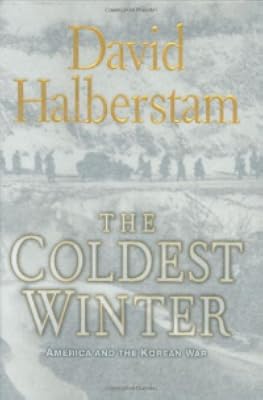
The Coldest Winter: America and the Korean War
by David Halberstam
On This Page
Description
Pulitzer-winning historian Halberstam first decided to write this book more than thirty years ago and it took him nearly ten years. It stands as a lasting testament to its author, and to the fighting men whose heroism it chronicles. Halberstam gives us a full narrative of the political decisions and miscalculations on both sides, charting the disastrous path that led to the massive entry of Chinese forces near the Yalu, and that caught Douglas MacArthur and his soldiers by surprise. He show more provides vivid portraits of all the major figures--Eisenhower, Truman, Acheson, Kim, and Mao, and Generals MacArthur, Almond, and Ridgway. He also provides us with his trademark narrative journalism, chronicling the crucial battles with reportage of the highest order. At the heart of the book are the stories of the soldiers on the front lines who were left to deal with the consequences of the dangerous misjudgments and competing agendas of powerful men.--From publisher description. show lessTags
Recommendations













Member Reviews
את ספרו של הלברסטם על ויאטנם קראתי לפני שנים רבות ואהבתי מאוד. את הספר הזה, על מלחמת קוריאה קראתי בעניין רב ואהבתי עוד יותר כי למדתי ממנו המון. בהתחשב בזה שעיסוקי בחצי השני של חיי היה מחקרים צבאיים זו בושה ממש שלא קראתי ולא ידעתי כלום על מלחמת קוריאה. הספר קצת מסביר למה. על כל פנים המלחמה עצמה והניתוח של הלברסתם הרבה יותר רלוונטי לנו ומלא לקחים מרתקים מאשר העיסוק הבלתי פוסק במלחמת העולם השנייה, ברומל ובמלחמת show more יום כיפור. עמדתו המוסרית החזקה ויכולת הכתיבה המרתקת של המחבר רק מוסיפים לעניין. הקדשתי לספר את הלילות של קיץ 2014 והוא הוסיף טעם לחיי הדי עלובים בקיץ הזה. show less
Halberstam was one of the greatest war correspondents and political journalists of the 20th century, and his talents are on display in this massive history of the Korean War. Equally adept at describing the horrors of a battlefield and the political decisions leading up to that battle, Halberstam takes the reader through the major moments and decisions of the Korean War.
His framing device is simple. Douglas MacArthur versus: vs Communists, vs the Truman administration, vs his own soldiers and ultimately, vs reality. MacArthur and his cronies are given little respect. In Halberstam's account, it's his usurpation of political authority in declaring Korea no longer part of America's Pacific perimeter that gives Stalin and Mao permission to show more let Kim Il Sung attack. It's his arrogance that sends outnumbered and poorly trained GIs into Korea to fight and die. And above all, it is his sycophantic staff and immense ego that allowed UN forces to be sucker-punched not once, but twice in less than a year.
This MacArthur centric-framing is probably not the most historically evenhanded, but it makes for a fun read, and this book needs all fun it can get. There's little to delight in-mostly bloody defeats, political miscalculations, and a paranoia as enveloping as the Manchurian cold. Halberstam does an amazing job bringing the players of the Korean War to life, although Washington DC is the major focus, with the rest of the UN coalition and the South Koreans given short shrift. Still, this is a classic of modern military history, and probably the 'one book' on the Korean War. show less
His framing device is simple. Douglas MacArthur versus: vs Communists, vs the Truman administration, vs his own soldiers and ultimately, vs reality. MacArthur and his cronies are given little respect. In Halberstam's account, it's his usurpation of political authority in declaring Korea no longer part of America's Pacific perimeter that gives Stalin and Mao permission to show more let Kim Il Sung attack. It's his arrogance that sends outnumbered and poorly trained GIs into Korea to fight and die. And above all, it is his sycophantic staff and immense ego that allowed UN forces to be sucker-punched not once, but twice in less than a year.
This MacArthur centric-framing is probably not the most historically evenhanded, but it makes for a fun read, and this book needs all fun it can get. There's little to delight in-mostly bloody defeats, political miscalculations, and a paranoia as enveloping as the Manchurian cold. Halberstam does an amazing job bringing the players of the Korean War to life, although Washington DC is the major focus, with the rest of the UN coalition and the South Koreans given short shrift. Still, this is a classic of modern military history, and probably the 'one book' on the Korean War. show less
El título del libro no corresponde con el original (que sería The Coldest Winter, el invierno más frío) pero si que cuadra con una guerra sobre la que se ha escrito muy poco (en contraste, puedes levantar un pisito con los libros sobre la Segunda Guerra Mundial o la Guerra Civil Española)
Aunque no es una historia completa de la guerra (hay partes que las pasa muy por encima pese a sus 900 páginas) muestra una perspectiva bastante interesante (dándole mucha importancia a la política estadounidense y a los conflictos entre Truman y MacArthur (las críticas a este último son devastadoras). También hace mucho énfasis en el punto de vista del soldado de a pie (con muchas declaraciones de supervivientes) Otra cosa que me llama la show more atención es que no te cuenta la historia linealmente, sino que empieza con el primer choque entre las Naciones Unidas y los chinos para luego retroceder a los antecedentes de la guerra y seguir con saltos continuos entre Corea, Washington y Tokio, a mi esa forma de contarlo me gusta, pero igual a algunos lectores les echa para atrás.
Le pondría un par de pegas, lo primero es la ya mencionada de que pasa muy por encima de la fase final de la guerra y lo segundo es que probablemente necesitase algunos mapas más (cuesta mucho orientarse en un entorno tan desconocido como el de Corea) Pero en general me ha parecido un libro excelente (por lo menos desde mi punto de vista de desconocedor de la historia coreana) show less
Aunque no es una historia completa de la guerra (hay partes que las pasa muy por encima pese a sus 900 páginas) muestra una perspectiva bastante interesante (dándole mucha importancia a la política estadounidense y a los conflictos entre Truman y MacArthur (las críticas a este último son devastadoras). También hace mucho énfasis en el punto de vista del soldado de a pie (con muchas declaraciones de supervivientes) Otra cosa que me llama la show more atención es que no te cuenta la historia linealmente, sino que empieza con el primer choque entre las Naciones Unidas y los chinos para luego retroceder a los antecedentes de la guerra y seguir con saltos continuos entre Corea, Washington y Tokio, a mi esa forma de contarlo me gusta, pero igual a algunos lectores les echa para atrás.
Le pondría un par de pegas, lo primero es la ya mencionada de que pasa muy por encima de la fase final de la guerra y lo segundo es que probablemente necesitase algunos mapas más (cuesta mucho orientarse en un entorno tan desconocido como el de Corea) Pero en general me ha parecido un libro excelente (por lo menos desde mi punto de vista de desconocedor de la historia coreana) show less
I love a really good history book, and nobody wrote them better than David Halberstam. As a young journalist, he was there in the early years in Vietnam, and out of it came THE BEST AND THE BRIGHTEST, the first, and for many, the best book about how America lost its way in that war. He also wrote THE POWERS THAT BE, an authoritative history of the news media in America from the early 20th Century to the mid ‘70s, and THE FIFTIES, an exhaustive look at the politics and the culture of that decade. THE COLDEST WINTER: AMERICA AND THE KOREAN WAR sat on my shelf far too long, for it might be the best book I’ve yet to read on that long ago conflict and it contains some of Halberstam’s best writing.
I’ve read a number of books on the show more Korean conflict, including Clay Blair’s authoritative history, THE FORGOTTEN WAR, William Manchester’s bio of Douglas MacArthur, AMERICAN CAESAR, and most recently, H.W. Brands’ THE GENERAL AND THE PRESIDENT, all good works that stand on their own, but I think Halberstam’s book might be the best on any of any of them. At nearly 700 pages, THE COLDEST WINTER, moves seamlessly from the halls of power in Washington, Moscow, Beijing, and Tokyo to the front lines on the Korean peninsula, where American soldiers and Marines fought and died on some of the most brutal battlefields ever, under the worst possible conditions ever. It was a war America most certainly didn’t want to fight, coming so soon after the struggle of World War II, and though it was considered a draw at best when the truce was finally signed, Halberstam makes the case that it was worth it in the end. All books on this subject have to do a lot of unpacking of old history to explain why and how the conflict in Korea happened. Halberstam is good at giving a concise recounting of the Chinese Civil War of the late 1940’s, which ended in the triumph of Mao Zedong’s Communists over Chaing Kai-chek’s Nationalists, with the latter retreating to the island of Taiwan. America had backed the losing side in that conflict, giving millions upon millions of dollars to Chaing, and investing much political prestige to his cause. The triumph of Mao in China was one of the most important events of the 20th Century, with huge political ramifications in America, where the long out of power Republican Party embraced the notion that Communists had infiltrated the Democratic Administrations of Franklin Roosevelt and Harry Truman, actively working to further the interests of Communists abroad. Halberstam goes behind closed doors in Moscow and Beijing and brings to light what went on between these two Communist giants in the months preceding the opening of hostilities and after the fighting began. This is often a blind spot in other histories of the war. We get a take on just who Stalin and Mao were, how they operated, and just what their relationship with Kim Il Sung, the founder of the Korean Communist Party, was. Kim had set up a regime in the northern half of the peninsula occupied by the Soviets at the end of World War II, and was determined to unify his country, long under a brutal colonial occupation by the Japanese. The southern half was ostensibly part of the American occupation of Japan, with a government set up in Seoul by Syngman Rhee, who had spent years outside his country agitating for its independence. When Washington mistakenly made statements that seemed to put Korea outside of it national interest, Kim saw an opening, and got Stalin’s military support for an invasion of the South, and a quick reunification of the country under Communist rule. When the North Koreans invaded in late June of 1950, America had no choice but to come to aide of Seoul lest the Communists score another big win on the Asian mainland.
From the desperate days of the Pusan perimeter, to the landing at Inchon, THE COLDEST WINTER details how the Korean War was nearly lost except for the determination and bravery of outnumbered American troops, and then virtually won overnight by a daring and risky counter offensive orchestrated by General Douglas MacArthur. At this point the decision was made to push north and destroy Kim’s remaining forces, and unify Korea. This meant American and its UN allies marching all the way to the Yalu River, which separated Korea from Manchuria, and Mao, deeply suspicious that the Americans ultimately meant to restore Chaing to power, was not about to let that happen. He sent hundreds of thousands of his battle hardened troops of the People’s Liberation Army across the Yalu to meet the Americans head on in some of the most inhospitable terrain on earth just as winter was about to set in. What followed was maybe the hardest war any soldier ever fought.
Though the book details the enormous historical forces at work in those times, I think its strongest point is when it deals with the personalities involved, either in uniform or out. Stalin is an absolute dictator, ruling by brute force and distrusting of anyone he cannot have executed at will, and very wary of the new Communist leader in Beijing. Mao is a Marist ideologue with an abundant faith in a “peasants’ revolution,” while at the same time, a staunch Chinese patriot, determined to make his country a world power again. Kim is Stalin’s disciple who will ultimately outdo the teacher when comes to leading repressive regimes, while deeply committed to building an independent Korean nation after centuries of foreign domination. Harry Truman is a canny politician walking a fine line amidst the Cold War, attempting to hold the line against Communist aggression worldwide while gingerly sidestepping nuclear war. Douglas MacArthur is the General who led the allies to victory in the Pacific, and now leads the occupation of Japan, thus making him the commander on the ground in Korea when the war starts. MacArthur is vain and egotistical, with a staff of sycophants in Tokyo, and filled with contempt for civilian authority; he is also without any friends among his fellow officers in high positions in Washington, something which will do him no good in the long run. Dean Acheson, George Marshall, Omar Bradley, George Kennan, among others, play prominent parts in the story. Halberstam had a keen eye for good officers who saved the lives of their men, were quick to improvise and adjust when things went wrong on the battlefield (which happened often in Korea), and who read the enemy and figured out how to beat him. Among those who deservedly get praise are Generals Walton Walker, who held off the North Koreans at Pusan, and helped lead the drive North, and his successor in command of the 8th Army, Matthew Ridgeway, a soldier’s soldier, who snatched survival from the jaws of annihilation in the face of Mao’s armies, and fought the People’s Liberation Army to a bloody standstill. Then there was General Ned Almond, MacArthrur’s Chief of Staff who commanded the 10th Corp in Korea, an over confident martinet filled with contempt for his Asian enemies, unable to recognize the military disaster all around him. Charles Willoughby was MacArthur’s chief of intelligence, whose deliberate suppression of evidence that the Chinese were coming into the war bordered on the criminal. And while all these high ranking officers get plenty of space, THE COLDEST WINTER also puts the spotlight on the frontline officers and soldiers who did the fighting and the dying. There are harrowing accounts of being overrun by the Chinese; retreating down winding mountain roads under constant fire by the enemy on higher ground; of comrades being ground under tank treads while others crawled for miles to safety after being badly wounded; of having to stand and fight until you’re killed or run out of ammunition, whichever comes first; of men left behind in a disorderly retreat who were never heard from again. THE COLDEST WINTER introduced me to the names of Paul McGee, O.P. Smith, and Paul Freeman, and why they are heroes worthy of being remembered.
David Halberstam was one of the early journalists who went to Vietnam, reporting on that war and telling the truth about what was happening there. He became one of the scapegoats of those who tried to blame the debacle of the Vietnam War on “un-American reporters who undermined our troops.” I think Halberstam had great respect for the men who put it on the line for America, but he had an unsparing eye for spin, deliberate falsehoods, hubris, and self delusion among the powerful who should know better when responsible for the lives of others. One of the best things he does in THE COLDEST WINTER is lay out the miscalculations among those in authority that not only led to the Korean War, but were perpetrated on the battlefield at the cost of thousands of lives. Though he is far from the only guilty party, Halberstam is merciless when it comes to MacArthur, painting the portrait of an aging out of touch General, too believing in his own good press, who sends American soldiers headlong into a massive Chinese ambush when there was ample intelligence warning him ahead of time. The General’s confrontation with Truman that resulted in his firing had been well documented in other books, but Halberstam more than makes the case that MacArthur deliberately provoked his dismissal to further political ambitions that came to nothing. The author also has a take on the emotional outpouring that greeted MacArthur when he returned to America that I found interesting, one I had not considered before.
Halberstam makes the case at the end of the book that this unpopular war, which seemingly ended in a stalemate, was worth it, that the men who fought it and came home to public indifference had a right to be proud of their sacrifice. They saved South Korea, and gave the long oppressed people of that country a chance to prosper on their own, and build a democracy. But there was a darker legacy of the Korean War, one that cast a long shadow in Washington, and Halberstam is unsparing in documenting that as well. THE COLDEST WINTER was his last book, one that was decades in the making according to his final notes. As someone who loves reading history, I must say that he is sorely missed. show less
I’ve read a number of books on the show more Korean conflict, including Clay Blair’s authoritative history, THE FORGOTTEN WAR, William Manchester’s bio of Douglas MacArthur, AMERICAN CAESAR, and most recently, H.W. Brands’ THE GENERAL AND THE PRESIDENT, all good works that stand on their own, but I think Halberstam’s book might be the best on any of any of them. At nearly 700 pages, THE COLDEST WINTER, moves seamlessly from the halls of power in Washington, Moscow, Beijing, and Tokyo to the front lines on the Korean peninsula, where American soldiers and Marines fought and died on some of the most brutal battlefields ever, under the worst possible conditions ever. It was a war America most certainly didn’t want to fight, coming so soon after the struggle of World War II, and though it was considered a draw at best when the truce was finally signed, Halberstam makes the case that it was worth it in the end. All books on this subject have to do a lot of unpacking of old history to explain why and how the conflict in Korea happened. Halberstam is good at giving a concise recounting of the Chinese Civil War of the late 1940’s, which ended in the triumph of Mao Zedong’s Communists over Chaing Kai-chek’s Nationalists, with the latter retreating to the island of Taiwan. America had backed the losing side in that conflict, giving millions upon millions of dollars to Chaing, and investing much political prestige to his cause. The triumph of Mao in China was one of the most important events of the 20th Century, with huge political ramifications in America, where the long out of power Republican Party embraced the notion that Communists had infiltrated the Democratic Administrations of Franklin Roosevelt and Harry Truman, actively working to further the interests of Communists abroad. Halberstam goes behind closed doors in Moscow and Beijing and brings to light what went on between these two Communist giants in the months preceding the opening of hostilities and after the fighting began. This is often a blind spot in other histories of the war. We get a take on just who Stalin and Mao were, how they operated, and just what their relationship with Kim Il Sung, the founder of the Korean Communist Party, was. Kim had set up a regime in the northern half of the peninsula occupied by the Soviets at the end of World War II, and was determined to unify his country, long under a brutal colonial occupation by the Japanese. The southern half was ostensibly part of the American occupation of Japan, with a government set up in Seoul by Syngman Rhee, who had spent years outside his country agitating for its independence. When Washington mistakenly made statements that seemed to put Korea outside of it national interest, Kim saw an opening, and got Stalin’s military support for an invasion of the South, and a quick reunification of the country under Communist rule. When the North Koreans invaded in late June of 1950, America had no choice but to come to aide of Seoul lest the Communists score another big win on the Asian mainland.
From the desperate days of the Pusan perimeter, to the landing at Inchon, THE COLDEST WINTER details how the Korean War was nearly lost except for the determination and bravery of outnumbered American troops, and then virtually won overnight by a daring and risky counter offensive orchestrated by General Douglas MacArthur. At this point the decision was made to push north and destroy Kim’s remaining forces, and unify Korea. This meant American and its UN allies marching all the way to the Yalu River, which separated Korea from Manchuria, and Mao, deeply suspicious that the Americans ultimately meant to restore Chaing to power, was not about to let that happen. He sent hundreds of thousands of his battle hardened troops of the People’s Liberation Army across the Yalu to meet the Americans head on in some of the most inhospitable terrain on earth just as winter was about to set in. What followed was maybe the hardest war any soldier ever fought.
Though the book details the enormous historical forces at work in those times, I think its strongest point is when it deals with the personalities involved, either in uniform or out. Stalin is an absolute dictator, ruling by brute force and distrusting of anyone he cannot have executed at will, and very wary of the new Communist leader in Beijing. Mao is a Marist ideologue with an abundant faith in a “peasants’ revolution,” while at the same time, a staunch Chinese patriot, determined to make his country a world power again. Kim is Stalin’s disciple who will ultimately outdo the teacher when comes to leading repressive regimes, while deeply committed to building an independent Korean nation after centuries of foreign domination. Harry Truman is a canny politician walking a fine line amidst the Cold War, attempting to hold the line against Communist aggression worldwide while gingerly sidestepping nuclear war. Douglas MacArthur is the General who led the allies to victory in the Pacific, and now leads the occupation of Japan, thus making him the commander on the ground in Korea when the war starts. MacArthur is vain and egotistical, with a staff of sycophants in Tokyo, and filled with contempt for civilian authority; he is also without any friends among his fellow officers in high positions in Washington, something which will do him no good in the long run. Dean Acheson, George Marshall, Omar Bradley, George Kennan, among others, play prominent parts in the story. Halberstam had a keen eye for good officers who saved the lives of their men, were quick to improvise and adjust when things went wrong on the battlefield (which happened often in Korea), and who read the enemy and figured out how to beat him. Among those who deservedly get praise are Generals Walton Walker, who held off the North Koreans at Pusan, and helped lead the drive North, and his successor in command of the 8th Army, Matthew Ridgeway, a soldier’s soldier, who snatched survival from the jaws of annihilation in the face of Mao’s armies, and fought the People’s Liberation Army to a bloody standstill. Then there was General Ned Almond, MacArthrur’s Chief of Staff who commanded the 10th Corp in Korea, an over confident martinet filled with contempt for his Asian enemies, unable to recognize the military disaster all around him. Charles Willoughby was MacArthur’s chief of intelligence, whose deliberate suppression of evidence that the Chinese were coming into the war bordered on the criminal. And while all these high ranking officers get plenty of space, THE COLDEST WINTER also puts the spotlight on the frontline officers and soldiers who did the fighting and the dying. There are harrowing accounts of being overrun by the Chinese; retreating down winding mountain roads under constant fire by the enemy on higher ground; of comrades being ground under tank treads while others crawled for miles to safety after being badly wounded; of having to stand and fight until you’re killed or run out of ammunition, whichever comes first; of men left behind in a disorderly retreat who were never heard from again. THE COLDEST WINTER introduced me to the names of Paul McGee, O.P. Smith, and Paul Freeman, and why they are heroes worthy of being remembered.
David Halberstam was one of the early journalists who went to Vietnam, reporting on that war and telling the truth about what was happening there. He became one of the scapegoats of those who tried to blame the debacle of the Vietnam War on “un-American reporters who undermined our troops.” I think Halberstam had great respect for the men who put it on the line for America, but he had an unsparing eye for spin, deliberate falsehoods, hubris, and self delusion among the powerful who should know better when responsible for the lives of others. One of the best things he does in THE COLDEST WINTER is lay out the miscalculations among those in authority that not only led to the Korean War, but were perpetrated on the battlefield at the cost of thousands of lives. Though he is far from the only guilty party, Halberstam is merciless when it comes to MacArthur, painting the portrait of an aging out of touch General, too believing in his own good press, who sends American soldiers headlong into a massive Chinese ambush when there was ample intelligence warning him ahead of time. The General’s confrontation with Truman that resulted in his firing had been well documented in other books, but Halberstam more than makes the case that MacArthur deliberately provoked his dismissal to further political ambitions that came to nothing. The author also has a take on the emotional outpouring that greeted MacArthur when he returned to America that I found interesting, one I had not considered before.
Halberstam makes the case at the end of the book that this unpopular war, which seemingly ended in a stalemate, was worth it, that the men who fought it and came home to public indifference had a right to be proud of their sacrifice. They saved South Korea, and gave the long oppressed people of that country a chance to prosper on their own, and build a democracy. But there was a darker legacy of the Korean War, one that cast a long shadow in Washington, and Halberstam is unsparing in documenting that as well. THE COLDEST WINTER was his last book, one that was decades in the making according to his final notes. As someone who loves reading history, I must say that he is sorely missed. show less
Despite having been a history major, or perhaps because of it, these days I prefer my history tomes readable. David Halberstam's The Coldest Winter is both of these: a tome and readable. Originally a journalist, Halberstam's book is like an extended story, one whose cast of characters include the great (MacArthur, Truman, Acheson, Mao) and the everyman who might have been us (Paul McGee, Pappy Miller). These biographies are woven into the story so that we live the action through the characters, rather than observe the battles from a distance of time and space. I was thoroughly engaged throughout and wish that I could have been a fly on the wall during all the interviews that Halberstam conducted in the course of researching the book. show more General or infantryman, heroic or weak, the people are fascinating.
The other strength of the book is the clear way in which the author explains the origins and first winter of the war. Part I draws the reader in with a spell-binding, edge of your seat telling of the Chinese ambush of the American forces at Unsan. Once hooked, Halberstam takes you through the political forces, both domestic and internationally, which led to the Korean War. Then once again he returns to Korea and relates first the defeats and then the limited victories that were to define the war.
For anyone interested in an introduction to the Korean War, I would highly recommend The Coldest Winter. show less
The other strength of the book is the clear way in which the author explains the origins and first winter of the war. Part I draws the reader in with a spell-binding, edge of your seat telling of the Chinese ambush of the American forces at Unsan. Once hooked, Halberstam takes you through the political forces, both domestic and internationally, which led to the Korean War. Then once again he returns to Korea and relates first the defeats and then the limited victories that were to define the war.
For anyone interested in an introduction to the Korean War, I would highly recommend The Coldest Winter. show less
Sort of a biographical history of the Korean War. There’s not too much in the way of battle description; the retreat from Unsan (out of chronological order), battles at the Naktong Bulge, the Inchon landing, the near-destruction of the 2nd Infantry at the retreat to Sunchon, the Marines’ retreat from Chosin Reservoir, and the battles around Chipyongni. Much of the book is taken up by politics; in particular pretty harsh criticism of Douglas MacArthur, who comes across as a militarily incompetent megalomaniac. (If anything, I think Halberstam is too lenient to MacArthur; he claims MacArthur was “a military genius” in the Pacific theater in WWII without much basis).
According to Halberstam, MacArthur surrounded himself with “yes show more men”; he’s particularly hard on Charles Willoughby, MacArthur’s G2. Willoughby consistently filtered intelligence reports to MacArthur to ensure they contained what MacArthur wanted to hear, not what was actually happening; thus reports that the Chinese would enter the war were consistently discounted (the US had excellent intelligence reports on the Chinese; when they defeated the Nationalists, they had to retain many of the technicians in the now Communist army. These “former” Nationalists used their radios to send clandestine reports to Taiwan and on to the US. MacArthur ignored all these reports, claiming that he “understood the Oriental mind” and the Chinese would not enter the war).
Halberstam’s battle account are grimly realistic; however, they’re almost all about small unit actions. I suspect the reason is Halberstam, like most journalists, prefer interviews – and Korean war veterans are now scarce enough that the only ones left to interview were lieutenants at most during the war, and thus didn’t see much of the “big picture”.
When he can’t interview, Halberstam relies heavily on biography rather than history. I’ve already mentioned MacArthur and his staff; others covered are Matthew Ridgeway (portrayed as the most effective United Nations general in the campaign); Harry Truman (slightly criticized for failing to reign in MacArthur earlier); Mao Tse-Tung (surprisingly similar to MacArthur- distant from the battlefield, clueless as to what was going on, and a prisoner of ideology, insisting that working-class American soldiers would not fight on behalf of their capitalist masters); Kim Il Sung, also a prisoner of ideology - imagining that millions of oppressed South Koreans would rise up to overthrow their overlords as soon as the In Min Gun crossed the border (Halberstam notes that Kim Il Sung disregarded intelligence reports that the United States would stage a seaborne invasion, even though that intelligence came from China and the Soviet Union; and Peng Dehuai, the extremely competent Chinese general (eventually beaten to death during the Cultural Revolution due to a letter he wrote to Mao suggesting that maybe things were going a little too fast).
Halberstam claims that the Korean War set the stage for American politics for the next 20 years. The Democrats became the people who had “lost China” and who had failed to support MacArthur. That supposedly led to Democrats being afraid of being accused of being “weak” on Communism, and thus to things like the Bay of Pigs and Vietnam (Lyndon Johnson is quoted as saying that he would never get the Great Society if Ho Chi Min was running through the streets of Saigon).
With impeccable hindsight, Halberstam does have some ideas about what should have been done:
• Relieve MacArthur right after Inchon. Have him come home a triumphant hero.
• Bypass Seoul after Inchon; instead concentrate on bagging the remainder of the North Korean army in the south.
• Not cross the 38th parallel and thus not provoke Chinese entry. It’s not clear how politically acceptable this would have been back home.
• Cross the 38th parallel, but stop at about the 39th , where the Korean peninsula is narrowest, dig in, and go on the defensive. This would have left Pyongyang in United Nations hands. If the Chinese entered at that point, turn it into a war of attrition, with United Nations air power and artillery countering Chinese attacks. Also might have been unpopular at home, but the UN could negotiate from a position of strength.
• Assuming the historical situation when the Chinese entered, do not retreat and get ambushed. Instead lager up and resupply surrounded troops by air until ground forces could relieve them. This is what Ridgeway, an Airborne commander, wanted to do. I’m not sure it would have worked; OTOH the US had just finished the Berlin Airlift, which involved supplying an entire city by air.
All in all a good account and an easy read. Lots of good maps. The only thing really missing is any account of the air war. For another journalistic view, see Enter the Dragon. show less
According to Halberstam, MacArthur surrounded himself with “yes show more men”; he’s particularly hard on Charles Willoughby, MacArthur’s G2. Willoughby consistently filtered intelligence reports to MacArthur to ensure they contained what MacArthur wanted to hear, not what was actually happening; thus reports that the Chinese would enter the war were consistently discounted (the US had excellent intelligence reports on the Chinese; when they defeated the Nationalists, they had to retain many of the technicians in the now Communist army. These “former” Nationalists used their radios to send clandestine reports to Taiwan and on to the US. MacArthur ignored all these reports, claiming that he “understood the Oriental mind” and the Chinese would not enter the war).
Halberstam’s battle account are grimly realistic; however, they’re almost all about small unit actions. I suspect the reason is Halberstam, like most journalists, prefer interviews – and Korean war veterans are now scarce enough that the only ones left to interview were lieutenants at most during the war, and thus didn’t see much of the “big picture”.
When he can’t interview, Halberstam relies heavily on biography rather than history. I’ve already mentioned MacArthur and his staff; others covered are Matthew Ridgeway (portrayed as the most effective United Nations general in the campaign); Harry Truman (slightly criticized for failing to reign in MacArthur earlier); Mao Tse-Tung (surprisingly similar to MacArthur- distant from the battlefield, clueless as to what was going on, and a prisoner of ideology, insisting that working-class American soldiers would not fight on behalf of their capitalist masters); Kim Il Sung, also a prisoner of ideology - imagining that millions of oppressed South Koreans would rise up to overthrow their overlords as soon as the In Min Gun crossed the border (Halberstam notes that Kim Il Sung disregarded intelligence reports that the United States would stage a seaborne invasion, even though that intelligence came from China and the Soviet Union; and Peng Dehuai, the extremely competent Chinese general (eventually beaten to death during the Cultural Revolution due to a letter he wrote to Mao suggesting that maybe things were going a little too fast).
Halberstam claims that the Korean War set the stage for American politics for the next 20 years. The Democrats became the people who had “lost China” and who had failed to support MacArthur. That supposedly led to Democrats being afraid of being accused of being “weak” on Communism, and thus to things like the Bay of Pigs and Vietnam (Lyndon Johnson is quoted as saying that he would never get the Great Society if Ho Chi Min was running through the streets of Saigon).
With impeccable hindsight, Halberstam does have some ideas about what should have been done:
• Relieve MacArthur right after Inchon. Have him come home a triumphant hero.
• Bypass Seoul after Inchon; instead concentrate on bagging the remainder of the North Korean army in the south.
• Not cross the 38th parallel and thus not provoke Chinese entry. It’s not clear how politically acceptable this would have been back home.
• Cross the 38th parallel, but stop at about the 39th , where the Korean peninsula is narrowest, dig in, and go on the defensive. This would have left Pyongyang in United Nations hands. If the Chinese entered at that point, turn it into a war of attrition, with United Nations air power and artillery countering Chinese attacks. Also might have been unpopular at home, but the UN could negotiate from a position of strength.
• Assuming the historical situation when the Chinese entered, do not retreat and get ambushed. Instead lager up and resupply surrounded troops by air until ground forces could relieve them. This is what Ridgeway, an Airborne commander, wanted to do. I’m not sure it would have worked; OTOH the US had just finished the Berlin Airlift, which involved supplying an entire city by air.
All in all a good account and an easy read. Lots of good maps. The only thing really missing is any account of the air war. For another journalistic view, see Enter the Dragon. show less
Great account of the American experience in the Korean War. Contains compelling accounts of the soldiers at the front but I found the political-military battle in the upper echelons of the US gov't to be the most fascinating part of the book. Halberstam is particularly good at handling Dugout Doug MacArthur who was equal parts genius and arrogant fool in the early stage of the Korean War
Members
- Recently Added By
Lists

End of Your Life Book Club
134 works; 4 members

THE WAR ROOM
813 works; 24 members
Author Information

43+ Works 16,050 Members
David Halberstam was born on April 10, 1934 in New York City and later attended Harvard University. After graduating in 1955, Halberstam worked at a small daily newspaper until he attained a position at the Nashville Tennessean. Halberstam has written over 20 books including The Children, a written account of his coverage of the Civil Rights show more Movement; The Best and Brightest, which was a bestseller; and The Game and October, 1964, both detailing his fascination of sports. Halberstam also won a Pulitzer Prize for his reports on the Vietnam War while working for the New York Times. He was killed in a car crash on April 23, 2007 at the age of 73. (Bowker Author Biography) show less
Some Editions
Awards and Honors
Awards
Common Knowledge
- Original title
- The Coldest Winter: America and the Korean War
- Original publication date
- 2007-09-25
- People/Characters
- Harry S. Truman; Dean Acheson; Douglas MacArthur; Mao Zedong; Joseph Stalin; Kim Il-Sung (show all 10); Syngman Rhee; George C. Marshall; Matthew B. Ridgway; Dwight D. Eisenhower
- Important places
- Korea; North Korea; South Korea
- Important events
- Korean War (1950 | 1953)
- Dedication
- For Jean, again
- First words
- On June 25, 1950, nearly seven divisions of elite North Korean troops, many of whom had fought for the Communist side in the Chinese civil war, crossed the border into South Korea, with the intention of conquering the entire ... (show all)South in three weeks.
- Last words
- (Click to show. Warning: May contain spoilers.)It was a job to do, nothing more, nothing less, and when you thought about it, there had not been a lot of choice.
- Blurbers
- Moore, Harold G.
Classifications
Statistics
- Members
- 2,049
- Popularity
- 10,144
- Reviews
- 45
- Rating
- (4.11)
- Languages
- Chinese, English, Spanish
- Media
- Paper, Audiobook, Ebook
- ISBNs
- 22
- ASINs
- 12