On This Page
Description
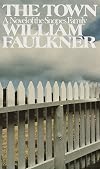
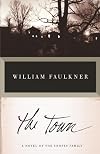
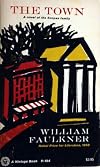
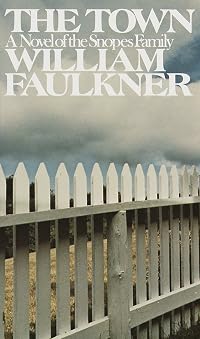
"This is the second volume of Faulkner's trilogy about the Snopes family, his symbol for the grasping, destructive element in the postbellum South. Like its predecessor, The Hamlet, and its successor, The Mansion, The Town is self-contained but gains resonance from being read with the other two. Flem Snope's ruthless struggle to take over the town of Jefferson, Mississippi, is rich in episodes of humor and profundity."--Page 4 of cover.Tags
Recommendations















Member Reviews
I don't know how many times I've read this...fewer than I've read The Hamlet, but not by a lot. It is just as funny, just as tragic, and just as frustrating, as every other time I've read it, but now I know I can skim the Gavin Stevens sections for the kernels of story buried in them, and just relish the Ratliff sections for all they're worth. This novel is Faulkner's tale of how a family of schemers and ne'er-do-wells moves into the town of Jefferson, Mississippi, from out in the boonies (Frenchman's Bend), singly and in bunches, and sets the place on its ear. Poor over-educated Lawyer Stevens, infatuated first with Eula Varner Snopes, and later obsessed with saving her daughter from what he imagines to be a stunted existence, expends show more all the words ever in trying to sort out motivations and intentions and passions, but as his friend V. K. Ratliff constantly points out, he mostly gets it wrong. A grand little piece of the Yoknapatawpha saga. show less
I thought Faulkner’s The Town, second novel in his Snopes Trilogy, more satisfying than The Hamlet. There were not the lapses into soaring and beautiful flights of rhetoric, which I struggled to hold onto, but then just let go of out of frustration. And it did have a plot, a plot which follows a line, as Flem eventually weasels his way into the presidency of the Jefferson Bank, seemingly his goal all along. The writing is Faulknerian, but somewhat simpler and more readable than The Hamlet.
Flem’s character is fleshed out in The Town, and we are given a great deal more understanding of Eula, and her daughter Linda and their relationship to Flem. Linda, a babe in her mother’s arms when the Snopes family arrives in Jefferson, becomes show more significant; and we now have a team of Snopes watchers: our faithful Ratliff, there when his route brings him to town; Gavin Stevens, young lawyer, educated at Harvard and abroad; and Gavin’s nephew, Chick Malleson, who is not yet born when the Snopeses first arrive. These Snopes watchers provide the narration, each telling us in sections things he has observed for himself or heard about from others. I enjoyed this narrative technique and the variety in narrative voice. And the narrators have plenty to watch and report on. Many of the Snopeses from Frenchman’s Bend move into Jefferson when Flem has a spot for them. A significant new character is Manfred de Spain, son of one of the most aristocratic families in Jefferson. Eula falls in love with him, and surprisingly, their affair proves to be the lasting kind. Flem is aware of this affair, but ignores it. The sorting out of this triangle is perhaps the major plot interest, bringing together its major threads.
There are more surprises in this story, not all happy ones. I enjoyed the novel a great deal and now feel all set up for The Mansion, to see what else Faulkner has in mind for his Snopses show less
Flem’s character is fleshed out in The Town, and we are given a great deal more understanding of Eula, and her daughter Linda and their relationship to Flem. Linda, a babe in her mother’s arms when the Snopes family arrives in Jefferson, becomes show more significant; and we now have a team of Snopes watchers: our faithful Ratliff, there when his route brings him to town; Gavin Stevens, young lawyer, educated at Harvard and abroad; and Gavin’s nephew, Chick Malleson, who is not yet born when the Snopeses first arrive. These Snopes watchers provide the narration, each telling us in sections things he has observed for himself or heard about from others. I enjoyed this narrative technique and the variety in narrative voice. And the narrators have plenty to watch and report on. Many of the Snopeses from Frenchman’s Bend move into Jefferson when Flem has a spot for them. A significant new character is Manfred de Spain, son of one of the most aristocratic families in Jefferson. Eula falls in love with him, and surprisingly, their affair proves to be the lasting kind. Flem is aware of this affair, but ignores it. The sorting out of this triangle is perhaps the major plot interest, bringing together its major threads.
There are more surprises in this story, not all happy ones. I enjoyed the novel a great deal and now feel all set up for The Mansion, to see what else Faulkner has in mind for his Snopses show less
Jefferson, Mississippi, meet Flem Snopes.
And yet, can it be that Jefferson and Flem might actually get along?
Faulkner's stream of consciousness style does wonders for realism. The story is always being told by one character at a time, and when it switches to another character's point of view we may get an amazingly different take on events, and yet no point of view is much more believable than another. Ah, the human mind, as it imbues the world around it with subjective meaning. As it fugues along sometimes in self-argument, so that the premise or action which was completely dismissed out of hand a page or so ago has now been accepted as a wonderful solution and why didn't I think of that before? (I am never like that ;) ) Indeed it show more wouldn't be far from the truth to say that we all live in our own little worlds sometimes, from the lawyer Gavin to his kid nephew Charles to the ubiquitous V.K. Ratliff.
I have to say that I am quite relieved Faulkner did not try to write from a feminine perspective in this book (I believe he did in As I Lay Dying, though I can't remember, that was ages ago). Mostly because of the opinions of his characters regarding women. I don't know (probably don't want to know) if those opinions were Faulkner's own, but I'm still relieved. I think it is hard for an author to write such a personal, in-depth point of view as stream of consciouness from the other gender's perspective, man or woman; such that it may only be possible if the character in question is quite slow or eccentric or sick. And I certainly don't want to know what Eula Snopes was thinking... she quite disturbs me!
The names, a word about the names. I'm not sure that Faulkner was thinking, because I myself have lived in the South and, um, yes, back out in the sticks there are sometimes names like this. Especially from people like the Snopes. Still... Flem and Eck as given names? First and middle combinations like Wallstreet Panic, Montgomery Ward, and Admiral Dewey? Plus the lovely sibling combination of Clarence and the twins Vardaman and Bilbo. or the sibs Byron and Virgil. Although we do get one lovely Russian name hidden in there, unsuspecting. Certainly never a dull moment in nomenclature... show less
And yet, can it be that Jefferson and Flem might actually get along?
Faulkner's stream of consciousness style does wonders for realism. The story is always being told by one character at a time, and when it switches to another character's point of view we may get an amazingly different take on events, and yet no point of view is much more believable than another. Ah, the human mind, as it imbues the world around it with subjective meaning. As it fugues along sometimes in self-argument, so that the premise or action which was completely dismissed out of hand a page or so ago has now been accepted as a wonderful solution and why didn't I think of that before? (I am never like that ;) ) Indeed it show more wouldn't be far from the truth to say that we all live in our own little worlds sometimes, from the lawyer Gavin to his kid nephew Charles to the ubiquitous V.K. Ratliff.
I have to say that I am quite relieved Faulkner did not try to write from a feminine perspective in this book (I believe he did in As I Lay Dying, though I can't remember, that was ages ago). Mostly because of the opinions of his characters regarding women. I don't know (probably don't want to know) if those opinions were Faulkner's own, but I'm still relieved. I think it is hard for an author to write such a personal, in-depth point of view as stream of consciouness from the other gender's perspective, man or woman; such that it may only be possible if the character in question is quite slow or eccentric or sick. And I certainly don't want to know what Eula Snopes was thinking... she quite disturbs me!
The names, a word about the names. I'm not sure that Faulkner was thinking, because I myself have lived in the South and, um, yes, back out in the sticks there are sometimes names like this. Especially from people like the Snopes. Still... Flem and Eck as given names? First and middle combinations like Wallstreet Panic, Montgomery Ward, and Admiral Dewey? Plus the lovely sibling combination of Clarence and the twins Vardaman and Bilbo. or the sibs Byron and Virgil. Although we do get one lovely Russian name hidden in there, unsuspecting. Certainly never a dull moment in nomenclature... show less
44. The Town : Volume Two, Snopes by William Faulkner
OPD: 1957
format: 371-page hardcover (4th printing from 1957)
acquired: 2006 (From author [[Larry D. Thomas]] read: Jul 8 – Aug 16 time reading: 15:24, 2.5 mpp
rating: 3
genre/style: Classic Fiction theme: Faulkner
locations: Fictional Jefferson Mississippi, roughly 1910’s to 1927
about the author: 1897-1962. American Noble Laureate who was born in New Albany, MS, and lived most of his life in Oxford, MS.
I want to be more circumspect, but I found this tough. Not difficult tough, just not catching, as in it was a drag. Wandering monologues around an ok story.
The book is a direct sequel to [The Hamlet], published 17 years earlier, where Flem Snopes, from nothing, takes over the political show more and financial dominance of a rural village, including marrying the daughter of the previous dominant person, Will Varner. In The Town, Flem and a couple other characters have moved into the local town of Jefferson, MS. And Flem continues his manipulations, getting key positions to have some control in town utilities and finances. But the story focused on the human side elements, especially on Flem's wife Eula, and his daughter Linda, who is not actually his biological daughter, a sort of open secret.
The story is told through three voices, Charlie Mallison, only 12 when the book, covering about 17 years, finishes, his uncle, Gavin Stevens, and a family friend, V.K. Ratliff, who lived in the village Flem took over and who feels he knows what Flem's up to. Charlie tells us the stories he's been told, sometimes narrating as a "we", as if the whole town is telling the story. Gavin, the Harvard-educated town attorney, is deeply involved, having fallen for Eula, and later, awkwardly, for Eula's teenage daughter. Ratcliff, a sewing machine salesman who used a horse-drawn carriage in the first book, but has upgraded to a motorcar, gives us the town intelligence, sometimes only in hints. Both Ratliff and Gavin would like to stop Flem, but neither seems have much impact on him...until Gavin reaches Flem's daughter.
The story isn't really the point, although it provides a narrative drive and has its moments. The point is early 20th-century southern small-town life during the American technological transition period. The book covers roughly 1910 to 1927. These towns were dominated by traditional leading southern families who sent their children to ivy-league schools, and were characterized by casual law-enforcement, a scurry of unnamed black men and woman filling in the servant roles and other undesirable jobs, while staying almost invisible. Education, economics, and morality seem to all fall in consistent extremes, with a few middle-class skilled or industrious types. Flem, having no education or morality or lineage, makes an exception an influencer.
Not sure anyone needed that whole summary, but if you read it, I hope it serves to show that this isn't a dead book. There is a lot going on here. But it's also a little, or maybe a lot, tough on the reader who just wants to enjoy his or her books. Recommended only to Faulkner completists.
2023
https://www.librarything.com/topic/351556#8212122 show less
OPD: 1957
format: 371-page hardcover (4th printing from 1957)
acquired: 2006 (From author [[Larry D. Thomas]] read: Jul 8 – Aug 16 time reading: 15:24, 2.5 mpp
rating: 3
genre/style: Classic Fiction theme: Faulkner
locations: Fictional Jefferson Mississippi, roughly 1910’s to 1927
about the author: 1897-1962. American Noble Laureate who was born in New Albany, MS, and lived most of his life in Oxford, MS.
I want to be more circumspect, but I found this tough. Not difficult tough, just not catching, as in it was a drag. Wandering monologues around an ok story.
The book is a direct sequel to [The Hamlet], published 17 years earlier, where Flem Snopes, from nothing, takes over the political show more and financial dominance of a rural village, including marrying the daughter of the previous dominant person, Will Varner. In The Town, Flem and a couple other characters have moved into the local town of Jefferson, MS. And Flem continues his manipulations, getting key positions to have some control in town utilities and finances. But the story focused on the human side elements, especially on Flem's wife Eula, and his daughter Linda, who is not actually his biological daughter, a sort of open secret.
The story is told through three voices, Charlie Mallison, only 12 when the book, covering about 17 years, finishes, his uncle, Gavin Stevens, and a family friend, V.K. Ratliff, who lived in the village Flem took over and who feels he knows what Flem's up to. Charlie tells us the stories he's been told, sometimes narrating as a "we", as if the whole town is telling the story. Gavin, the Harvard-educated town attorney, is deeply involved, having fallen for Eula, and later, awkwardly, for Eula's teenage daughter. Ratcliff, a sewing machine salesman who used a horse-drawn carriage in the first book, but has upgraded to a motorcar, gives us the town intelligence, sometimes only in hints. Both Ratliff and Gavin would like to stop Flem, but neither seems have much impact on him...until Gavin reaches Flem's daughter.
The story isn't really the point, although it provides a narrative drive and has its moments. The point is early 20th-century southern small-town life during the American technological transition period. The book covers roughly 1910 to 1927. These towns were dominated by traditional leading southern families who sent their children to ivy-league schools, and were characterized by casual law-enforcement, a scurry of unnamed black men and woman filling in the servant roles and other undesirable jobs, while staying almost invisible. Education, economics, and morality seem to all fall in consistent extremes, with a few middle-class skilled or industrious types. Flem, having no education or morality or lineage, makes an exception an influencer.
Not sure anyone needed that whole summary, but if you read it, I hope it serves to show that this isn't a dead book. There is a lot going on here. But it's also a little, or maybe a lot, tough on the reader who just wants to enjoy his or her books. Recommended only to Faulkner completists.
2023
https://www.librarything.com/topic/351556#8212122 show less
I know, this is Faulkner, so I should be in awe, but instead, I just found this rather exhausting. The idea is interesting (different voices, points of view), the story is rather slow going but definitely realistic in its capturing of human ideas, emotions, and motivations. Still...
Ratings
Members
- Recently Added By
Lists

1001 Books You Must Read Before You Die
1,448 works; 1,135 members

20th Century Literature
1,161 works; 55 members

The American Experience
173 works; 18 members

Books to Purchase
5 works; 1 member
Talk Discussions
Past Discussions
The Snopes Trilogy, Volume II, The Town in Club Read 2023 (August 2023)
Author Information

Born in an old Mississippi family, William Faulkner made his home in Oxford, seat of the University of Mississippi. After the fifth grade he went to school only off and on-lived, read, and wrote much as he pleased. In 1918, refusing to enlist with the "Yankees," he joined the Canadian Air Force, and was transferred to the British Royal Air Force. show more After the war he studied a little at the University, did house painting, worked as a night superintendent at a power plant, went to New Orleans and became a friend of Sherwood Anderson, then to Europe and back home to Oxford. By this time he had written two novels. The Sound and the Fury followed in 1929. Financial success came with Sanctuary in 1931, which he assisted in filming. Faulkner 's novels are intense in their character portrayals of disintegrating Southern aristocrats, poor whites, and African Americans. A complex stream-of-consciousness rhetoric often involves Faulkner in lengthy sentences of anguished power. Most of his tales are set in the mythical Yoknapatawpha County, Mississippi, and are characterized by the use of many recurring characters from families of different social levels spanning more than a century. His best subjects are the old, dying South and the newer materialistic South. As I Lay Dying (1930), is a grotesquely tragicomic story about a family of poor southern whites. With Absalom, Absalom! (1936); the difficult parts of his famous short novel "The Bear" (published in Go Down, Moses, 1942); and the allegorical A Fable (1954), a non-Yoknapatawpha novel set in France during World War I; Faulkner returned to an innovative and difficult style that most readers have trouble with. Yet, interspersed among such works are collections of easily read stories originally published in popular magazines. There seems to be a growing sentiment among critics that the Snopes trilogy-The Hamlet (1940), The Town (1957), and The Mansion (1959)-for the most part an example of Faulkner's "moderate" style, could well be among his most important works. Faulkner was awarded the 1949 Nobel Prize for literature "for his powerful and artistically independent contribution to the new American novel," but it would appear now that he also deserved to win that honor for his contribution to world literature. When reporting his death, the Boston Globe quoted Faulkner's having once told an interviewer: "Since man is mortal, the only immortality for him is to leave something behind him that is immortal since it will always move. That is the artist's way of scribbling "Kilroy was here" on the wall of the final and irrevocable oblivion through which he must some day pass." In addition to the Nobel Prize, Faulkner received the Howells Medal of the American Academy of Arts and Letters in 1950, and in 1951 he was given the National Book Award for his Collected Stories Collected Stories. For his novel A Fable he received the National Book Award for the second time, as well as the Pulitzer Prize in 1955. The Reivers (1962) was awarded the Pulitzer Prize in 1963. In 1957 and 1958, he was the University of Virginia's first writer-in-residence, and in January 1959 he accepted an appointment as consultant on contemporary literature to the Alderman Library of that university. Although Faulkner was not without honors in his lifetime and has received world recognition since then, it is surprising to learn that, when Malcolm Cowley edited The Portable Faulkner in 1946, he found that almost all of Faulkner's books were out of print. By arranging selections from the works to form a continuous chronicle, Cowley deserves much of the credit for making readers aware of the way in which Faulkner was creating a fictive world on a scale grander than that of any novelist since Balzac. William Faulkner died in Oxford, Mississippi, in 1962. (Bowker Author Biography) show less
Awards and Honors
Distinctions
Series

Belongs to Publisher Series
Vintage Books (V-184)
Work Relationships
Common Knowledge
- Canonical title
- The Town
- Original title
- The town
- Original publication date
- 1957
- People/Characters
- Flem Snopes; Eula Varner Snopes; V. K. Ratliff; Gavin Stevens; Charles 'Chick' Mallison; Gowan Stevens (show all 10); Linda Snopes; I. O. Snopes; Manfred DeSpain; Byron Snopes
- Important places
- Yoknapatawpha County, Mississippi, USA; Jefferson, Mississippi, USA; Mississippi, USA
- Dedication
- To PHIL STONE
He did the laughing for thirty years - First words
- "I wasn't born yet so it was Cousin Gowan who was there and big enough to see and remember and tell me afterward when I was big enough for it to make sense."
- Last words
- (Click to show. Warning: May contain spoilers.)"We never did know which it was."
Classifications
Statistics
- Members
- 807
- Popularity
- 34,404
- Reviews
- 6
- Rating
- (3.97)
- Languages
- 14 — Catalan, Czech, Dutch, English, Finnish, French, German, Italian, Norwegian (Bokmål), Polish, Portuguese, Romanian, Spanish, Swedish
- Media
- Paper, Audiobook, Ebook
- ISBNs
- 38
- ASINs
- 39