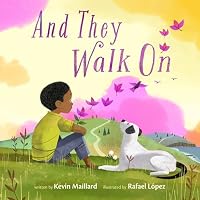
And They Walk On
by Kevin Maillard
On This Page
Description
A young boy reflects on the enduring presence of a loved one who has "walked on," finding comfort in memories, stories, and the love that lives on in his heart.Tags
Recommendations













Member Reviews
child grapples with the strange largeness of grief.
Where do our loved ones go when they walk on, and what does that mean for those who miss them? This poignant meditation on loss centers on the household that a grandmother leaves behind as life goes on. As the family packs up her home, each chore offers an opportunity to ponder what she’s doing elsewhere, earthly tasks made magnificent by the wonders of an unknowable beyond—perhaps she waters a garden, growing titanic sequoias or herbaceous jungles; perhaps she’s fishing, nabbing a dinnertime catch with the help of a friendly whale. All the while, her grandchild moves through their previously shared space, navigating death’s contradictions and confronting tensions between the show more permanence of loss and the material proof of life interrupted. The narrative’s conclusion leaves readers with a vital reminder: Mortality unifies humanity, but remembrance and the momentum that it inspires suggest an afterlife without end. The text’s treatment of grief is masterful and accessible, exploring the experience of loss with affirmative nuance, while captivating visuals emphasize the permeability between life and what lies ahead; the windy tendrils done in rainbow colors are especially affecting. Maillard (Seminole Nation) and Mexican illustrator López hail from cultures with distinct death traditions, each of which is touched on individually in informational backmatter. The protagonists are brown-skinned, and references to both creators’ heritages are woven into the artwork. Supporting characters are racially diverse.
Stunning and essential. (author’s and illustrator’s notes, recipe) (Picture book. 5-9)
-Kirkus Review show less
Where do our loved ones go when they walk on, and what does that mean for those who miss them? This poignant meditation on loss centers on the household that a grandmother leaves behind as life goes on. As the family packs up her home, each chore offers an opportunity to ponder what she’s doing elsewhere, earthly tasks made magnificent by the wonders of an unknowable beyond—perhaps she waters a garden, growing titanic sequoias or herbaceous jungles; perhaps she’s fishing, nabbing a dinnertime catch with the help of a friendly whale. All the while, her grandchild moves through their previously shared space, navigating death’s contradictions and confronting tensions between the show more permanence of loss and the material proof of life interrupted. The narrative’s conclusion leaves readers with a vital reminder: Mortality unifies humanity, but remembrance and the momentum that it inspires suggest an afterlife without end. The text’s treatment of grief is masterful and accessible, exploring the experience of loss with affirmative nuance, while captivating visuals emphasize the permeability between life and what lies ahead; the windy tendrils done in rainbow colors are especially affecting. Maillard (Seminole Nation) and Mexican illustrator López hail from cultures with distinct death traditions, each of which is touched on individually in informational backmatter. The protagonists are brown-skinned, and references to both creators’ heritages are woven into the artwork. Supporting characters are racially diverse.
Stunning and essential. (author’s and illustrator’s notes, recipe) (Picture book. 5-9)
-Kirkus Review show less
Thank you to NetGalley and the publisher, Macmillan Children's Publishing Group, for this DRC in exchange for a fair and honest review. The thoughts and opinions expressed below are my own.
This is one of the best children's books, and one of the best books, period, that I've read this year. It made me tear up frequently throughout the read, in a good way. By using the Native framing of departed loved ones "walking on" to a new stage of existence and making a new journey, Kevin Maillard paints a picture of an introspective young boy grieving his beloved grandmother, aas well as the ways that he grows to embrace her memory and the way that her presence remains with him in a new, fulfilling way. The concept of walking on and continuing a show more journey into another place is presented in a way that children will understand (and which they may already be familiar with) as well as the ways in which those we love still leave elements of themselves with us. This book would make an excellent one-on-one or small groups read for children, where they can talk about those whom they've lost and the many ways that they can still feel their presence, either though food, smells, experiences with nature and other memories. It also creates an opportunity to talk about different ways that their culture(s) discuss those who have passed away, and how they are different or similar to what's presented in the book.
The intentionality of the language and it's clear depiction of the boy's memories of his grandmother make an impression on the reader; immediately evoking emotions that will speak to children who have recently lost someone. The illustrations have that same intentionality and perfectly complement the text; the sweeping motifs of multicolored strands, representing both emotions and the essence of the grandmother, creates a comfort for the young protagonist as he wraps himself in the memories of her presence. I enjoyed illustrator Rafael Lopez' notes in the back about the various visual easter eggs that he included, The ending scenes of people of various ages and backgrounds walking on themselves and the boy moving forward with his grandmother's spirit to guide him (and her scarf around his neck) was poignant. As someone still processing the departure of a beloved one, the passages about her scent lingering over her house as if she just stepped away for a few moments resonated with me, as did the parts about the pressing desire to tell her about the day's events. Maillard describes this feeling in the book's end notes as phantom pains, which is quite accurate; something that children will understand even if they cannot verbalize the sensation quite yet.
One subtle detail that I appreciated is the way in which the young boy's parents let him process and grieve on his own, leaving him to sit with his sweet dog companion and think about his grandmother rather than hovering over him constantly. And even though the reader never sees him actually cry, they can tell that it still affects him deeply. It's a nice touch and a reminder to kids that everyone deals with sadness in their own way, and that no one way is correct. As with all of Maillard's work that I've seen so far, I greatly appreciate the Black Native representation, and the intentionality purposefulness behind the inclusion.
I also appreciate the recipes that Maillard includes in his books, the notes about where they originate from, his own modifications and the relevance that they hold. The grape dumplings recipe (which I'd heard about in passing over the years) sounds delicious. It sent me down a rabbit hole of research into different Native tribes' variations in preparing the dish. If he ever were to write a cookbook for children about the Native dishes from his childhood, I am all for it. show less
This is one of the best children's books, and one of the best books, period, that I've read this year. It made me tear up frequently throughout the read, in a good way. By using the Native framing of departed loved ones "walking on" to a new stage of existence and making a new journey, Kevin Maillard paints a picture of an introspective young boy grieving his beloved grandmother, aas well as the ways that he grows to embrace her memory and the way that her presence remains with him in a new, fulfilling way. The concept of walking on and continuing a show more journey into another place is presented in a way that children will understand (and which they may already be familiar with) as well as the ways in which those we love still leave elements of themselves with us. This book would make an excellent one-on-one or small groups read for children, where they can talk about those whom they've lost and the many ways that they can still feel their presence, either though food, smells, experiences with nature and other memories. It also creates an opportunity to talk about different ways that their culture(s) discuss those who have passed away, and how they are different or similar to what's presented in the book.
The intentionality of the language and it's clear depiction of the boy's memories of his grandmother make an impression on the reader; immediately evoking emotions that will speak to children who have recently lost someone. The illustrations have that same intentionality and perfectly complement the text; the sweeping motifs of multicolored strands, representing both emotions and the essence of the grandmother, creates a comfort for the young protagonist as he wraps himself in the memories of her presence. I enjoyed illustrator Rafael Lopez' notes in the back about the various visual easter eggs that he included, The ending scenes of people of various ages and backgrounds walking on themselves and the boy moving forward with his grandmother's spirit to guide him (and her scarf around his neck) was poignant. As someone still processing the departure of a beloved one, the passages about her scent lingering over her house as if she just stepped away for a few moments resonated with me, as did the parts about the pressing desire to tell her about the day's events. Maillard describes this feeling in the book's end notes as phantom pains, which is quite accurate; something that children will understand even if they cannot verbalize the sensation quite yet.
One subtle detail that I appreciated is the way in which the young boy's parents let him process and grieve on his own, leaving him to sit with his sweet dog companion and think about his grandmother rather than hovering over him constantly. And even though the reader never sees him actually cry, they can tell that it still affects him deeply. It's a nice touch and a reminder to kids that everyone deals with sadness in their own way, and that no one way is correct. As with all of Maillard's work that I've seen so far, I greatly appreciate the Black Native representation, and the intentionality purposefulness behind the inclusion.
I also appreciate the recipes that Maillard includes in his books, the notes about where they originate from, his own modifications and the relevance that they hold. The grape dumplings recipe (which I'd heard about in passing over the years) sounds delicious. It sent me down a rabbit hole of research into different Native tribes' variations in preparing the dish. If he ever were to write a cookbook for children about the Native dishes from his childhood, I am all for it. show less
This is a lovely book wherein I felt the joy of both the writer and the illustrator. The following was included in the jacket cover:
"To those who walk the marigold-paved paths
that lead us back to the one wed love
May this book honor the ties that never fade"
Rafael Lopez
The book begins with a highly intuitive young boy who feels and thinks deeply. He wonders when someone walks on, where do they go? Did they go to the market, to thump green melons, and sail shopping carts down the aisles?
The boy continues to dream of other destinations of possibilities:
Maybe someone goes fishing
Maybe someone is running late and will call him --he will wait, with stories of his new room, new toy, new friends and poems that are written.
The ending is also show more full of love for the possibilities of a new home, and those who live there with him.
I very much liked this book. I obtained it from the library, but because it resonated so deeply, I will buy a copy to place in the area of my favorite illustrated books, as yet again I walk the path of a special, beautifully illustrated book that touches me deeply!
Highly Recommended Five Stars show less
"To those who walk the marigold-paved paths
that lead us back to the one wed love
May this book honor the ties that never fade"
Rafael Lopez
The book begins with a highly intuitive young boy who feels and thinks deeply. He wonders when someone walks on, where do they go? Did they go to the market, to thump green melons, and sail shopping carts down the aisles?
The boy continues to dream of other destinations of possibilities:
Maybe someone goes fishing
Maybe someone is running late and will call him --he will wait, with stories of his new room, new toy, new friends and poems that are written.
The ending is also show more full of love for the possibilities of a new home, and those who live there with him.
I very much liked this book. I obtained it from the library, but because it resonated so deeply, I will buy a copy to place in the area of my favorite illustrated books, as yet again I walk the path of a special, beautifully illustrated book that touches me deeply!
Highly Recommended Five Stars show less
A young boy misses his grandmother, thinks about where she could have gone, hopes for her return, and finds the places in his home that remind him of her. Author's note, illustrator's note, recipe for grape dumplings.
"Because of the magic of food, I travel through time."
"When they walk on, they stay with us like the glimmer of a distant star."
"Because of the magic of food, I travel through time."
"When they walk on, they stay with us like the glimmer of a distant star."
Ratings
Members
- Recently Added By
Lists

Youth: Abuse, Grief, & Loss
51 works; 1 member
Author Information
1 Work 26 Members
Awards and Honors
Classifications
- Genres
- Picture Books, Children's Books, Fiction and Literature
- DDC/MDS
- 155.937 — Philosophy and Psychology Psychology Differential and developmental psychology Environmental psychology Influences of Traumatic Experiences and Bereavement Death and Dying
- LCC
- PZ7.1 .M34682 — Language and Literature Fiction and juvenile belles lettres Fiction and juvenile belles lettres Juvenile belles lettres
- BISAC
Statistics
- Members
- 27
- Popularity
- 1,006,328
- Reviews
- 4
- Rating
- (4.50)
- Languages
- English
- Media
- Paper
- ISBNs
- 3