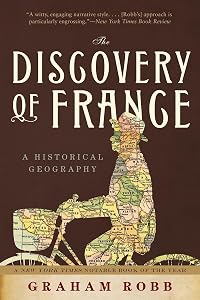
The Discovery of France: A Historical Geography
by Graham Robb
On This Page
Description
A New York Times Notable Book, Publishers Weekly Best Book, Slate Best Book, and Booklist Editor's Choice A narrative of exploration—full of strange landscapes and even stranger inhabitants—that explains the enduring fascination of France. While Gustave Eiffel was changing the skyline of Paris, large parts of France were still terra incognita. Even in the age of railways and newspapers, France was a land of ancient tribal divisions, prehistoric communication networks, and pre–Christian show more beliefs. French itself was a minority language. Graham Robb describes that unknown world in arresting narrative detail. He recounts the epic journeys of mapmakers, scientists, soldiers, administrators, and intrepid tourists, of itinerant workers, pilgrims, and herdsmen with their millions of migratory domestic animals. We learn how France was explored, charted, and colonized, and how the imperial influence of Paris was gradually extended throughout a kingdom of isolated towns and villages. The Discovery of France explains how the modern nation came to be and how poorly understood that nation still is today. Above all, it shows how much of France—past and present—remains to be discovered. show lessTags
Recommendations




















Member Recommendations


Member Reviews
Francophile that I am, I will never see France quite the same way after having read Robb's fascinating historical geography (or geographical history)of France up to WWI. Almost every page, in fact, almost every paragraph proves chock-full of interesting "facts" and authorial observations. There are chapters on languages (French having been a minority, i.e., "foreign" language a mere hundred years ago); animals (the "60 million Others" who also inhabited the Hexagon); maps, roads, travel in all its dimensions, "colonization" of the nation, tourism and more. I am already rereading this book with a map of France spread out on the dining room table in front of me as I do so (bearing in mind that to "find" all the locales Robb references show more really requires a palimpsest of old and new, large and small scale, linguistic, ethnographic & topographic maps, some of which may not even exist.
A few anecdotal gems:
"But if all the nicknames had been adopted, the map of France would now be covered with obscenities and incomprehensible jokes." (36)
"Human hibernation was a physical and economic necessity. Lowering the metabolic rate prevented hunger from exhausting supplies . . . Slowness was not an attempt to savour the moment." (76)
"The Virgin Mary was always more important than God . . . . He was no more important than a bishop." (130)
"The century's greatest expert on gossip and pre-industrial telecommunications, Honore de Balzac, suggested that rumour could travel at about 9 mph." (141)
"Any commemoration of European unity should remember the smugglers and pedlars who helped to keep the borders open." (152)
"Three years later the dogs of Paris had their own ambulance." (179)
"The shepherds of the Landes spent whole days on stilts, using a stick to form a tripod when they wanted to rest. Perched ten feet in the air, they knitted woollen garments and scanned the horizon for stray sheep. People who saw them in the distance compared them to tiny steeples and giant spiders." (243)
"France was repeatedly reconquered by French forces." (256)
"it is quite possible to travel from one end of the country to the other without . . . realizing that many of the landscapes that seem typically and eternally French are younger than the Eiffel Tower." (268) show less
A few anecdotal gems:
"But if all the nicknames had been adopted, the map of France would now be covered with obscenities and incomprehensible jokes." (36)
"Human hibernation was a physical and economic necessity. Lowering the metabolic rate prevented hunger from exhausting supplies . . . Slowness was not an attempt to savour the moment." (76)
"The Virgin Mary was always more important than God . . . . He was no more important than a bishop." (130)
"The century's greatest expert on gossip and pre-industrial telecommunications, Honore de Balzac, suggested that rumour could travel at about 9 mph." (141)
"Any commemoration of European unity should remember the smugglers and pedlars who helped to keep the borders open." (152)
"Three years later the dogs of Paris had their own ambulance." (179)
"The shepherds of the Landes spent whole days on stilts, using a stick to form a tripod when they wanted to rest. Perched ten feet in the air, they knitted woollen garments and scanned the horizon for stray sheep. People who saw them in the distance compared them to tiny steeples and giant spiders." (243)
"France was repeatedly reconquered by French forces." (256)
"it is quite possible to travel from one end of the country to the other without . . . realizing that many of the landscapes that seem typically and eternally French are younger than the Eiffel Tower." (268) show less
My takeaway from this book is that there is more to France than Paris. As true as that is today, it was even more the case in earlier times, when in vast regions people spoke in Basque, Breton, Catalan, Alsatian, Flemish, and other non-French languages and had no concept of living in a country called France. The land was a quilt of a thousand or more pays.
Graham Robb chronicles this neither with a sense of nostalgia nor of being a collector of the quaint. Before writing this book, he was already acclaimed for his biographies of Balzac, Victor Hugo, and Rimbaud. He counted as an expert.
His bicycle tours of the countryside revealed to him much he didn’t know. He supplemented the first-hand knowledge his trips gave him with years of show more research in many libraries and archives. This combination of first-hand observation and digesting hundreds of old guidebooks, maps, and postcards yields the insight that “the more accurate the map, the more misleading the impression” (p. 6). This sentence is an example of his love of tersely antithetical sentences. Here is another: “Even before it was finished, it was clear that the map of France, with its standardized spellings and consistent symbols, would be considerably more coherent than the country itself” (p. 196).
At times the narrative threatens to become a collection of oddities, but even then, the reader is sustained by the author’s taut, lively prose.
The book is organized more carefully, however, than readily apparent. The first half uncovers a France that has disappeared, the second deals with “forms of life that are more recognizably modern” (p. 138). I especially enjoyed the interlude between parts 1 and 2, on the animal population of France in the 18th and 19th centuries. Merely to conceive of writing such a chapter shows the imagination of the author.
The material Robb integrates into his narrative could have easily bloated to a book twice the size in the hands of a less-disciplined writer. This is a book that repays attentive reading. A very good read. show less
Graham Robb chronicles this neither with a sense of nostalgia nor of being a collector of the quaint. Before writing this book, he was already acclaimed for his biographies of Balzac, Victor Hugo, and Rimbaud. He counted as an expert.
His bicycle tours of the countryside revealed to him much he didn’t know. He supplemented the first-hand knowledge his trips gave him with years of show more research in many libraries and archives. This combination of first-hand observation and digesting hundreds of old guidebooks, maps, and postcards yields the insight that “the more accurate the map, the more misleading the impression” (p. 6). This sentence is an example of his love of tersely antithetical sentences. Here is another: “Even before it was finished, it was clear that the map of France, with its standardized spellings and consistent symbols, would be considerably more coherent than the country itself” (p. 196).
At times the narrative threatens to become a collection of oddities, but even then, the reader is sustained by the author’s taut, lively prose.
The book is organized more carefully, however, than readily apparent. The first half uncovers a France that has disappeared, the second deals with “forms of life that are more recognizably modern” (p. 138). I especially enjoyed the interlude between parts 1 and 2, on the animal population of France in the 18th and 19th centuries. Merely to conceive of writing such a chapter shows the imagination of the author.
The material Robb integrates into his narrative could have easily bloated to a book twice the size in the hands of a less-disciplined writer. This is a book that repays attentive reading. A very good read. show less
I read a lot, but not often do I come on a book that opens as many vistas as this one did.
Example: Robb has a long string of anecdotes about how the peasantry relied on local saints to cure specific diseases, and punished them by flogging (the images were the saints, not representations of them) when they didn't help. He then turns on the reader who is amused or appalled by this level of ignorance, saying: The peasants were on the right track! Specific diseases have specific causes and can often be cured by someone who knows how. The peasants were thus mentally ready to accept the discoveries of modern medical science; all they lacked was information. Whereas the educated classes, including the doctors, maundered on about "humors" and show more such which didn't explain a thing. show less
Example: Robb has a long string of anecdotes about how the peasantry relied on local saints to cure specific diseases, and punished them by flogging (the images were the saints, not representations of them) when they didn't help. He then turns on the reader who is amused or appalled by this level of ignorance, saying: The peasants were on the right track! Specific diseases have specific causes and can often be cured by someone who knows how. The peasants were thus mentally ready to accept the discoveries of modern medical science; all they lacked was information. Whereas the educated classes, including the doctors, maundered on about "humors" and show more such which didn't explain a thing. show less
This effortlessly-flowing narrative explores the historical geography of France with fascinating anecdotes and enlightening facts. I learned so much from this book--it's the kind of thing I can really geek out over. Topics range from regional dialects to historical side hustles (get paid to be an alarm clock!) to how to fake injuries for begging to fairy lore and saints galore to the evolution of transportation in the past few hundred years to the 'lost territories' in the 19th century and how they became part of an escalation in national identity. This is a book I'll keep on my shelf for reference from here onward.
The Discovery of France is a historical perspective on the unification of pays into the France we know today told via a patchwork of interesting facts and anecdotes. It is charming account from Graham Robb, often injected with humour, that led me to enjoy learning history I previously thought was uninteresting. Some of my favourite parts were the stories of the brave map-makers, clever dogs that taught themselves tricks, and the travelling methods of the swamp-dwelling French.
The chapters are centred on themes (e.g., maps, migrants and communities, the Wonders of France, etc.). The temporal progression is conserved within chapters, and the ordering of themes generally is too, though at times there is a bit of skipping back-and-forth show more between chapter breaks. I found the earlier chapters much more enjoyable, and the final few a bit of a slog. Though this is likely because I was most interested in learning the identities of the different regions of France and less interested in the history of transport. At times it was a bit repetitive with the message too, but not debilitatingly so. From what I see in other comments, I understand that the author brought his own perspective on the country when assembling this book. While this could be a negative for some, I'd say the author's engaging style more than makes up for it.
I read this book to learn more about the French outside of Paris, and I look forward to having these stories in mind as I visit the different regions once being a tourist becomes normal again. show less
The chapters are centred on themes (e.g., maps, migrants and communities, the Wonders of France, etc.). The temporal progression is conserved within chapters, and the ordering of themes generally is too, though at times there is a bit of skipping back-and-forth show more between chapter breaks. I found the earlier chapters much more enjoyable, and the final few a bit of a slog. Though this is likely because I was most interested in learning the identities of the different regions of France and less interested in the history of transport. At times it was a bit repetitive with the message too, but not debilitatingly so. From what I see in other comments, I understand that the author brought his own perspective on the country when assembling this book. While this could be a negative for some, I'd say the author's engaging style more than makes up for it.
I read this book to learn more about the French outside of Paris, and I look forward to having these stories in mind as I visit the different regions once being a tourist becomes normal again. show less
The Discovery of France gives the reader an account of the discovery and creation of the modern nation France from the multitude of different small communes with a strong tribe identity.
Graham Robb, professor of French literature, researched this non-intellectual history for four years. These four years have proven to be productive, because there is a vast number of themes passing by. From language to tourism, from religion to the organisation of work and infrastructure.
According to Richard Eder of the Boston Globe all these themes distract from the main team Boston Globe. I disagree. Graham Robb is able to give a wide array of information in an image provoking language and at the same time still turn back to the theme, that is: that show more France was a diverse country with closed communities.
The structure of the book is mostly chronological. The story starts just before the revolution, but will give you some background on i.e. the Romans if needed. The chapters are thematic. What was a big surprise for me was the chapter about language.
Most of the French countryside was hard to reach. People lived in small communities with their own system of law and customs. There was a lot of rivalry between villages and every ‘mini state’ spoke their own dialect. For a lot of regions it was not until the introduction of the train and bike that people moved regular out and into the villages.
Before French was enforced on the people there where at least 10 different languages with hundreds of dialects. French, a Paris dialect of the Oïl language group was the main language in the North with Bretons, Flemish, Frankish and German being spoken on the borders. In the South OC was the main language next to Basque, Catalan, Corsican and Gallo Italian. In the center people spoke Franco Provençal and Marchions/Creusot.
The French government had an active policy in removing all barbarian languages (read: non-Parisian). To achieve the unity of brotherhood they dreamt of. This was a slow process, as even in 1863 the communes in the south had no more 10% till 0% French speakers. It is sad that so much of these languages are lost in a couple of decennials.
The modernisation and colonization of the different regions was slow. ‘Pedagogical’ intellectuals complained about the wintersleep that was common in some regions after a summer of hard work, where human energy was wasted by whole families laying in bed for months. There where still feasts at old the old stones that accounted for prehistoric beliefs.
A lot of the information Graham Robb collected comes from observations of tourist and geographers. Both came in contact with people that do not write history. I got the impression that tourism, mainly from the UK, accounted for the invention of modern day France. Tourists searched for pittoreske scenes, local food (invented by local store owners) and good roads. Later French tourists followed, and still the countryside is depended on Europeans coming to see the ‘local’ specialities.
Robb’ research is good he is able to draw from a lot of available sources. The only aspect missing was how the different people make sense of their world. There is some good information about the sighting of Maria at Louvre where the belief in ghosts collides with Christian beliefs. But overall, there is not much information about the ‘worldview’ of different people groups in France. I understand that this is hard to do, since there are no written accounts, but I've would have liked if Robb left the accounts of tourists and politicians sometimes to go into a more speculative account about the ways people believed.
How much is lost in the passage of time! I've read this book with so much different emotions. Sometimes my romantic half took over and enjoyed the diversity of all those different (archaic) cultures. Although this feeling never lasted long. The sheer horror of rough living, bad food, repression of women, gang behaviour all made me think the European past was barbaric indeed.
This book is a good counterbalance against all the Liberté, égalité, fraternité of great intellectual man. The book is well researched, consciously written an image provoking.
The Discovery of France won the Duff Cooper Prize in 2007 and the RSL Ondaatje Prize in 2008 and I can understand this. The book is quite an adventure. show less
Graham Robb, professor of French literature, researched this non-intellectual history for four years. These four years have proven to be productive, because there is a vast number of themes passing by. From language to tourism, from religion to the organisation of work and infrastructure.
According to Richard Eder of the Boston Globe all these themes distract from the main team Boston Globe. I disagree. Graham Robb is able to give a wide array of information in an image provoking language and at the same time still turn back to the theme, that is: that show more France was a diverse country with closed communities.
The structure of the book is mostly chronological. The story starts just before the revolution, but will give you some background on i.e. the Romans if needed. The chapters are thematic. What was a big surprise for me was the chapter about language.
Most of the French countryside was hard to reach. People lived in small communities with their own system of law and customs. There was a lot of rivalry between villages and every ‘mini state’ spoke their own dialect. For a lot of regions it was not until the introduction of the train and bike that people moved regular out and into the villages.
Before French was enforced on the people there where at least 10 different languages with hundreds of dialects. French, a Paris dialect of the Oïl language group was the main language in the North with Bretons, Flemish, Frankish and German being spoken on the borders. In the South OC was the main language next to Basque, Catalan, Corsican and Gallo Italian. In the center people spoke Franco Provençal and Marchions/Creusot.
The French government had an active policy in removing all barbarian languages (read: non-Parisian). To achieve the unity of brotherhood they dreamt of. This was a slow process, as even in 1863 the communes in the south had no more 10% till 0% French speakers. It is sad that so much of these languages are lost in a couple of decennials.
The modernisation and colonization of the different regions was slow. ‘Pedagogical’ intellectuals complained about the wintersleep that was common in some regions after a summer of hard work, where human energy was wasted by whole families laying in bed for months. There where still feasts at old the old stones that accounted for prehistoric beliefs.
A lot of the information Graham Robb collected comes from observations of tourist and geographers. Both came in contact with people that do not write history. I got the impression that tourism, mainly from the UK, accounted for the invention of modern day France. Tourists searched for pittoreske scenes, local food (invented by local store owners) and good roads. Later French tourists followed, and still the countryside is depended on Europeans coming to see the ‘local’ specialities.
Robb’ research is good he is able to draw from a lot of available sources. The only aspect missing was how the different people make sense of their world. There is some good information about the sighting of Maria at Louvre where the belief in ghosts collides with Christian beliefs. But overall, there is not much information about the ‘worldview’ of different people groups in France. I understand that this is hard to do, since there are no written accounts, but I've would have liked if Robb left the accounts of tourists and politicians sometimes to go into a more speculative account about the ways people believed.
How much is lost in the passage of time! I've read this book with so much different emotions. Sometimes my romantic half took over and enjoyed the diversity of all those different (archaic) cultures. Although this feeling never lasted long. The sheer horror of rough living, bad food, repression of women, gang behaviour all made me think the European past was barbaric indeed.
This book is a good counterbalance against all the Liberté, égalité, fraternité of great intellectual man. The book is well researched, consciously written an image provoking.
The Discovery of France won the Duff Cooper Prize in 2007 and the RSL Ondaatje Prize in 2008 and I can understand this. The book is quite an adventure. show less
This is not a guide book or a potted history of France aimed at the tourist or the casual visitor. Graham Robb has written biographies of Balzac, Victor Hugo and Rimbaud and is considered as an expert on France and its culture and in his introduction says that he has cycled 14000 miles and spent 4 years in libraries in preparation for the writing of The Discovery of France. Reading this book tells me that Robb is more comfortable in the library than in the saddle; it is a book written by an intellectual for a reader with some knowledge of France and its history. There are over 60 pages of notes and works cited, with more references to Victor Hugo than to cheese or wine (arguably more important to the average Frenchman)
Robb says that his show more book can be read as a social and geographical history as a collection of tales and tableaux. This is most certainly the case however he achieves more than this. He carefully builds a picture for us English speakers of what it means to be french. He demonstrates how and why they think the way they do; he attempts to get into their psyche and in this he is largely successful. The majority of the book focuses on the 18th and 19th centuries and is organised by themes rather than a linear account of the social and geographical history. It is underpinned with Robb's contention that France is not a homogeneous nation; it never was and is not so today.
Robb says that France is more a collection of individual pays, which in the past were separated by customs and toll barriers as well as language and today theses pays still lie just beneath the surface. In 1880 there were still only one fifth of Frenchman comfortable with speaking french and today there are still over 20 regional dialects recognised. France is shown until quite recently as an undiscovered country, undiscovered that is by the French. Huge difficulties were encountered in producing reliable maps with the Parisians largely unconcerned with the countryside away from the main arterial routes or beyond the suburbs of Paris. Transport is explored and again there was difficulties right up to the coming of the railways. France did not have an industrial revolution quite like that experienced in England. Any industry was fueled largely by migrant workers anxious to return to their pays as soon as it was financially viable. There were few heavily industrialised towns and where there were the local population were keen to move out to the countryside, their quality of life being much more important than amassing vast amounts of money.
Robb is very good at highlighting local customs and has plenty of fascinating stories to tell; the stilt walking shepherds of les Landes, the search for the primitive Frenchmen in the new fashionable seaside resorts in Brittany, the child migrations to the cities in the second half of the nineteenth century. The darker side of the french Psyche is also explored; the tribalism that resulted in the pitched battles between villages, the fear and hatred of the Cagots in S W France, the actions of the Vichy government and more recently the massacre of the Algerians in Paris.
The book is well written but it is not always easy to read. Robb's themed approach means that it is not always clear what links the thoughts and ideas and what period of history Robb is discussing. I would also suggest it is advisable to have a map of France handy if your geography is not up to scratch. I soon got used to the writing style and became enthralled with the main ideas and the many deviations that seemed to occur almost naturally. An invaluable book for those wishing to explore France and the french in more detail. The differences between French and English social history are used to great effect to demonstrate why the two races are so different. As an Englishman living in France I learned a great deal and some of the fog of local behaviour and customs have been lifted. show less
Robb says that his show more book can be read as a social and geographical history as a collection of tales and tableaux. This is most certainly the case however he achieves more than this. He carefully builds a picture for us English speakers of what it means to be french. He demonstrates how and why they think the way they do; he attempts to get into their psyche and in this he is largely successful. The majority of the book focuses on the 18th and 19th centuries and is organised by themes rather than a linear account of the social and geographical history. It is underpinned with Robb's contention that France is not a homogeneous nation; it never was and is not so today.
Robb says that France is more a collection of individual pays, which in the past were separated by customs and toll barriers as well as language and today theses pays still lie just beneath the surface. In 1880 there were still only one fifth of Frenchman comfortable with speaking french and today there are still over 20 regional dialects recognised. France is shown until quite recently as an undiscovered country, undiscovered that is by the French. Huge difficulties were encountered in producing reliable maps with the Parisians largely unconcerned with the countryside away from the main arterial routes or beyond the suburbs of Paris. Transport is explored and again there was difficulties right up to the coming of the railways. France did not have an industrial revolution quite like that experienced in England. Any industry was fueled largely by migrant workers anxious to return to their pays as soon as it was financially viable. There were few heavily industrialised towns and where there were the local population were keen to move out to the countryside, their quality of life being much more important than amassing vast amounts of money.
Robb is very good at highlighting local customs and has plenty of fascinating stories to tell; the stilt walking shepherds of les Landes, the search for the primitive Frenchmen in the new fashionable seaside resorts in Brittany, the child migrations to the cities in the second half of the nineteenth century. The darker side of the french Psyche is also explored; the tribalism that resulted in the pitched battles between villages, the fear and hatred of the Cagots in S W France, the actions of the Vichy government and more recently the massacre of the Algerians in Paris.
The book is well written but it is not always easy to read. Robb's themed approach means that it is not always clear what links the thoughts and ideas and what period of history Robb is discussing. I would also suggest it is advisable to have a map of France handy if your geography is not up to scratch. I soon got used to the writing style and became enthralled with the main ideas and the many deviations that seemed to occur almost naturally. An invaluable book for those wishing to explore France and the french in more detail. The differences between French and English social history are used to great effect to demonstrate why the two races are so different. As an Englishman living in France I learned a great deal and some of the fog of local behaviour and customs have been lifted. show less
Members
- Recently Added By
Lists

Recommend the 20 best books you've read in the last five years
2,168 works; 602 members

Non-Fiction Worth Reading
1,016 works; 262 members

All Things France
100 works; 8 members

Books Read in 2024
4,727 works; 128 members
Author Information

17+ Works 4,760 Members
Graham Robb's two previous books, "Victor Hugo" & "Balzac," were "New York Times" Notable Books. He lives in Oxford, England. (Bowker Author Biography)
Some Editions
Awards and Honors
Awards
Distinctions
Notable Lists
Common Knowledge
- Canonical title*
- Une histoire buissonnière de la France
- Original title
- The Discovery of France: A Historical Geography from the Revolution to the First World War
- Alternate titles
- The Discovery of France: A Historical Geography from the Revolution to the First World War
- Original publication date
- 2007
- Important places
- France
- Dedication
- For Margaret
- First words
- Ten years ago, I began to explore the country on which I was supposed to be an authority.
- Last words
- (Click to show. Warning: May contain spoilers.)In the twenty-first century, many parts of France remain to be discovered.
- Original language
- English
- Canonical LCC
- DC20.5 .R63 2007
*Some information comes from Common Knowledge in other languages. Click "Edit" for more information.
Classifications
Statistics
- Members
- 1,427
- Popularity
- 16,561
- Reviews
- 29
- Rating
- (3.95)
- Languages
- 6 — Chinese, Dutch, English, Estonian, French, Portuguese
- Media
- Paper, Audiobook, Ebook
- ISBNs
- 16
- ASINs
- 18