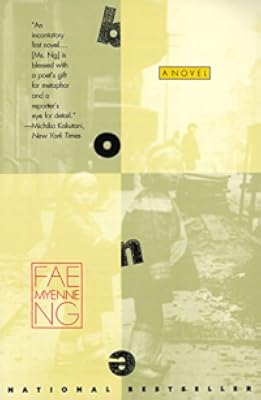
Bone
by Fae Myenne Ng
On This Page
Description
Set in San Francisco's Chinatown, a novel of family ties chronicles the Leongs--a Chinese-American family caught between the traditions of their ancestry and the realities of life in America.Tags
Recommendations










Member Reviews
Here's what you need to understand first and foremost. This is a story built around grief. Ona, the middle sister, jumped off the M floor of the Nam. M happens to be the thirteenth floor. Unlucky, unforgivable thirteen. Everything that happens to her surviving family centers on this one fact. Ona jumped. Everything is marked by the time Before Ona Jumped and the time After Ona Jumped. Confessional: I am like that, too. When I hear a specific date, I quickly do the math to determine if it is A.D.D. (after dad's death) or before - B.D.D. Leila is the eldest of three daughters and the one most constrained by old China values versus modern American China. She is aware of the boldness of her actions (eloping when her ancestors had childbride show more arranged marriages), but she isn't the boldest of the family. All three sisters are responsible for Mah's shame. Her sister Ona committed suicide (shame) and her sister, Nina, had an abortion (shame). Even Mah carries shame (an affair while her second husband was away at sea as a merchant marine). Told from the perspective of Lei, she has to make a decision between dating and duty; between marriage with Mason and Mah. Having both seems impossible. show less
A searing novel about grief, family, and the profound effect our choices make on those who love us told through an odd, though effective, backward spiral in time.
The backward storyline impressed me the most, as I had not read a book told from the end to the beginning. At first, I was startled, but as I continued to read, the more profound and deeply moving the narrative became. Imagine starting out cynical and world-weary and going backward to a time of unconditional love and innocence.
A must-read for anyone coping with loss, family-dynamics... A bonus is the Chinese immigrant and first generation Chinese-American cultural insights.
The backward storyline impressed me the most, as I had not read a book told from the end to the beginning. At first, I was startled, but as I continued to read, the more profound and deeply moving the narrative became. Imagine starting out cynical and world-weary and going backward to a time of unconditional love and innocence.
A must-read for anyone coping with loss, family-dynamics... A bonus is the Chinese immigrant and first generation Chinese-American cultural insights.
The children of immigrants have often been called upon to translate for their parents. Their ability to switch from the language of their parents to the English of their birthplace makes them the bridge between the customs of the old world and the expectations and demands of the new. Not only are these children faced with a generation gap, but they must also cope with a cultural gap. This enormous responsibility can become an overwhelming burden. Fae Myenne Ng's first novel, Bone, confronts and explores this responsibility and burden. Ng, who grew up in San Francisco, is herself the daughter of Chinese immigrants and in an interview explained the title of her novel: "Bone is what lasts. And I wanted to honor the quality of endurance in show more the immigrant spirit."
Bone relates the story of the Leong family which has recently suffered the death by suicide of the Middle Girl, Ona. Ona committed suicide by jumping off the M floor of one of Chinatown's housing projects--she left no note; and although the police reported she was on downers, there was no apparent cause for the suicide.
The novel is narrated by "The First Girl," Leila Fu Louie, Ona's half-sister and the eldest daughter in the Leong family. Lei's attempts to come to terms with her sister's death, and thereby her own life, lead her to muse about incidents from their childhood and the everyday circumstances of the present. The story unfolds in a series of stories that move from the present into the past.
As the book opens, Lei has just returned from New York and must tell her mother that she married Mason while there. The conversation jumps between languages:
"I went up to Mah and started out in Chinese, 'I want to tell you something.'
"Mah looked up, wide eyed, expectant.
"I switched to English, 'Time was right, so Mason and I just went to City Hall. We got married there....In New York....Nina was my witness.'
"Mah grunted, a huumph sound that came out like a curse. My translation was: Disgust, anger. There's power behind her sounds. Over the years I've listened and rendered her Chinese grunts into English words."
Lei's attempt at accomodation by approaching her mother in Chinese falls away in the American reality of her deed; she must speak in English. Her mother counters in her ancient language, one that goes back to primitive grunts, to express her displeasure and provoke guilt in her daughter. Not only does Mah have a Chinese vocabulary to draw on, but she can invoke the universal language of motherhood. Lei survives the encounter because she chooses not to retaliate against her mother by reminding her of her own failed marriages; instead, she reaches across the divide of affection by shifting the focus to Mason.
"'You don't like Mason, is that it?'
"'Mason,' Mah spoke his name soft, 'I love.'
For love she used a Chinese word: to embrace, to hug.
"I stepped around the boxes, opened my arms and hugged Mah."
Although Lei must continually face the chasm between her parents' expectations and her own reality, her ability to build a bridge of translation is grounded in her strong need and appreciation for the family.
Her youngest sister, Nina, the End Girl, refuses to shoulder this burden of translation. Her rebellion has caused her to move to New York, far away from San Francisco's Chinatown where her parents live. Although she returns for Ona's funeral and later tries to alleviate her mother's grief by taking her on a trip back to China, she declares her independence by refusing to lie in order to appease her parents. She bluntly announces to them that she has had an abortion.
But it is the self imposed silence of Ona, that is at the center of the novel. Ona, the middle child, is caught in the middle; she learned too well how to keep secrets.
Fae Myenne Ng, does not seek to solve the mystery of Ona's death in this novel; it is a mystery that is unsolvable; rather, through the narrative voice of Lei, she explores the languages and silences of love, grief, assimilation, avoidance, anger, guilt and finally acceptance.
The novel begins with the language of gossip: "We heard things. `A failed family. That Dulcie Fu. And you know which one: bald Leon. Nothing but daughters.'" Whispers are heard behind children's backs a failed family because there were no sons, because Dulcie had left her first husband, because Dulcie and Leon fought and Leon had moved out, because Nina had moved to New York, because Ona had committed suicide, because Lei had moved in with Mason Louie and then married him in New York without the benefit of the traditional banquet.
Gossip gives way to lies, when Lei begins to work through her relationship with Leon. Leon needs a steady source of income to pay his rent at the resident hotel he moved into after Ona's suicide. When Lei finally convinces him he can still earn some money while collecting Social Security, he agrees to apply for his benefits. Lei accompanies him to the Social Security office where she and the interviewer try to sort through the morass of aliases and multiple birthdates Leon has claimed over the years. These are the lies that Leon had used to survive and support his family in a society which patronized him and devalued his masculinity.
The Social Security interviewer sends them home to find proper documentation. What Lei finds is a suitcase full of papers, neatly sorted by year and rubber banded by decade -- a history of rejections, letters from Mah when he had shipped out, photographs, newspaper clippings, receipts of money sent to China, official documents that contradicted each other and finally the needed certificate of identification and entry into the country. The contents of the suitcase attest to a life created by papers -- writing that is at once sacred and duplicitous, a testimony to the difficulties of sustaining an existence in an alien society.
Lei realizes that Leon Leong had to imagine himself into being: "I'm the stepdaughter of a paper son and I've inherited this whole suitcase of lies. All of it is mine. All I have is those memories, and I want to remember them all."
These threads of affection and memories, spun of gossip and lies, draw Lei and the reader into the fabric of the family's life that was rent by Ona's suicide. Everyone in the family longs for escape: Leon from the humiliations of failure, Mah from loneliness, and the girls from the expectations and needs of their parents. They long to escape from the boundaries of Chinatown, from their own lives. The children are drawn away by fast cars, drugs, casual sex, the world of American youth, but each is bound more or less tightly by complexities of loving and living in the ambiguous reality of two languages. Lei, the translator from language to another, finally succeeds in moving across town, but even as she leaves, she realizes the truth of what Leon once told her: "The heart never travels."
Fae Myenne Ng's Bone is eloquently understated. She explores how the force of words, whether in English of Chinese, whether spoken or left unsaid, determines the course of lives. Perhaps it is the words not said that haunt the book most tellingly. Was there a conversation, a secret revealed, a word said that might have saved Ona? What does one do with those secrets, those unspoken promises that are the bones of every family?
Bone is a journey into a territory that is at once the common heritage of all non-native Americans and the particular traditions of Chinese immigrants. The path to assimilation into American society is one fraught with contradictions and ambivalence -- what does one preserve, what does one discard? Ng provides few answers, she simply reveals for us one family's experience. show less
Bone relates the story of the Leong family which has recently suffered the death by suicide of the Middle Girl, Ona. Ona committed suicide by jumping off the M floor of one of Chinatown's housing projects--she left no note; and although the police reported she was on downers, there was no apparent cause for the suicide.
The novel is narrated by "The First Girl," Leila Fu Louie, Ona's half-sister and the eldest daughter in the Leong family. Lei's attempts to come to terms with her sister's death, and thereby her own life, lead her to muse about incidents from their childhood and the everyday circumstances of the present. The story unfolds in a series of stories that move from the present into the past.
As the book opens, Lei has just returned from New York and must tell her mother that she married Mason while there. The conversation jumps between languages:
"I went up to Mah and started out in Chinese, 'I want to tell you something.'
"Mah looked up, wide eyed, expectant.
"I switched to English, 'Time was right, so Mason and I just went to City Hall. We got married there....In New York....Nina was my witness.'
"Mah grunted, a huumph sound that came out like a curse. My translation was: Disgust, anger. There's power behind her sounds. Over the years I've listened and rendered her Chinese grunts into English words."
Lei's attempt at accomodation by approaching her mother in Chinese falls away in the American reality of her deed; she must speak in English. Her mother counters in her ancient language, one that goes back to primitive grunts, to express her displeasure and provoke guilt in her daughter. Not only does Mah have a Chinese vocabulary to draw on, but she can invoke the universal language of motherhood. Lei survives the encounter because she chooses not to retaliate against her mother by reminding her of her own failed marriages; instead, she reaches across the divide of affection by shifting the focus to Mason.
"'You don't like Mason, is that it?'
"'Mason,' Mah spoke his name soft, 'I love.'
For love she used a Chinese word: to embrace, to hug.
"I stepped around the boxes, opened my arms and hugged Mah."
Although Lei must continually face the chasm between her parents' expectations and her own reality, her ability to build a bridge of translation is grounded in her strong need and appreciation for the family.
Her youngest sister, Nina, the End Girl, refuses to shoulder this burden of translation. Her rebellion has caused her to move to New York, far away from San Francisco's Chinatown where her parents live. Although she returns for Ona's funeral and later tries to alleviate her mother's grief by taking her on a trip back to China, she declares her independence by refusing to lie in order to appease her parents. She bluntly announces to them that she has had an abortion.
But it is the self imposed silence of Ona, that is at the center of the novel. Ona, the middle child, is caught in the middle; she learned too well how to keep secrets.
Fae Myenne Ng, does not seek to solve the mystery of Ona's death in this novel; it is a mystery that is unsolvable; rather, through the narrative voice of Lei, she explores the languages and silences of love, grief, assimilation, avoidance, anger, guilt and finally acceptance.
The novel begins with the language of gossip: "We heard things. `A failed family. That Dulcie Fu. And you know which one: bald Leon. Nothing but daughters.'" Whispers are heard behind children's backs a failed family because there were no sons, because Dulcie had left her first husband, because Dulcie and Leon fought and Leon had moved out, because Nina had moved to New York, because Ona had committed suicide, because Lei had moved in with Mason Louie and then married him in New York without the benefit of the traditional banquet.
Gossip gives way to lies, when Lei begins to work through her relationship with Leon. Leon needs a steady source of income to pay his rent at the resident hotel he moved into after Ona's suicide. When Lei finally convinces him he can still earn some money while collecting Social Security, he agrees to apply for his benefits. Lei accompanies him to the Social Security office where she and the interviewer try to sort through the morass of aliases and multiple birthdates Leon has claimed over the years. These are the lies that Leon had used to survive and support his family in a society which patronized him and devalued his masculinity.
The Social Security interviewer sends them home to find proper documentation. What Lei finds is a suitcase full of papers, neatly sorted by year and rubber banded by decade -- a history of rejections, letters from Mah when he had shipped out, photographs, newspaper clippings, receipts of money sent to China, official documents that contradicted each other and finally the needed certificate of identification and entry into the country. The contents of the suitcase attest to a life created by papers -- writing that is at once sacred and duplicitous, a testimony to the difficulties of sustaining an existence in an alien society.
Lei realizes that Leon Leong had to imagine himself into being: "I'm the stepdaughter of a paper son and I've inherited this whole suitcase of lies. All of it is mine. All I have is those memories, and I want to remember them all."
These threads of affection and memories, spun of gossip and lies, draw Lei and the reader into the fabric of the family's life that was rent by Ona's suicide. Everyone in the family longs for escape: Leon from the humiliations of failure, Mah from loneliness, and the girls from the expectations and needs of their parents. They long to escape from the boundaries of Chinatown, from their own lives. The children are drawn away by fast cars, drugs, casual sex, the world of American youth, but each is bound more or less tightly by complexities of loving and living in the ambiguous reality of two languages. Lei, the translator from language to another, finally succeeds in moving across town, but even as she leaves, she realizes the truth of what Leon once told her: "The heart never travels."
Fae Myenne Ng's Bone is eloquently understated. She explores how the force of words, whether in English of Chinese, whether spoken or left unsaid, determines the course of lives. Perhaps it is the words not said that haunt the book most tellingly. Was there a conversation, a secret revealed, a word said that might have saved Ona? What does one do with those secrets, those unspoken promises that are the bones of every family?
Bone is a journey into a territory that is at once the common heritage of all non-native Americans and the particular traditions of Chinese immigrants. The path to assimilation into American society is one fraught with contradictions and ambivalence -- what does one preserve, what does one discard? Ng provides few answers, she simply reveals for us one family's experience. show less
BONE is a story of the Leong family, two generations, Chinese and Chinese-American, who live in San Francisco's Chinatown. Fae Myenne Ng's writing is honest and direct and full of compassion for her characters.
This novel is narrated by Leila, the oldest of three sisters of Chinese immigrant parents (she is raised by her stepfather Leon, her sisters' father--her father, who convinced her mother to emigrate, now lives in Australia). Ona, the middle sister, jumped off a building a year earlier, and the family is preparing to recognize the one-year anniversary of her death.
Lei is still trying to understand why Ona felt the need to jump. And this book is her running over their childhood with Leon and Mah, he away for a month at a time on ships, she a seamstress. The failed businesses, schemes, and inventions of Leon. How like Leon Ona was in many ways. The girls' relationships with men, her own moving in with her boyfriend and youngest sister show more Nina's move to New York. The story moves from present to past to present, and I was a little confused in several sections and had to re-read to figure out when the chapters were. In the course of the book, Lei comes to understand why Ona was so despondent, and only wishes she would have spoken to her, or Nina, or Mah.
I enjoyed the peek at Chinatown San Francisco in the 1980s (that's a guess based on the cars, other details, and pub date of the book). The street names, the restaurants, the basements, the quick walk into North Beach for coffee, the bridges, the names and histories of other characters (Peruvian Chinese immigrants; and Principal Lagomarsino--a Val Fontanabuona name, and thus also a very North Beach name). I spent a fair amount of time in SF in the late 80s/early 90s, and it took me right back. Even the phone booth. show less
Lei is still trying to understand why Ona felt the need to jump. And this book is her running over their childhood with Leon and Mah, he away for a month at a time on ships, she a seamstress. The failed businesses, schemes, and inventions of Leon. How like Leon Ona was in many ways. The girls' relationships with men, her own moving in with her boyfriend and youngest sister show more Nina's move to New York. The story moves from present to past to present, and I was a little confused in several sections and had to re-read to figure out when the chapters were. In the course of the book, Lei comes to understand why Ona was so despondent, and only wishes she would have spoken to her, or Nina, or Mah.
I enjoyed the peek at Chinatown San Francisco in the 1980s (that's a guess based on the cars, other details, and pub date of the book). The street names, the restaurants, the basements, the quick walk into North Beach for coffee, the bridges, the names and histories of other characters (Peruvian Chinese immigrants; and Principal Lagomarsino--a Val Fontanabuona name, and thus also a very North Beach name). I spent a fair amount of time in SF in the late 80s/early 90s, and it took me right back. Even the phone booth. show less
In many ways, I really love this book. It has an incredibly unique and complex narrative structure that is extremely fun and deep to analyze, the characters are compelling, and it speaks a great deal to the heart of the immigrant experience, with the children thrust into the position of being outsiders in many ways to both worlds. Not saying too much about it, it is certainly well worth giving a try if the description captures your interest at all.
Books Reads in the Past:
A novel structured with jumps in the time of the narrative, and very effectively so. Ng's plotting allows for revelations and surprises even though the outcomes are already known. This structure can feel formulaic in less capable hands, but here is simply a plot structure to provide scaffolding for a well-rendered, emotional, and intimate story.
A novel structured with jumps in the time of the narrative, and very effectively so. Ng's plotting allows for revelations and surprises even though the outcomes are already known. This structure can feel formulaic in less capable hands, but here is simply a plot structure to provide scaffolding for a well-rendered, emotional, and intimate story.
Members
- Recently Added By
Lists

500 Great Books by Women
507 works; 60 members

Pen/Faulkner Winners and Finalists
178 works; 9 members

AP Lit
363 works; 6 members
Author Information

4+ Works 709 Members
Awards and Honors
Awards
Notable Lists
Work Relationships
Has as a student's study guide
Common Knowledge
- Original publication date
- 1993-12-03
- People/Characters
- Mah; Leon; Ona; Nina; Leila; Mason
- Important places
- Chinatown, San Francisco, California, USA
- First words
- We were a family of three girls.
- Blurbers
- Edmund White; Ishmael Reed; Wong, Sau-ling C.; Brown, Rosellen; Agee, Joel; MacShane, Frank (show all 8); Green, Hannah; Kakutani, Michiko
Classifications
Statistics
- Members
- 609
- Popularity
- 47,915
- Reviews
- 19
- Rating
- (3.47)
- Languages
- Dutch, English, German, Italian
- Media
- Paper, Ebook
- ISBNs
- 12
- ASINs
- 4