Blind Spots: Why Smart People Do Dumb Things
by Madeleine L. Van Hecke
On This Page
Description
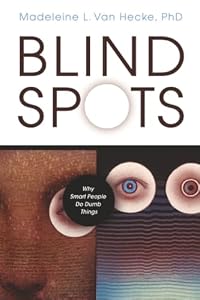
A woman planning a dinner party calls a gourmet caterer and learns that "Chateaubriand" can be ordered. To which she responds, "No, thanks. We're going to take care of the wine ourselves." The dead silence at the end of the phone is her first clue that something is amiss. A CEO attempts to put an end to complaints from employees about the demeaning behavior of certain managers by berating the managers before the staff -- thus reinforcing the very behavior he's trying to correct. We often show more criticize such incidents with remarks like "How dumb!" or "What was he thinking?" But psychologist Madeleine L. Van Hecke argues that much of what we label stupidity can better be explained as blind spots. Just as the blind spot in the driver's side mirror can swallow up a passing car, patterns in the way we think can likewise become blind spots, sifting out information and observations that to other people seem obvious. Drawing on research in creativity, cognitive psychology, critical thinking, child development, education, and philosophy, Dr. Van Hecke shows how our assets as thinkers create the very blind spots that become our worst liabilities. She devotes a chapter to each of ten mental blind spots that afflict even the smartest people: not stopping to think, jumping to conclusions, my-side bias, getting trapped by categories, and much more. At the end of each chapter she offers tactics for overcoming that specific blind spot, so we can become more creative and competent thinkers. Full of funny, poignant stories about human foibles, Blind Spots offers many insights for improving our social and political lives while giving us fresh slants into the minds of people who are poles apart from ourselves. show lessTags
Recommendations


Member Reviews
Unlike recent books like Willful Blindness by Margaret Heffernan, or even On Second Thought by Herbert Wrey, which discuss the concept of blind spots from the point of view of generalized heuristic principles (Wrey) or the implications for society of our choice to deliberately ignore things which make us uncomfortable (Heffernan), Van Hecke's book is deeply individualistic and personal - she's a clinical psychologist, and reading this is like chatting with your therapist during your weekly counseling session. If you want validation that "we're all special in our own unique way" you'll get it here; and while Van Hecke makes a stab at acknowledging that some intelligences really might be more important than others, she quickly dismisses show more the importance of that recognition for the individual by saying that 'we just need to acknowledge that someone without [choose your important ability] can't develop in that direction." The book is heavily weighted toward arguments of why her perspective is important to the development of positive esteem in children. If you need to feel good about yourself this book is for you! show less
I bought "Blind Spots:Why Smart People Do Dumb Things" when I was smarting over a particularly stupid thing I had done. Dr. Van Hecke is upfront about this book being a "self-help book", but she uses a lot of actual psychological theory current a the time the book is written [2007]. The writing is clear. The examples fit the particular blind spot. And she does not spare herself in selecting those examples. There is an index, and a bibliography so that the reader has a chance to go beyond her theories and suggestions for change.
Dr. Van Hecke does not trivialize the difficulty of recognizing and correcting our blind spots nor limit the incidence of blind spots to individuals. She recognizes that looking past blind spots is difficult for show more companies and countries as well as it is for individuals.
This book helped me, even though I read it a decade after it was written. show less
Dr. Van Hecke does not trivialize the difficulty of recognizing and correcting our blind spots nor limit the incidence of blind spots to individuals. She recognizes that looking past blind spots is difficult for show more companies and countries as well as it is for individuals.
This book helped me, even though I read it a decade after it was written. show less
About: Guide to the mental traps and patterns we all have and how to avoid them.
Pros: quick read, interesting, good examples, chapters flow together well, bibliography
Cons: It seems like it might be tough to break thinking habits.
Grade: B+
Pros: quick read, interesting, good examples, chapters flow together well, bibliography
Cons: It seems like it might be tough to break thinking habits.
Grade: B+
facile
Ratings
Members
- Recently Added By
Published Reviews
ThingScore 75
Blind Spots: Why smart people do dumb things.
Author: Madeleine L. Van Hecke
Genre: Psychology, Self-Help, Behavior
This is an important, engaging book that should be read by anyone in a position of authority or in an area where common sense and recognizing how stupid decisions can contribute to ruin. Stupid comments by one person about another can mislead others into believing that person may be show more of a lower IQ.
The author points out that there are 10 common “blind spots”. She goes on to give many more ways to avoid these blind spots with lots of examples and ideas.
As a self-help book, this is very user-friendly, giving the reader a new way of thinking. It is a fast read with real world examples and anecdotes that make it easy to use and follow. The book is also well written with chapters and ideas that flow. Because it does show us newer ways of decision making and thinking, this book helps us become more tolerant of other people when they say or do dumb things.
This book points out the differences between true stupidity and people who are simply untrained or misinformed in certain areas. On page 62, the book states that people can be simply ignorant of information, which to you or may be considered common knowledge.
The book goes on to teach how to defend yourself from being called stupid, by pointing out that we all had to learn during our lives and were not born with inherent world knowledge.
The book points out that there are differences between academic intelligence and other areas of interest or activities. Which brings up the book’s other point: Diversity. We need to celebrate it, not just tolerate it.
Other chapters in the book go on to talk about how people are raised affects the way they see things. How one person sees something is not necessarily the same as others will understand it.
Another point made is that how we view ourselves can determine how we view the world outside of our selves.
A good point of this book is to really listen to other people’s view points, as this is a way to learn and understand outside your own ability. We can still show empathy, yet as it states on page 120, “trip up because we are blind to another person’s perspective.”
A caring person’s acts of kindness can be misunderstood by a person as rude, or insensitive simply by saying that person has a blind spot. We should still challenge their words or behavior, just as the person that said the insensitive remark should be given a chance to apologize.
I learned a lot from this book and it will cause me to question my own beliefs before judging a person or comment from now on.
This book should be required reading for all students that are entering college.
I enjoyed the way the chapters were broken down into sub-sections, first describing the blind spot, then with real life examples followed by methods to overcome that blind spot.
I give this book an A+ show less
Author: Madeleine L. Van Hecke
Genre: Psychology, Self-Help, Behavior
This is an important, engaging book that should be read by anyone in a position of authority or in an area where common sense and recognizing how stupid decisions can contribute to ruin. Stupid comments by one person about another can mislead others into believing that person may be show more of a lower IQ.
The author points out that there are 10 common “blind spots”. She goes on to give many more ways to avoid these blind spots with lots of examples and ideas.
As a self-help book, this is very user-friendly, giving the reader a new way of thinking. It is a fast read with real world examples and anecdotes that make it easy to use and follow. The book is also well written with chapters and ideas that flow. Because it does show us newer ways of decision making and thinking, this book helps us become more tolerant of other people when they say or do dumb things.
This book points out the differences between true stupidity and people who are simply untrained or misinformed in certain areas. On page 62, the book states that people can be simply ignorant of information, which to you or may be considered common knowledge.
The book goes on to teach how to defend yourself from being called stupid, by pointing out that we all had to learn during our lives and were not born with inherent world knowledge.
The book points out that there are differences between academic intelligence and other areas of interest or activities. Which brings up the book’s other point: Diversity. We need to celebrate it, not just tolerate it.
Other chapters in the book go on to talk about how people are raised affects the way they see things. How one person sees something is not necessarily the same as others will understand it.
Another point made is that how we view ourselves can determine how we view the world outside of our selves.
A good point of this book is to really listen to other people’s view points, as this is a way to learn and understand outside your own ability. We can still show empathy, yet as it states on page 120, “trip up because we are blind to another person’s perspective.”
A caring person’s acts of kindness can be misunderstood by a person as rude, or insensitive simply by saying that person has a blind spot. We should still challenge their words or behavior, just as the person that said the insensitive remark should be given a chance to apologize.
I learned a lot from this book and it will cause me to question my own beliefs before judging a person or comment from now on.
This book should be required reading for all students that are entering college.
I enjoyed the way the chapters were broken down into sub-sections, first describing the blind spot, then with real life examples followed by methods to overcome that blind spot.
I give this book an A+ show less
added by Duchesssammi
Author Information

3 Works 177 Members
Classifications
Statistics
- Members
- 162
- Popularity
- 201,471
- Reviews
- 4
- Rating
- (3.07)
- Languages
- English, Greek
- Media
- Paper, Ebook
- ISBNs
- 3
- ASINs
- 1