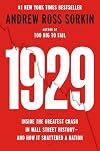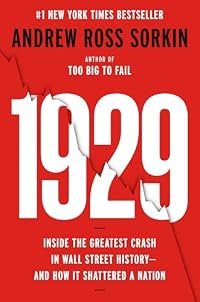
1929: Inside the Greatest Crash in Wall Street History—and How It Shattered a Nation
by Andrew Ross Sorkin
On This Page
Description
"From the bestselling author of Too big to fail, "the definitive history of the 2008 banking crisis," comes a spellbinding narrative of the most infamous stock market crash in history. With the depth of a classic history and the drama of a thriller, 1929 unravels the greed, blind optimism, and human folly that led to an era-defining collapse-one with ripple effects that still shape our society today. In 1929, the world watched in shock as the unstoppable Wall Street bull market went into a show more freefall, wiping out fortunes and igniting a depression that would reshape a generation. But behind the flashing ticker tapes and panicked traders, another drama unfolded-one of visionaries and fraudsters, titans and dreamers, euphoria and ruin. With unparalleled access to historical records and newly uncovered documents, New York Times bestselling author Andrew Ross Sorkin takes readers inside the chaos of the crash, behind the scenes of a raging battle between Wall Street and Washington and the larger-than-life characters whose ambition and naivete in an endless boom led to disaster. The dizzying highs and brutal lows of this era eerily mirror today's world-where markets soar, political tensions mount, and the fight over financial influence plays out once again. This is not just a story about money. 1929 is a tale of power, psychology, and the seductive illusion that "this time is different." It's about disregarded alarm bells, financiers who fell from grace, and skeptics who saw the crash coming-only to be dismissed until it was too late. Hailed as a landmark book, Too Big to Fail reimagined how financial crises are told. Now, with 1929, Sorkin delivers an immersive, electrifying account of the most pivotal market collapse of all time-with lessons that remain as urgent as ever. More than just a history, 1929 is a crucial blueprint for understanding the cycles of speculation, the forces that drive financial upheaval, and the warning signs we ignore at our peril"-- Provided by publisher. show lessTags
Recommendations






Member Reviews
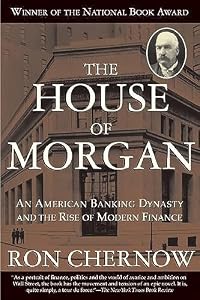
I liked it. Fantastic storytelling of an important historical event and its aftermath. Sorkin does a good job using narratives about individuals who shaped events and usually suffered adverse consequences: Charles Mitchell, for example. There's an interesting commentary about Presidents Hoover and Roosevelt, with the latter coming off looking flaky. The House of Morgan and its unique culture is studied too.
All in all, the story is well presented, demonstrating to me there was careful research and consideration of the facts. The style is non-judgemental too, which adds credibility to the presentation. I found that the Afterword offered some apt conclusions about events like the market crash of 1929:
"Ultimately, the story of 1929 is not show more about rates or regulation, nor about the cleverness of short sellers or the failures of bankers. It is about something far more enduring: human nature. No matter how many warnings are issued or how many laws are written, people will find new ways to believe that the. good times can last forever."
Recommended for students of history and economics. show less
All in all, the story is well presented, demonstrating to me there was careful research and consideration of the facts. The style is non-judgemental too, which adds credibility to the presentation. I found that the Afterword offered some apt conclusions about events like the market crash of 1929:
"Ultimately, the story of 1929 is not show more about rates or regulation, nor about the cleverness of short sellers or the failures of bankers. It is about something far more enduring: human nature. No matter how many warnings are issued or how many laws are written, people will find new ways to believe that the. good times can last forever."
Recommended for students of history and economics. show less
A highly readable, entertaining look into what could be a rather dry subject. Starting from the beginning of the year, Mr. Sorkin takes us through the events, market manipulations, mini crashes and recoveries that ultimately lead up to Black Tuesday and the beliefs and denials that come after. It also, disturbingly, shows how much hasn't changed in today's world..."this time it is different".
Reasonably informative but a bit on the dull side. I thought the most interesting part was how Glass-Steagall came about. I think my main problem with the book is that there wasn't one single person in it that was likeable or with whom I could connect. They were all avaricious thoughtless jerks, just like today.
A riveting narrative of the most infamous stock market crash in history—one with ripple effects that still shape our society today.
A well-written non-fiction narrative about the market crash of 1929, but much of the book covers the subsequent years leading to the great depression. The author saw a need to pick a few villains and focus on them, and stock prices were documented in detail. What was missing were other important metrics like GDP, employment, unemployment rates leading up to 1929, including 1929 and following 1929.
4.8 Terrific! Sorkin is a very talented writer and this book is a page turner. Great look at the intricacies of the 1929 market crash and periods well before and after. Could have done a deeper look at signals we’re seeing in modern times.
I learned so much about the stock crash of 1929 that I did not know before. While I got somewhat lost at times in all the names, the information was excellent. Like so many people, I thought that Black Thursday was just one day with people losing loads of money and throwing themselves off buildings, etc. I was certainly wrong. It was a very complex situation that began before that day and continued for a few more years. I always appreciate learning something new, especially when it helps clear up a common misconception. Excellent read!
Members
- Recently Added By
Lists

Books recommended by Barack Obama
295 works; 28 members

To Read
133 works; 1 member

What A Year: Books titled with a particular year
147 works; 2 members

Favorite Reads of 2025
25 works; 1 member

Governerds Insider
32 works; 1 member

Books Read in 2026
1,719 works; 62 members

Books Read in 2026
17 works; 1 member
Author Information

11 Works 2,711 Members
Andrew Ross Sorkin is an assistant editor of business and finance news at The New York Times. He is also The New York Times chief mergers and acquisitions reporter and a columnist and the editor of DealBook an online daily financial report. Sorkin is a graduate of Cornell University. Too Big to Fail: How Wall Street and Washington Fought to Save show more the Financial System - and Themselves is Sorkin's first book. Sorkin has appeared on NBC's "Today" show and on "Charlie Rose" on PBS, and is a frequent guest host of CNBC's "Squawk Box." He's won a Gerald Loeb Award in 2004, a Society of American Business Editors and Writers Award in 2005 and in 2006. In 2007, the World Economic Forum named him a Young Global Leader. He was also named to the Directorship 100, a list of the most influential people on the nation's board of directors. He is a term member of the Council on Foreign Relations. Sorkin and his wife live in Manhattan. (Bowker Author Biography) show less
Awards and Honors
Distinctions
Common Knowledge
- Canonical title
- 1929: Inside the Greatest Crash in Wall Street History—and How It Shattered a Nation
- Original publication date
- 2025
- Important events
- Stock Market Crash of 1929
- Epigraph
- The ordinary human being does not live long enough to draw any substantial benefit from his own experience. And no one, it seems, can benefit from the experiences of others. Being both a father and a teacher, I know we can ... (show all)teach our children nothing . . . Each must learn its lesson anew.
- Albert Einstein, October 26, 1929 - Dedication
- For my children, Henry, Max, and Sydney. Love you always.
- First words
- (Author's Note) Many people know 1929 as the year of the great stock market crash - the event that triggered the Great Depression and scarred a generation.
(Prologue) Charles Mitchell strode up the steps of 55 Wall Street, determined to project his usual state of confidence and certitude.
On the chilly, windswept evening of February 1, 1929, an hour or so before midnight, Thomas Lamont and his wife, Florence, arrived by limousine at Pier 54 near Fourteenth Street in Manhattan. - Last words
- (Click to show. Warning: May contain spoilers.)Carter Glass may have changed Wall Street and the banking industry, but there were some things that would never change, so long as he could help it.
(Click to show. Warning: May contain spoilers.)(Afterword) The greater the heights of or certainty, the longer and harder we fall. - Blurbers
- Chernow, Ron; Isaacson, Walter; Gage, Beverly; Meacham, Jon
- Original language
- English US
Classifications
Statistics
- Members
- 612
- Popularity
- 47,447
- Reviews
- 16
- Rating
- (3.89)
- Languages
- English
- Media
- Paper, Audiobook, Ebook
- ISBNs
- 9
- ASINs
- 3