On This Page
Description
Introduces various types of pronouns, explains how and when to use them, and provides whimsical glimpses of what our language would be without them.Tags
Recommendations



Member Reviews
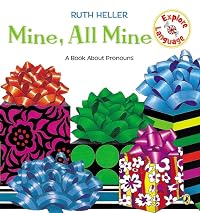
In playful poetry Heller explores pronouns in many categories: personal, possessive, reflexive, demonstrative, relative, interrogative, and indefinite. With zany pictures accompanying the silly yet factual text, Heller makes learning about pronouns fun. I like the surreal nature of the illustrations in this series, where objects are presented in a realistic style but are juxtaposed in ways that aren't at all natural. The vibrancy of the pictures grab the reader's attention.
This is a great series in children's nonfiction. Language and writing are so essential to life. Not only are the results of language fun - such as books - but the play of language itself can be amusing, as this book demonstrates. Heller presents the power and show more potential of pronouns, helping readers of every age appreciate language at a deeper level. show less
This is a great series in children's nonfiction. Language and writing are so essential to life. Not only are the results of language fun - such as books - but the play of language itself can be amusing, as this book demonstrates. Heller presents the power and show more potential of pronouns, helping readers of every age appreciate language at a deeper level. show less
I used Mine, All Mine and the other seven books in Ruth Heller's World of Language series in an intensive 45-hour summer English-as-a-second-language class with students exiting third through sixth grades. The students had been in this country anywhere from two days to two years when the class began, although a few had studied English for many years in their countries of origin. I used Heller's books as a fun way to introduce each section on parts of speech. Heller's eye-catching illustrations made it possible for my students to interpret new words and helped expand their vocabularies. Heller's clever poetry also made the study of grammar more enjoyable, and introduced my students to more rhyming words as well.
I don't think any of the show more books in the series are suitable for the reading level indicated on the books (ages 4-8), unless read aloud, with much explanation, by a parent or teacher. However, I think the series is highly appropriate for advanced third graders on up. The books are properly classified as non-fiction in most libraries, and would be found with a search on the part of speech (e.g., pronouns). I should know; I had to scour three different library systems to get enough copies for my students to use! show less
I don't think any of the show more books in the series are suitable for the reading level indicated on the books (ages 4-8), unless read aloud, with much explanation, by a parent or teacher. However, I think the series is highly appropriate for advanced third graders on up. The books are properly classified as non-fiction in most libraries, and would be found with a search on the part of speech (e.g., pronouns). I should know; I had to scour three different library systems to get enough copies for my students to use! show less
In my opinion this is a whimsical book. The book is very unique in that it talks about the most random things when explaining the different pronouns. The writing style was something I really liked. The author uses rhyming words and although there really isn't a story line, the readers cannot predict what will come next. One page would be talking about candy, but then the next page would be talking about elves eating fruit. It is very interesting and fun to read.
Another reason why I like this book is because of the illustrations. Like stated before, the story is very random, so having the illustrations would help the children keep up with the unpredictability. Also, the illustrations are fun to look at and for visual learners, the show more pictures would help remember the different pronouns.
The purpose of this book is to inform children on the different categories of pronouns and tell them which every day words go in them. This fun book can help children remember, maybe not all, but a lot of the different pronouns by coinciding it with the images or the rhyming. show less
Another reason why I like this book is because of the illustrations. Like stated before, the story is very random, so having the illustrations would help the children keep up with the unpredictability. Also, the illustrations are fun to look at and for visual learners, the show more pictures would help remember the different pronouns.
The purpose of this book is to inform children on the different categories of pronouns and tell them which every day words go in them. This fun book can help children remember, maybe not all, but a lot of the different pronouns by coinciding it with the images or the rhyming. show less
This book was surprisingly entertaining to read. With bouncing rhymes and colorful pictures, this could be a fun way to introduce pronouns to the class.
Not only was this book informational but it was funny! The words all rhyme together which makes it easier for kids to want to listen to it more. Mine, All Mine is written for children who are able to distinguish different pronouns and use them correctly. This is a really great book in the first or second grade classrooms. It shows all the rules in English for pronouns with just a few words per page!
This book is all about pronouns. This book would be great to include in a language arts lesson on pronouns. This book is humorous and really makes the reader think about the proper way to use pronouns in sentences. This book shows the importance of using pronouns and how it adds character and interest to sentences. I loved how the author included examples of not using pronouns and how boring it was. I feel that this would be a fun read for students that is very beneficial to their learning of pronouns.
Kindergarteners through third grade are bound to favor this informational mentor text over the plain stuffy way of teaching pronouns. Through rhyming, Heller teaches the different types of pronouns and how to use them.
Members
- Recently Added By
Author Information

82+ Works 20,295 Members
Awards and Honors
Series

Common Knowledge
- Original publication date
- 1997
Classifications
Statistics
- Members
- 822
- Popularity
- 33,708
- Reviews
- 18
- Rating
- (4.31)
- Languages
- English
- Media
- Paper
- ISBNs
- 9
- ASINs
- 2