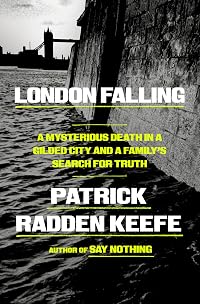
London Falling: A Mysterious Death in a Gilded City and a Family's Search for Truth
by Patrick Radden Keefe 
On This Page
Description
"From the bestselling, prize-winning author of SAY NOTHING, a powerfully compelling account of a family devastated by the apparent suicide of their nineteen year-old son, only to discover he had created a separate identity which drew him into the dangerous international criminal underworld underlying London's glittering surface. In the early morning of November 29th, 2019, surveillance cameras at the headquarters of MI6, Britain's spy agency, captured a video of a young man pacing back and show more forth on a balcony of Riverwalk, a luxury building on the opposite bank of the Thames River. At 2:24 a.m., he jumped. In a quiet London neighborhood several miles away, Rachelle Brettler was worried. She hadn't heard from her son Zac, who told her he had gone to stay with a friend for the night, but wasn't answering his phone. Five days later, a police car pulled up in front of the house, and she knew she was about to hear the news every parent dreads: Her son was dead. In their unbearable grief, Rachelle and her husband Matthew tried to understand what had happened to Zac. He had his troubles, but in no way seemed suicidal. But his death was just the beginning of the shocks: The man who owned the apartment in Riverwalk, a wealthy businessman named Akbar Shamji, told them he knew Zac by a different identity: Zac Ismailov, the child of a wealthy Russian oligarch, whose widowed mother was living in Dubai and freezing him out of his inheritance. Then they learned that the apartment was occupied by a notorious gangster known as "Indian Dave" in London criminal circles. Indian Dave had been implicated in a gangland slaying and fled the country, but for opaque reasons came back to England and was never prosecuted. From the physical evidence and recovered text messages between Shamji and Sharma, it appeared something very different than a suicide had taken place in Riverwalk that night. But to the immense frustration of the Brettlers, Scotland Yard seemed to have no interest in investigating. In a bravura piece of reporting and writing, Patrick Radden Keefe delves into a story that peels back multiple layers of mystery, and exposes the seedy truths beneath the glamourous London of posh mansions and private night clubs, a world sustained and abetted by fundamental corruption. Zac Brettler was not the only person in the tale spinning lies. London Falling is a mesmerizing investigation of an inexplicable death, fueled by multiple turns and revelations, but at its heart it is a deeply empathetic portrait of a family trying to understand not just why their son died, but who he was"-- Provided by publisher. show lessTags
Recommendations










Member Reviews
I found this initially gripping—why did a 19-year-old end up dead in the Thames, and what does that have to do with some of the seedier underbelly of 21st-century London?—but the more I read on, the more dubious I got.
Patrick Radden Keefe writes with his usual verve, but with far too many tangents that I far too often suspected were included to bulk up the book's sense of misty conspiratorialism. What do Sergei Skripal and Idi Amin's expulsion of Ugandan Asians have to do with why Zac Brettler died? Nothing, certainly nothing that justifies the amount they and other figures are discussed here, except in a vague domino sense that could also justify a discussion of the rise of manufacturing in East Asia and Ronald Reagan's economic show more policy. So why include them in particular? Exoticism, perhaps? Equally I found myself deeply frustrated by things like the feints in the direction of "Was X a police informant who faked his own death? Because there's no record of him having died!" which were then followed many pages later by "Oh yeah, he died and there was an inquest etc, guess that was missed on a first search." What?
The more that PRK gestured towards all these shadowy possibilities, the less I found myself inclined to believe that there is anything super mysterious here—no London Met collusion with shadowy figures to cover up Brettler's death. The scenario that PRK posits as to what happened the night of Brettler's death is a plausible one, and perhaps even a probable one. It's also one that he put forward after almost 300 pages, while it had occurred to me long, long before. If that is what happened, well, the failure for anyone to ever be charged may well be in part down to incurious and/or overworked police, but I think it may also be because the Met looked at the evidence it had or was ever likely to get about Brettler's death, and the chances of securing a conviction based on that, and decided to direct precious resources elsewhere. Distasteful, perhaps, but I think that's a far likelier explanation for the interactions which Brettler's parents had with some officers over the months following their son's death than the spin which PRK puts on it. I don't think they were "maddeningly incurious"; I think they had a reasonable understanding of the situation, and were trying to avoid the awkwardness of being up-front with the Brettlers about it. And listen, I'm an Irish woman with no particular love for cops in any country, let alone British ones, but you can apply Occam's razor to human behaviour.
As I understand it, this book began life as a magazine article, and my sense is that is a far better length for the story it contains. Brettler's life was, in many ways, banal and vulgar. It was marked by fabulism, venality and the capacity for violence (PRK admits but then wildly underplays the fact that Brettler once throttled his own mother), and distinguished only by the striking manner of his death. If PRK did feel the need to spin it up into a book, well, then take the kernel of what you've got here and make it the hook/chapter in a more deeply researched book about London crime, or oligarchs' power, or police corruption, or how a journalist's sympathies for the bereaved can skew the stories they tell—but a book needs more depth to it than what can be provided by one shallow life. show less
Patrick Radden Keefe writes with his usual verve, but with far too many tangents that I far too often suspected were included to bulk up the book's sense of misty conspiratorialism. What do Sergei Skripal and Idi Amin's expulsion of Ugandan Asians have to do with why Zac Brettler died? Nothing, certainly nothing that justifies the amount they and other figures are discussed here, except in a vague domino sense that could also justify a discussion of the rise of manufacturing in East Asia and Ronald Reagan's economic show more policy. So why include them in particular? Exoticism, perhaps? Equally I found myself deeply frustrated by things like the feints in the direction of "Was X a police informant who faked his own death? Because there's no record of him having died!" which were then followed many pages later by "Oh yeah, he died and there was an inquest etc, guess that was missed on a first search." What?
The more that PRK gestured towards all these shadowy possibilities, the less I found myself inclined to believe that there is anything super mysterious here—no London Met collusion with shadowy figures to cover up Brettler's death. The scenario that PRK posits as to what happened the night of Brettler's death is a plausible one, and perhaps even a probable one. It's also one that he put forward after almost 300 pages, while it had occurred to me long, long before. If that is what happened, well, the failure for anyone to ever be charged may well be in part down to incurious and/or overworked police, but I think it may also be because the Met looked at the evidence it had or was ever likely to get about Brettler's death, and the chances of securing a conviction based on that, and decided to direct precious resources elsewhere. Distasteful, perhaps, but I think that's a far likelier explanation for the interactions which Brettler's parents had with some officers over the months following their son's death than the spin which PRK puts on it. I don't think they were "maddeningly incurious"; I think they had a reasonable understanding of the situation, and were trying to avoid the awkwardness of being up-front with the Brettlers about it. And listen, I'm an Irish woman with no particular love for cops in any country, let alone British ones, but you can apply Occam's razor to human behaviour.
As I understand it, this book began life as a magazine article, and my sense is that is a far better length for the story it contains. Brettler's life was, in many ways, banal and vulgar. It was marked by fabulism, venality and the capacity for violence (PRK admits but then wildly underplays the fact that Brettler once throttled his own mother), and distinguished only by the striking manner of his death. If PRK did feel the need to spin it up into a book, well, then take the kernel of what you've got here and make it the hook/chapter in a more deeply researched book about London crime, or oligarchs' power, or police corruption, or how a journalist's sympathies for the bereaved can skew the stories they tell—but a book needs more depth to it than what can be provided by one shallow life. show less
“London Falling” is an unsettling work of investigative nonfiction that examines the mysterious death of Zac Brettler, a young man who plunged from a fifth-floor balcony overlooking the Thames. Officially ruled a suicide, the case immediately raises doubts, and Keefe methodically explores whether Zac’s death was in fact something far darker. What emerges is less a conventional true-crime narrative than a portrait of contemporary London itself—a city saturated with money, corruption, illusion, and moral compromise.
Keefe’s extraordinary reporting is the book’s key strength. He follows numerous leads and reconstructs a tangled web of interconnected stories surrounding Zac. Each strand is compelling in its own right. There are show more wealthy elites and aspiring social climbers, con men selling fantasies of financial success, brutal criminals who extort the rich through threats and violence, and investigators whose failures suggest either incompetence or deliberate concealment. Through these narratives, Keefe reveals how easy it is for vulnerable people to become seduced by the glamour of wealth and proximity to power.
Zac himself becomes a tragic figure caught between worlds. Fascinated by luxury and status, he appears to have imagined a double life in which he could move among London’s rich and influential. Keefe handles this aspect of the story carefully, portraying Zac not simply as naïve but as emblematic of a culture obsessed with image, access, and reinvention. Keefe is equally attentive to the emotional devastation experienced by Zac’s parents, whose grief drives much of his investigation. Their desperate search for answers gives the book its emotional center. Keefe’s exploration of the family’s history adds important psychological depth, helping to explain both Zac’s motivations and the intensity of his parents’ refusal to accept simplistic conclusions.
Another major achievement of the book is its depiction of London itself. Keefe presents the city as a global haven for oligarchs, financiers, and shadowy operators, where enormous wealth often exists alongside corruption and moral indifference. Expensive apartments, exclusive clubs, and hidden criminal networks form the disturbing backdrop of a society in which money can distort justice and obscure truth. In fact, one of the most effective aspects of the book is the atmosphere of instability and uncertainty that Keefe creates through his reporting. The deeper he investigates Zac’s death, the more the reader experiences a growing sense that every reassuring surface conceals something darker underneath. Keefe is not simply investigating a suspicious fall; he is dismantling the illusion of security and respectability that surrounded nearly every aspect of Zac’s life. What makes this mood so unsettling is that Keefe repeatedly introduces figures or institutions that initially appear trustworthy, only to reveal hidden corruption, deception, or menace. The Brettlers’ aspiration toward a stable, successful family life—with financial comfort, educational opportunity, and social advancement—gradually curdles into something tragic and disorienting. Their dream resembles a classic modern ideal of prosperity and achievement, yet the closer Keefe looks, the more fragile and illusory that ideal becomes. Their family history is especially important in creating this emotional atmosphere. Keefe uncovers how even revered figures within the family mythology are compromised. An ancestor celebrated as a respected religious leader is revealed to have fabricated parts of his educational background while secretly maintaining two separate families. That revelation is deeply symbolic within the book. A figure who should represent moral authority and stability instead embodies duplicity and concealed shame. With this element, Keefe suggests that the instability haunting Zac’s life did not emerge suddenly but existed beneath the family narrative long before his death.
This pattern repeats throughout the investigation. Individuals who present themselves as guides, protectors, or benefactors are exposed as manipulative opportunists. A seemingly avuncular entrepreneurial mentor offering wisdom and access to wealth turns out to be little more than a grifter trafficking in fantasies and failed schemes. Likewise, an older man who appears to rescue a vulnerable young Zac from trouble gradually reveals himself as profoundly sinister—a predator whose outward charm masks intimidation and violence. Keefe is particularly skilled at showing how charisma and menace can coexist. Many of the book’s most dangerous figures survive precisely because they understand how to appear helpful, worldly, or reassuring. Even the police investigation contributes to this atmosphere. The police’s inability—or unwillingness—to pursue certain leads leaves lingering suspicions of either extraordinary incompetence or deliberate protection of criminal informants. Keefe never forces definitive conclusions, but he carefully arranges the evidence, so the reader feels trapped inside ambiguity. The cumulative effect is a profound erosion of certainty. Readers begin to feel that no testimony is entirely reliable, no institution fully competent, and no relationship free from hidden agendas.
That uncertainty gives the book much of its emotional power. Rather than providing the satisfaction of a solved mystery, Keefe creates the feeling of wandering through a hall of mirrors where appearances continually collapse. Wealth becomes entangled with criminality, mentorship with exploitation, family history with deception, and opportunity with danger. By the end, the reader shares the Brettlers’ anguish: the terrifying realization that the world they believed they inhabited may never have existed in the form they imagined.
At times, however, the book’s greatest virtue also becomes its primary weakness. Keefe includes an immense amount of detail, and not all of it feels equally relevant. Some peripheral stories, while fascinating, seem to move the narrative away from the central mystery rather than closer to resolution. Readers hoping for definitive answers may find the conclusion frustratingly inconclusive. Keefe points toward several plausible scenarios, but concrete proof remains elusive. In the end, the uncertainty surrounding Zac’s death persists. Yet perhaps that ambiguity is precisely his point. “London Falling” demonstrates how difficult truth can be to establish in a world shaped by wealth, secrecy, and institutional failure. The book is especially effective in showing how modern technology—surveillance footage, phone records, digital traces—creates the possibility of uncovering hidden realities, while still leaving crucial gaps that cannot always be bridged.
Ultimately, the book succeeds not because it solves a mystery, but because it illuminates the murky social forces surrounding it. Keefe combines investigative rigor with empathy and atmospheric storytelling to create a haunting examination of grief, corruption, and the seductive dangers of wealth. show less
Keefe’s extraordinary reporting is the book’s key strength. He follows numerous leads and reconstructs a tangled web of interconnected stories surrounding Zac. Each strand is compelling in its own right. There are show more wealthy elites and aspiring social climbers, con men selling fantasies of financial success, brutal criminals who extort the rich through threats and violence, and investigators whose failures suggest either incompetence or deliberate concealment. Through these narratives, Keefe reveals how easy it is for vulnerable people to become seduced by the glamour of wealth and proximity to power.
Zac himself becomes a tragic figure caught between worlds. Fascinated by luxury and status, he appears to have imagined a double life in which he could move among London’s rich and influential. Keefe handles this aspect of the story carefully, portraying Zac not simply as naïve but as emblematic of a culture obsessed with image, access, and reinvention. Keefe is equally attentive to the emotional devastation experienced by Zac’s parents, whose grief drives much of his investigation. Their desperate search for answers gives the book its emotional center. Keefe’s exploration of the family’s history adds important psychological depth, helping to explain both Zac’s motivations and the intensity of his parents’ refusal to accept simplistic conclusions.
Another major achievement of the book is its depiction of London itself. Keefe presents the city as a global haven for oligarchs, financiers, and shadowy operators, where enormous wealth often exists alongside corruption and moral indifference. Expensive apartments, exclusive clubs, and hidden criminal networks form the disturbing backdrop of a society in which money can distort justice and obscure truth. In fact, one of the most effective aspects of the book is the atmosphere of instability and uncertainty that Keefe creates through his reporting. The deeper he investigates Zac’s death, the more the reader experiences a growing sense that every reassuring surface conceals something darker underneath. Keefe is not simply investigating a suspicious fall; he is dismantling the illusion of security and respectability that surrounded nearly every aspect of Zac’s life. What makes this mood so unsettling is that Keefe repeatedly introduces figures or institutions that initially appear trustworthy, only to reveal hidden corruption, deception, or menace. The Brettlers’ aspiration toward a stable, successful family life—with financial comfort, educational opportunity, and social advancement—gradually curdles into something tragic and disorienting. Their dream resembles a classic modern ideal of prosperity and achievement, yet the closer Keefe looks, the more fragile and illusory that ideal becomes. Their family history is especially important in creating this emotional atmosphere. Keefe uncovers how even revered figures within the family mythology are compromised. An ancestor celebrated as a respected religious leader is revealed to have fabricated parts of his educational background while secretly maintaining two separate families. That revelation is deeply symbolic within the book. A figure who should represent moral authority and stability instead embodies duplicity and concealed shame. With this element, Keefe suggests that the instability haunting Zac’s life did not emerge suddenly but existed beneath the family narrative long before his death.
This pattern repeats throughout the investigation. Individuals who present themselves as guides, protectors, or benefactors are exposed as manipulative opportunists. A seemingly avuncular entrepreneurial mentor offering wisdom and access to wealth turns out to be little more than a grifter trafficking in fantasies and failed schemes. Likewise, an older man who appears to rescue a vulnerable young Zac from trouble gradually reveals himself as profoundly sinister—a predator whose outward charm masks intimidation and violence. Keefe is particularly skilled at showing how charisma and menace can coexist. Many of the book’s most dangerous figures survive precisely because they understand how to appear helpful, worldly, or reassuring. Even the police investigation contributes to this atmosphere. The police’s inability—or unwillingness—to pursue certain leads leaves lingering suspicions of either extraordinary incompetence or deliberate protection of criminal informants. Keefe never forces definitive conclusions, but he carefully arranges the evidence, so the reader feels trapped inside ambiguity. The cumulative effect is a profound erosion of certainty. Readers begin to feel that no testimony is entirely reliable, no institution fully competent, and no relationship free from hidden agendas.
That uncertainty gives the book much of its emotional power. Rather than providing the satisfaction of a solved mystery, Keefe creates the feeling of wandering through a hall of mirrors where appearances continually collapse. Wealth becomes entangled with criminality, mentorship with exploitation, family history with deception, and opportunity with danger. By the end, the reader shares the Brettlers’ anguish: the terrifying realization that the world they believed they inhabited may never have existed in the form they imagined.
At times, however, the book’s greatest virtue also becomes its primary weakness. Keefe includes an immense amount of detail, and not all of it feels equally relevant. Some peripheral stories, while fascinating, seem to move the narrative away from the central mystery rather than closer to resolution. Readers hoping for definitive answers may find the conclusion frustratingly inconclusive. Keefe points toward several plausible scenarios, but concrete proof remains elusive. In the end, the uncertainty surrounding Zac’s death persists. Yet perhaps that ambiguity is precisely his point. “London Falling” demonstrates how difficult truth can be to establish in a world shaped by wealth, secrecy, and institutional failure. The book is especially effective in showing how modern technology—surveillance footage, phone records, digital traces—creates the possibility of uncovering hidden realities, while still leaving crucial gaps that cannot always be bridged.
Ultimately, the book succeeds not because it solves a mystery, but because it illuminates the murky social forces surrounding it. Keefe combines investigative rigor with empathy and atmospheric storytelling to create a haunting examination of grief, corruption, and the seductive dangers of wealth. show less
I have had a string of 5-star reads, and I am starting to worry that I am going to lose all credibility, assuming I had any to be lost. But I swear that it is just dumb luck that I have been reading a lot of stellar books, and that every star I award here has been earned.
I have never read a Patrick Raden Keefe book or article that I have not thought was exceptional, and that streak is not broken here. This is the story of the murder? suicide? of Zac Brettler, a 19-year old London boy with the analytical powers and decayed soul of Donald Trump. Zac was raised to believe he was the center of the world, and when he did not get one thing (admission into an elite school) it apparently turned him into a selfish person who always needed to be show more a person people envied, and as a result a compulsive liar. Zac was obsessed with wealth and position, and in his quest to be incredibly wealthy (he was raised with significant economic privilege, but that was not enough) he created a situation through his deceit and choice of companions in which he was going to die. And when he died, the only question was whether he killed himself before someone else did the job, or whether they did the deed. The story is jaw-dropping, and also very relevant to this historic moment where truth is reviled, obscene wealth has become our golden idol, and all sense of duty to the collective has been crushed. Yes, I was a voyeur here, but not entirely that. This raises meaningful questions and avenues for thought for the reader, and holds Scotland Yard and the economic structure of London up to the light.
The story is told in three pieces. First, we meet Zac and learn something about his story (though some of this is guesswork. The second piece is where we meet the grifters and thugs who caused Zac's death, and boy, is that colorful. Finally, we ride alongside Zac's parents as they try to get answers, and as they are introduced to PRK, they tirelessly work together to tell this story. IT doesn't seem like that structure should work, but it does.
My heart goes out to the Brettlers, and I appreciate their rigor in trying to find Zac's story and to find a way for some good to have come from their heartbreak. This is an extraordinary true crime story. This is how it is done. show less
I have never read a Patrick Raden Keefe book or article that I have not thought was exceptional, and that streak is not broken here. This is the story of the murder? suicide? of Zac Brettler, a 19-year old London boy with the analytical powers and decayed soul of Donald Trump. Zac was raised to believe he was the center of the world, and when he did not get one thing (admission into an elite school) it apparently turned him into a selfish person who always needed to be show more a person people envied, and as a result a compulsive liar. Zac was obsessed with wealth and position, and in his quest to be incredibly wealthy (he was raised with significant economic privilege, but that was not enough) he created a situation through his deceit and choice of companions in which he was going to die. And when he died, the only question was whether he killed himself before someone else did the job, or whether they did the deed. The story is jaw-dropping, and also very relevant to this historic moment where truth is reviled, obscene wealth has become our golden idol, and all sense of duty to the collective has been crushed. Yes, I was a voyeur here, but not entirely that. This raises meaningful questions and avenues for thought for the reader, and holds Scotland Yard and the economic structure of London up to the light.
The story is told in three pieces. First, we meet Zac and learn something about his story (though some of this is guesswork. The second piece is where we meet the grifters and thugs who caused Zac's death, and boy, is that colorful. Finally, we ride alongside Zac's parents as they try to get answers, and as they are introduced to PRK, they tirelessly work together to tell this story. IT doesn't seem like that structure should work, but it does.
My heart goes out to the Brettlers, and I appreciate their rigor in trying to find Zac's story and to find a way for some good to have come from their heartbreak. This is an extraordinary true crime story. This is how it is done. show less
Keefe once again delivers a riveting true story, in his strong narrative nonfiction style. This one focuses on the Brettler family, middle-class Londoners, with two sons. One fateful early morning in 2019, their youngest son Zac jumps from an apartment balcony to his death in the river Thames. The news was a terrible blow to the family but it even became darker and more tangled as the Brettler’s discovered that their nineteen-year-old son was living a double life- posing as a Russian oligarch's son. He was also deeply mixed up with some shady businessmen and a couple of crafty gangsters. How this all happened and how this led to his death, is how this story deftly unfolds.
London Falling by Patrick Radden Keefe is an excellent true-crime investigation book. Keefe explores the wide-ranging story of Zac Brettler, who fell from the fifth-floor balcony of an exclusive apartment building when he was just 19 years old. His distraught parents didn’t know who to turn to, and soon learned their son was leading a double life they knew nothing about. The story touches on many aspects of London society — from the Russian oligarchy to crime bosses, the Jewish community, and more — as Keefe examines all aspects of Zac’s death.
Is impersonating a Russian oligarch a crime? Is it a crime when everyone is a con man? Only is there is murder or a suspicion of murder.
Zac Battler dies at age 19 and his parents learn that he had been pretending that he was the son of a Russian oligarch. The boy is charismatic and bright and the cons he falls in with believe his as they mentor him or feel sorry for Zac.
After his death the parents are desperate to figure out what happened to Zac and why they were blind to what was happening. The police are not always helpful so they get a private detective and ultimately the journalist/author puts the pieces together. An equally interesting part of the book was historic glimpses into London’s development as a financial center and show more laundry for oligarchs money. Very well written if somewhat repetitive at the end. There were lengthy endnotes. show less
Zac Battler dies at age 19 and his parents learn that he had been pretending that he was the son of a Russian oligarch. The boy is charismatic and bright and the cons he falls in with believe his as they mentor him or feel sorry for Zac.
After his death the parents are desperate to figure out what happened to Zac and why they were blind to what was happening. The police are not always helpful so they get a private detective and ultimately the journalist/author puts the pieces together. An equally interesting part of the book was historic glimpses into London’s development as a financial center and show more laundry for oligarchs money. Very well written if somewhat repetitive at the end. There were lengthy endnotes. show less
Rating: 3.5 Stars
In a nutshell:
19-year-old Nick has gone missing. We eventually learn he has died from a fall - or jump? - from a building along the Thames in London. His death reveals he has been lying about who he is, pretending to be the son of a Russian oligarch.
Best for:
Fans of investigative reporting.
Quote that made me think:
N/A
Why I chose it:
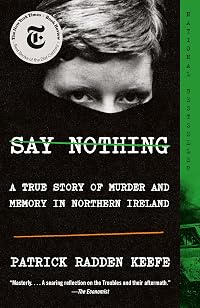
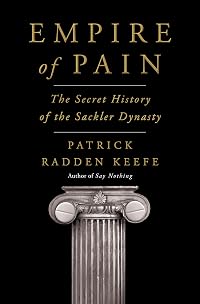
Say Nothing and Empire of Pain are two of the best non-fiction books I’ve ever read. As soon as I saw this I knew I had to read it.
Review:
The book starts with a description of two buildings in London: a government building on the south side of the Thames, and the Riverwalk condos on the north side. We learn quickly that Nick has died from a fall from the Riverwalk building, though his show more family doesn’t learn of this for a few days, when his body is discovered just next to the embankment. Cameras on the government building showed that Nick jumped from the building and was not pushed - though it doesn’t show if something led him to think that was his only option. (As an aside - while listening to the audio book I was in London and ran past both buildings a couple of times. That’s always a bit weird.)
Before his parents learn about Nick’s death and only know he is missing, they discover he has been lying to people for a few years, saying that his dad Matthew is dead and his mom Rochelle lives overseas. He says he knows the owner of Chelsea Football Club, and ingratiates himself with some folks who may or may not be involved in criminal activities.
From there, so many doors open, leading to so many different stories. In the center of it all is the Metropolitan Police, who don’t seem to take the investigation as seriously as the parents want. So they engage an investigator to look into the backgrounds of two individuals who claimed to have been fully fooled by Nick’s stories.
There are other interweaving stories, including the interesting background of Nick’s grandfather, but in the end, like so much in life, we don’t really learn what happened. It’s someone’s life, so I’m not going to say its ‘unsatisfying,’ but it is a bit frustrating. Like real life, I suppose. I feel for Nick, because he clearly had some issues to make up such severe lies, and then at the end of his life in one way or another felt he had no choice but to jump from that balcony. And I feel for his parents, because they’re left with so many questions.
Would I recommend it to its target audience:
I guess. I didn’t find it as engaging as his previous work, but it was still clearly very well researched and written. show less
In a nutshell:
19-year-old Nick has gone missing. We eventually learn he has died from a fall - or jump? - from a building along the Thames in London. His death reveals he has been lying about who he is, pretending to be the son of a Russian oligarch.
Best for:
Fans of investigative reporting.
Quote that made me think:
N/A
Why I chose it:
Say Nothing and Empire of Pain are two of the best non-fiction books I’ve ever read. As soon as I saw this I knew I had to read it.
Review:
The book starts with a description of two buildings in London: a government building on the south side of the Thames, and the Riverwalk condos on the north side. We learn quickly that Nick has died from a fall from the Riverwalk building, though his show more family doesn’t learn of this for a few days, when his body is discovered just next to the embankment. Cameras on the government building showed that Nick jumped from the building and was not pushed - though it doesn’t show if something led him to think that was his only option. (As an aside - while listening to the audio book I was in London and ran past both buildings a couple of times. That’s always a bit weird.)
Before his parents learn about Nick’s death and only know he is missing, they discover he has been lying to people for a few years, saying that his dad Matthew is dead and his mom Rochelle lives overseas. He says he knows the owner of Chelsea Football Club, and ingratiates himself with some folks who may or may not be involved in criminal activities.
From there, so many doors open, leading to so many different stories. In the center of it all is the Metropolitan Police, who don’t seem to take the investigation as seriously as the parents want. So they engage an investigator to look into the backgrounds of two individuals who claimed to have been fully fooled by Nick’s stories.
There are other interweaving stories, including the interesting background of Nick’s grandfather, but in the end, like so much in life, we don’t really learn what happened. It’s someone’s life, so I’m not going to say its ‘unsatisfying,’ but it is a bit frustrating. Like real life, I suppose. I feel for Nick, because he clearly had some issues to make up such severe lies, and then at the end of his life in one way or another felt he had no choice but to jump from that balcony. And I feel for his parents, because they’re left with so many questions.
Would I recommend it to its target audience:
I guess. I didn’t find it as engaging as his previous work, but it was still clearly very well researched and written. show less
Members
- Recently Added By
Lists

To Read
140 works; 1 member

The Economist Books of 2026 So Far (June 2026)
25 works; 1 member

Bina's reviews
12 works; 1 member
Author Information

9+ Works 7,806 Members
Patrick Radden Keefe is a LibraryThing Author, an author who lists their personal library on LibraryThing.
Awards and Honors
Distinctions
Notable Lists
Common Knowledge
- Original publication date
- 2026-04-07
- People/Characters
- Zac Brettler; Rachelle Brettler; Matthew Brettler; Akbar Shamji; Abdul Shamji
- Important places
- London, England, UK
- Epigraph
- the boy shocked to see
what could so easily be himself in the river
bent to greet it.
--Gboyega Odubanjo
London, after all, is a city of tombs.
--Virginia Woolf - Dedication
- For Jennifer Radden and Frank Keefe
- First words
- The headquarters of Britain's Secret Intelligence Service, MI6, occupies an imposing edifice of concrete and green glass on the south bank of the River Thames, in London.
- Original language
- English
Classifications
- Genres
- General Nonfiction, Biography & Memoir
- DDC/MDS
- 364.106 — Society, government, & culture Social problems and social services Crime Criminal offenses Organized Crime
- LCC
- HV6950 .L7 .K44 — Social sciences Social pathology. Social and public welfare. Criminology Social pathology. Social and public welfare. Criminology Crimes and criminal classes
- BISAC
Statistics
- Members
- 459
- Popularity
- 66,505
- Reviews
- 13
- Rating
- (4.19)
- Languages
- English, German
- Media
- Paper, Audiobook, Ebook
- ISBNs
- 7
- ASINs
- 2