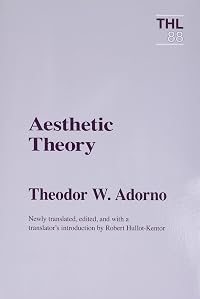
Aesthetic Theory
by Theodor W. Adorno
On This Page
Description
The culmination of a lifetime of aesthetic investigation, Aesthetic Theory is Adorno's major work, a defense of modernism that is paradoxical in its defense of illusion. In it, Adorno takes up the problem of art in a day when "it goes without saying that nothing concerning art goes without saying." In the course of his discussion, Adorno revisits such concepts as the sublime, the ugly, and the beautiful, demonstrating that concepts such as these are reservoirs of human experience. These show more experiences ultimately underlie aesthetics, for in Adorno's formulation "art is the sedimented history of human misery." show lessTags
Recommendations




Member Reviews
Adorno's magnum opus. Frustrating, eclectic, incisive, like a flame to the synapse. Undoubtedly the greatest work on Aesthetics in the 20th Century. Spars with the Aesthetics of Kant, Hegel, Valery, Benjamin as Adorno traverses a manifold of artistic mediums and numerous specific artist. What is form and content, what is meaning, what is truth-content, what is technique, what is arts relation to society, to it's creator, how should it be understood? Just some of the many questions this book stages. His chapter on the notion of Modernism alone is enough reason to grab this.
Well bound, nice typeface..great, because this is a book for life. Highly recommended.
Well bound, nice typeface..great, because this is a book for life. Highly recommended.
if you want to know where Duchamp got it from and have an almost metaphysical experience of what art is, read this. You may not end up agreeing with him but he will take you to places no other art critic or philosopher has gone..
In den letzten Lebensjahren arbeitete Adorno, mit häufigen Revisionen, Umstellungen und Neuformulierungen an dem Text, der uns als die Ästhetische Theorie in Fragmenten zuhanden liegt. Diese Ästhetik sollte nach Gerhard Kaiser „alle Motive seines Denkens [engführen].“ Nach dem Willen Adornos selbst sollte dieser Torso der Ästhetischen Theorie, zusammen mit der Negativen Dialektik und einem geplanten moralphilosophischen Buch „das darstellen“, was er „in die Waagschale zu werfen“ habe. Die Ästhetische Theorie erschien posthum als Torso im Jahre 1970 und beginnt – wie bereits in ähnlicher Weise angeklungen - mit der Infragestellung der Möglichkeit von Kunst überhaupt. Wenn es denn überhaupt in Frage steht, ob nach show more Auschwitz Poesie an und für sich noch möglich ist, steht es auf allgemeinerer Ebene auch in Frage, ob nach Auschwitz Kunst überhaupt noch ihr vielbesagtes Existenzrecht hat.
Wohlbekannt ist der Satz: „"Zur Selbstverständlichkeit wurde, daß nichts, was die Kunst betrifft, mehr selbstverständlich ist, weder in ihr noch in ihrem Verhältnis zum Ganzen, nicht einmal ihr Existenzrecht." (Adorno 1993, S. 9)
Wenn die Kunst ihre Selbstverständlichkeit verliert und ihr Existenzrecht durch die Zeitgeschichte derart in Frage gestellt wird, so erhebt sich dort, wo Kunst zum Licht der Welt drängt, zugleich die Ungewissheit über die Möglichkeit oder Unmöglichkeit von Kunst. Dass Kunst aber von sich aus zur Emanzipation von der Gesellschaft, in der sie geboren wird, strebt, sich immer wieder Enklaven schaffen will und muß, in der sie unbehelligt von sozialen Diktaten arbeiten kann, scheint Adorno stets im Auge zu behalten. Gerade weil Kunst ein fait social, Kunstwerke soziale Produkte sind, müssen sich die Emanzipationsbestrebungen in ein Spannungsverhältnis zwischen Autonomie und Heteronomie, also Selbständigkeit und Fremdbestimmtheit, begeben. Trotzdem oder gerade deshalb scheint es nach dem Frankfurter Philosophen gerade so, als ob Kunst sich nach dieser Emanzipation die eigenen Voraussetzungen, nämlich hier vor allem soziale Voraussetzungen, wie er sagt, abgegraben und verloren habe. Damit steht zugleich immer auch das Verhältnis der traditionellen zur zeitgenössischen Kunst zur Disposition. Wie – möchte man fragen – soll man sich als zeitgenössischer Künstler in ein Verhältnis setzen zur traditionellen Kunst? show less
Wohlbekannt ist der Satz: „"Zur Selbstverständlichkeit wurde, daß nichts, was die Kunst betrifft, mehr selbstverständlich ist, weder in ihr noch in ihrem Verhältnis zum Ganzen, nicht einmal ihr Existenzrecht." (Adorno 1993, S. 9)
Wenn die Kunst ihre Selbstverständlichkeit verliert und ihr Existenzrecht durch die Zeitgeschichte derart in Frage gestellt wird, so erhebt sich dort, wo Kunst zum Licht der Welt drängt, zugleich die Ungewissheit über die Möglichkeit oder Unmöglichkeit von Kunst. Dass Kunst aber von sich aus zur Emanzipation von der Gesellschaft, in der sie geboren wird, strebt, sich immer wieder Enklaven schaffen will und muß, in der sie unbehelligt von sozialen Diktaten arbeiten kann, scheint Adorno stets im Auge zu behalten. Gerade weil Kunst ein fait social, Kunstwerke soziale Produkte sind, müssen sich die Emanzipationsbestrebungen in ein Spannungsverhältnis zwischen Autonomie und Heteronomie, also Selbständigkeit und Fremdbestimmtheit, begeben. Trotzdem oder gerade deshalb scheint es nach dem Frankfurter Philosophen gerade so, als ob Kunst sich nach dieser Emanzipation die eigenen Voraussetzungen, nämlich hier vor allem soziale Voraussetzungen, wie er sagt, abgegraben und verloren habe. Damit steht zugleich immer auch das Verhältnis der traditionellen zur zeitgenössischen Kunst zur Disposition. Wie – möchte man fragen – soll man sich als zeitgenössischer Künstler in ein Verhältnis setzen zur traditionellen Kunst? show less
Dec 29, 2012German
FG-5
Sep 11, 2020Catalan
Members
- Recently Added By
Author Information

Theodor W. Adorno is the progenitor of critical theory, a central figure in aesthetics, and the century's foremost philosopher of music. He was born and educated in Frankfurt, Germany. After completing his Ph.D. in philosophy, he went to Vienna, where he studied composition with Alban Berg. He soon was bitterly disappointed with his own lack of show more talent and turned to musicology. In 1928 Adorno returned to Frankfurt to join the Institute for Social Research, commonly known as The Frankfurt School. At first a privately endowed center for Marxist studies, the school was merged with Frankfort's university under Adorno's directorship in the 1950s. As a refugee from Nazi Germany during World War II, Adorno lived for several years in Los Angeles before returning to Frankfurt. Much of his most significant work was produced at that time. Critics find Adorno's aesthetics to be rich in insight, even when they disagree with its broad conclusions. Although Adorno was hostile to jazz and popular music, he advanced the cause of contemporary music by writing seminal studies of many key composers. To the distress of some of his admirers, he remained pessimistic about the prospects for art in mass society. Adorno was a neo-Marxist who believed that the only hope for democracy was to be found in an interpretation of Marxism opposed to both positivism and dogmatic materialism. His opposition to positivisim and advocacy of a method of dialectics grounded in critical rationalism propelled him into intellectual conflict with Georg Hegel, Martin Heidegger, and Heideggerian hermeneutics. (Bowker Author Biography) show less
Some Editions
Series
Belongs to Publisher Series
Common Knowledge
- Canonical title
- Aesthetic Theory
- Original title
- Ästhetische Theorie
- Original publication date
- 1970; 1997 (English) (English)
- First words*
- Zur Selbstverständlichkeit wurde, daß nichts, was die Kunst betrifft, mehr selbstverständlich ist, weder in ihr noch in ihrem Verhältnis zum Ganzen, nicht einmal ihr Existenzrecht.
- Original language
- German
*Some information comes from Common Knowledge in other languages. Click "Edit" for more information.
Classifications
- Genres
- Nonfiction, Philosophy, Literature Studies and Criticism, Art & Design, General Nonfiction
- DDC/MDS
- 111.85 — Philosophy & psychology Metaphysics (existence, purpose, and the nature of reality) Ontology Properties of being Aesthetics
- LCC
- B3199 .A33 .A813 — Philosophy, Psychology and Religion Philosophy (General) By period Modern By region or country
- BISAC
Statistics
- Members
- 1,038
- Popularity
- 25,034
- Reviews
- 5
- Rating
- (3.96)
- Languages
- 13 — Czech, English, Finnish, French, German, Greek, Italian, Norwegian (Bokmål), Norwegian, Polish, Portuguese, Spanish, Swedish
- Media
- Paper, Ebook
- ISBNs
- 40
- UPCs
- 1
- ASINs
- 8