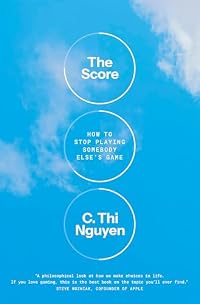
The Score: How to Stop Playing Somebody Else's Game
by C. Thi Nguyen
On This Page
Description
"A philosophy of games to help us win back control over what we value. The philosopher C. Thi Nguyen -- one of the leading experts on the philosophy of games and the philosophy of data -- takes us deep into the heart of games, and into the depths of bureaucracy, to see how scoring systems shape our desires. Games are the most important art form of our era. They embody the spirit of free play. They show us the subtle beauty of action everywhere in life in video games, sports, and boardgames show more -- but also cooking, gardening, fly-fishing, and running. They remind us that it isn't always about outcomes, but about how glorious it feels to be doing the thing. And the scoring systems help get us there, by giving us new goals to try on. Scoring systems are also at the center of our corporations and bureaucracies -- in the form of metrics and rankings. They tell us exactly how to measure our success. They encourage us to outsource our values to an external authority. And they push on us to value simple, countable things. Metrics don't capture what really matters; they only capture what's easy to measure. The price of that clarity is our independence. The Score asks us is this the game you really want to be playing?"-- Provided by publisher. show lessTags
Recommendations





















Member Reviews
I believe Nguyen's Games: Agency as Art to be the most profound modern contributions to the philosophy of games. The Score extends Nguyen's frameworks of striving play and variable agency to describe how scoring systems in games create freedom, and how scoring systems in the real world (metrics) are tyrannical.
The book alternates chapters between games and metrics. The games sections are delightful and charming, as Nguyen describes the "process aesthetics" of his various hobbies. What it means to live well is one of the bigger questions of philosophy, and for Nguyen it is the subtle perfection of elegant movement climbing a cliff, the ability to craft a mess of random ingredients into a fantastic meal for the moment, the meditative show more awareness of nature encouraged by fly fishing, or the simply joy of tension and momentum with a yo-yo.
Games are centered around their scoring systems, but they also hold those scoring systems lightly, encouraging players to find their own paths, strategies, and fun. Simple rules and shared language allow the emergence of complex social joys. Nguyen translates the important points of his previous book from philosophical arcana to daily language.
The metrics components are provocative, though less novel. Admittedly, I have a PhD in science and technology studies, and I've spent a lot of time thinking about knowledge, power, and bureaucratic structure, including Nguyens primary sources like Scott's Seeing Like a State, Bowker and Starr's Sorting Things Out, and Porter's Trust In Numbers (okay, I haven't actually read Porter.)
Any system that operates efficiently at scale requires certain inputs, mechanical rules, replaceable parts, and central control. These inputs come at the sacrifice of local variability, freedom of choice, context, and expert judgement. To give an example from Nguyen's life, as a professor he can tell after a semester if a student has learned something, but the Dean of Students cares about four year graduation rates and post-college job outcomes. The vital work of deepening minds gets sacrificed into creating a pipeline of career ready graduates.
Goodhart's Law states that when a measure becomes a target, it ceases to be a good measure, but in Nguyen's analysis the situation is even worse. The simplicity and power of metrics make them potent tools of value capture, where we stop thinking about what we really want in life, and just chase the values on the ladder. For example, weight loss rather than feeling good, or papers in highly cited journals rather than interesting science, or the hardest rock climbs rather than the most pleasurable.
The section on the conflict between transparency and expert judgement was particularly provocative. Personally, even as a specialist in this field, I hadn't quite considered that metrics substitute for trust in expertise, which means that solutions are often crude and clumsy. But also as someone who believes in tracking progress towards measurable outcomes, we do need something.
Nguyen displays a similar ambivalence towards the end. Modernity, in the guise of asthma treatments, keeps him alive. Metrics are powerful, and he admits he doesn't have much beyond "just close your eyes and think deeply about what you want as an escape". There is more work to be done by all of us on an individual basis, but the framing may be useful. show less
The book alternates chapters between games and metrics. The games sections are delightful and charming, as Nguyen describes the "process aesthetics" of his various hobbies. What it means to live well is one of the bigger questions of philosophy, and for Nguyen it is the subtle perfection of elegant movement climbing a cliff, the ability to craft a mess of random ingredients into a fantastic meal for the moment, the meditative show more awareness of nature encouraged by fly fishing, or the simply joy of tension and momentum with a yo-yo.
Games are centered around their scoring systems, but they also hold those scoring systems lightly, encouraging players to find their own paths, strategies, and fun. Simple rules and shared language allow the emergence of complex social joys. Nguyen translates the important points of his previous book from philosophical arcana to daily language.
The metrics components are provocative, though less novel. Admittedly, I have a PhD in science and technology studies, and I've spent a lot of time thinking about knowledge, power, and bureaucratic structure, including Nguyens primary sources like Scott's Seeing Like a State, Bowker and Starr's Sorting Things Out, and Porter's Trust In Numbers (okay, I haven't actually read Porter.)
Any system that operates efficiently at scale requires certain inputs, mechanical rules, replaceable parts, and central control. These inputs come at the sacrifice of local variability, freedom of choice, context, and expert judgement. To give an example from Nguyen's life, as a professor he can tell after a semester if a student has learned something, but the Dean of Students cares about four year graduation rates and post-college job outcomes. The vital work of deepening minds gets sacrificed into creating a pipeline of career ready graduates.
Goodhart's Law states that when a measure becomes a target, it ceases to be a good measure, but in Nguyen's analysis the situation is even worse. The simplicity and power of metrics make them potent tools of value capture, where we stop thinking about what we really want in life, and just chase the values on the ladder. For example, weight loss rather than feeling good, or papers in highly cited journals rather than interesting science, or the hardest rock climbs rather than the most pleasurable.
The section on the conflict between transparency and expert judgement was particularly provocative. Personally, even as a specialist in this field, I hadn't quite considered that metrics substitute for trust in expertise, which means that solutions are often crude and clumsy. But also as someone who believes in tracking progress towards measurable outcomes, we do need something.
Nguyen displays a similar ambivalence towards the end. Modernity, in the guise of asthma treatments, keeps him alive. Metrics are powerful, and he admits he doesn't have much beyond "just close your eyes and think deeply about what you want as an escape". There is more work to be done by all of us on an individual basis, but the framing may be useful. show less
Interesting book. The striving play/achievement play concept is really interesting to think through. What kind of games we are playing and why. I skimmed a bit in the second half, but I will think about these ideas and that's the good part of reading books like these.
Ratings
Members
- Recently Added By
Lists

Guardian Books of the Day 2026
14 works; 1 member
Author Information
5 Works 169 Members
Awards and Honors
Distinctions
The Guardian Book of the Day (2026-01-06)
Classifications
Statistics
- Members
- 83
- Popularity
- 381,436
- Reviews
- 2
- Rating
- (4.56)
- Languages
- English
- Media
- Paper, Ebook
- ISBNs
- 2
- ASINs
- 1