On This Page
Description
Life changes drastically for a Hungarian family when World War I upsets their peaceful, contented existence and the children are left in charge of the farm.Tags
Recommendations








Member Reviews
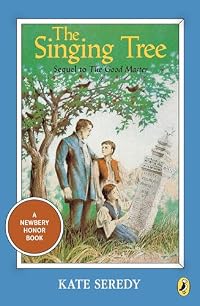
The first half of "The Singing Tree" continues the tale of Kate and Jansci in their Hungarian country home from "The Good Master." The second half tell of life on their little farm during World War I. Uncle Marton goes off to do his duty and fight in the war, leaving teenage Jansci as the "man of the house." Soon they are made guardians of a sort, of six Russian prisoners of war. Far from being kept as prisoners, the six big Russian men immediately become loving members of the household.
"The Good Master" was weakened by the instantaneous way Kate's moving to live on the rural homestead converted her from hellion to wonderful loving child. In "The Singing Tree," the same thing happens with another obnoxious child, and then the six show more captured Russian soldiers, who immediately become members of the family instead of enemy prisoners. The anti-war message of the book is sweet, but incredibly naive. Knowing that this was published immediately before Germany invaded Poland, to begin World War II, makes the innocent naivety of the book stand out all the more. Yet, there is truth in this message as well. What matters is not what side one is on, but rather, that one is a good, kind person, helping those in need, whoever they may be, and doing all one can for family, friends and neighbors.
I liked this book a little more than its predecessor, in spite of, or maybe partly because of, its naivety. show less
"The Good Master" was weakened by the instantaneous way Kate's moving to live on the rural homestead converted her from hellion to wonderful loving child. In "The Singing Tree," the same thing happens with another obnoxious child, and then the six show more captured Russian soldiers, who immediately become members of the family instead of enemy prisoners. The anti-war message of the book is sweet, but incredibly naive. Knowing that this was published immediately before Germany invaded Poland, to begin World War II, makes the innocent naivety of the book stand out all the more. Yet, there is truth in this message as well. What matters is not what side one is on, but rather, that one is a good, kind person, helping those in need, whoever they may be, and doing all one can for family, friends and neighbors.
I liked this book a little more than its predecessor, in spite of, or maybe partly because of, its naivety. show less
Life on the Hungarian plains is changing quickly for Jancsi and his cousin Kate. Father has given Jancsi permission to be in charge of his own herd, and Kate has begun to think about going to dances. Jancsi hardly even recognizes Kate when she appears at Peter and Mari's wedding wearing nearly as many petticoats as the older girls wear. And Jancsi himself, astride his prized horse, doesn't seem to Kate to be quite so boyish anymore. Then, when Hungary must send troops to fight in the Great War and Jancsi's father is called to battle, the two cousins must grow up all the sooner in order to take care of the farm and all the relatives, Russian soldiers, and German war orphans who take refuge there.
Life on the Hungarian plains is changing quickly for Jancsi and his cousin Kate. Father has given Jancsi permission to be in charge of his own herd, and Kate has begun to think about going to dances. Jancsi hardly even recognizes Kate when she appears at Peter and Mari's wedding wearing nearly as many petticoats as the older girls wear. And Jancsi himself, astride his prized horse, doesn't seem to Kate to be quite so boyish anymore. Then, when Hungary must send troops to fight in the Great War and Jancsi's father is called to battle, the two cousins must grow up all the sooner in order to take care of the farm and all the relatives, Russian soldiers, and German war orphans who take refuge there.
Oh those proud, good, brave, kind, beautiful Hungarians! I have no idea if the the (softened) history is accurate, but what a different picture of WWI is given here than other accounts I've read. I liked this more than The Good Master because, even though it wasn't as much of a fun story, the info-dumps were helpful and so the story made more sense - the exotic culture didn't seem so mysteriously alien.
The Singing Tree, while being a Newbery Honor, I thought started out to be very juvenile. Perhaps a little too young even for the age group intended. However halfway through the book, it suddenly turns into a great resource for WWI European history for kids. I liked how the author pulls us into the story of what Europe was like for many children. Families taking in other children and even housing prisoners of war as workers.All in all I likes the book , but had a verrry slow beginning.
This book, because it is overshadowed by World War I, is possibly even more beautiful than its predecessor. Kate and Jansci are definitely growing up (I originally didn't like this, but the more I read this book, the better it gets!). When WWI begins it at first seems far away from the farm. Then Father volunteers for military service and goes MIA. Meanwhile back at farm, the family takes in several people including six Russian POWs and six very young German refugees. Farm life continues, without Father, but with young Jansci at its head instead. Like "The Good Master" the author illustrations are lovely.
• 216 pages, small pages but lots of words per page
• Historical Fiction
• Newberry Honor Book
• Sequel to The Good Master
Set in Hungary beginning in 1915. Jancsi and Kate are 13, and WW I breaks out, sending both of their fathers to war. Covers all the years of the war. Jancsi becomes the man of the family and keeps the farm running with the help of Russian war prisoners. His mother becomes mother to all, including 6 German orphans.
Well-written and more interesting than The Good Master
Appropriate for strong 4th grade readers
• Historical Fiction
• Newberry Honor Book
• Sequel to The Good Master
Set in Hungary beginning in 1915. Jancsi and Kate are 13, and WW I breaks out, sending both of their fathers to war. Covers all the years of the war. Jancsi becomes the man of the family and keeps the farm running with the help of Russian war prisoners. His mother becomes mother to all, including 6 German orphans.
Well-written and more interesting than The Good Master
Appropriate for strong 4th grade readers
Members
- Recently Added By
Lists

Best Newbery Honor Books
241 works; 31 members

Children's Books about World War I (1914-1918)
91 works; 11 members

A Child's Book Tour of Hungary
29 works; 2 members

Honey For a Child's Heart
1,152 works; 25 members

Sonlight Books
1,487 works; 25 members

Necessary & Exquisite
30 works; 4 members

Newbery Honor Books By Year - I - 1922-1980
199 works; 3 members

CCE 1000 Good Books List
1,033 works; 12 members

50+ Books for a 6th Grader Who Loves to Read
53 works; 4 members

Beautiful Feet Books
304 works; 7 members

The Story of the World: Activity Book Four: The Modern Age
333 works; 2 members

EGBERTINA'S List of childhood books worthy of merit or unspeakable delight
155 works; 6 members

Build Your Library Level 4
23 works; 1 member

HMS: Make Your Child a Lover of Books, Ages 7-9
52 works; 2 members
Author Information

15+ Works 7,577 Members
Awards and Honors
Awards
Notable Lists
Series

Belongs to Publisher Series
Work Relationships
Common Knowledge
- Canonical title
- The Singing Tree
- Original publication date
- 1939
- Important places
- Hungary
- Important events
- World War I (1914 | 1918)
Classifications
Statistics
- Members
- 1,860
- Popularity
- 11,521
- Reviews
- 16
- Rating
- (4.20)
- Languages
- English
- Media
- Paper, Ebook
- ISBNs
- 14
- ASINs
- 26