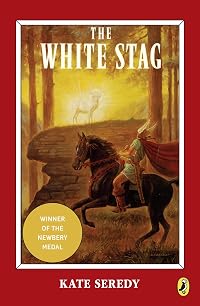
The White Stag
by Kate Seredy
On This Page
Description
Retells the legendary story of the Huns' and Magyars' long migration from Asia to Europe where they hope to find a permanent home.Tags
Recommendations






Member Reviews
When I was a child I read all sorts of nation founding and preserving myths, tales of Ulster, the Fianna, the Cid, whoever. This was another of those nation founding myths, but a bit more foreign. I liked it fine then, and remember just a bit of it. But it's not very thrilling now and the way those heroes are dressed in the illustrations are preposterous. I guess I prefer my Attila a lot more historical and not the great, great, grandson of Noah. Nimrod is impressively long lived, I've gotta say.
The Cimmerians show up in this tale; it is notable that Conan (the Barbarian) is more properly known as "the Cimmerian". Perhaps, in her illustrations, Seredy was following the Conan rule that the colder the temperature gets the less the hero show more wears, until, when surrounded by nothing but snow and ice he's usually stripped down to a pair of fur boots and some kind of fur bikini. show less
The Cimmerians show up in this tale; it is notable that Conan (the Barbarian) is more properly known as "the Cimmerian". Perhaps, in her illustrations, Seredy was following the Conan rule that the colder the temperature gets the less the hero show more wears, until, when surrounded by nothing but snow and ice he's usually stripped down to a pair of fur boots and some kind of fur bikini. show less
Newbery winner or not, that was boring as hell.
It read like those tedious warmongering chapters in the Old Testament, with a dash of ancient mythology thrown into the mix. Hard to imagine a child of any age ever enjoying this, but I guess kids were different in1937.
To be fair though, I've never had any taste for mythology. I prefer books about characters I can identify with and care about. Nimrod, Bendeguz and Attila were definitely not characters I related to, had interest in, or muster compassion for.
It read like those tedious warmongering chapters in the Old Testament, with a dash of ancient mythology thrown into the mix. Hard to imagine a child of any age ever enjoying this, but I guess kids were different in1937.
To be fair though, I've never had any taste for mythology. I prefer books about characters I can identify with and care about. Nimrod, Bendeguz and Attila were definitely not characters I related to, had interest in, or muster compassion for.
This book is incredibly deserving of its 1938 Newbery Medal. It's brilliant. Though it appears to be a children's book, the style is a mature blend of the epic style of Virgil, the wide story arc of the Old Testament, and the legends of the Huns. The prose reads like poetry, with descriptions that modern authors can only dream of. And the illustrations are simply amazing. This is a story to aspire to, but also a story to treasure. It yearns to be read aloud.
That's all I can say, and my words are woefully inadequate. The White Stag leaves me with a sense of awe.
That's all I can say, and my words are woefully inadequate. The White Stag leaves me with a sense of awe.
I think I expected more modern storytelling, this felt more like a mythic bard but it was stirring and well-written and I ended up enjoying it, even if I didn't know the storyline and didn't follow it as well.
I read this shortly after finishing "The Historian," by Elizabeth Kostova, a novel about Dracula (in this library). I wondered if Seredy would mention Dracula, Dragons, Vampires, etc., since the Carpathians and Transylvania are right in the middle of that whole myth (is it a myth?). Anyway, no mention is made except for where on page 86, line 7, she refers to the Hunnic horde as a "dragon," as it emerges from the 'Pasul Oituz,' into Transylvania. I suppose, given the geography, she could not possibly avoid referring to the dragon somewhere. This is quite an interesting setting of the Myth of the origin of Hungary (or 'Magyar Orszag'), its founding. I imagine this myth is based on Hungarian folklore, but it does seem somewhat biased show more toward Christianity. Seredy ends her tale before the Huns (Atilla) conquered Rome and before the invasion of the Magyars into Eastern Europe. The tale is definitely evocative of mythical themes (in the same way as Wagner's operas); the text itself seems to be written with middle-school students as an audience. I will give it: show less
Seredy's writing, as expected, is excellent. Presented as a legend of the Hungarian people, it is quite possibly an oral history. We've all heard about Atilla the Hun coming from the Russian steppes. The story begins 3 generations previous, with Nimrod and his sons Hunor and Magyar, during a time of famine. They follow the leading of their god to find a land where they will prosper. In this generation it is a white stag who shows the way. There is much fighting as local tribes try to defend their homes from the massive migration. Over the decades of fighting, some of the leaders begin to doubt the leading of their god. Magyar & his followers remain where they are in a pleasant valley between the Don & Volga rivers (p.46). Hunor & his show more people, led by his grandson Atilla, follow the path of a flaming sword with much brutal warfare and eventual disastrous consequences. Hunor's tribe eventually is led again by a white stag to a new home, with an accepting small local tribe, west of the Carpathian mountains between the rivers Pathissus and Danubius.
Some small pieces of factual information are integrated: the comet in 408, the response of Flavius Honorius (Roman Emperor) and Pope Innocentius, the fighting with Sarmatians, Dacians, Goths, Franks, and Romans. These are peoples I have vaguely heard of but have no idea of their role in history. This legend is good motivation to learn more about this time in our world history. What did become of the Magyars? Damon's prophecy (p.59) says "for seven generations will they roam the earth, outcasts among men."
I am reminded of the Menominee tradition of being led west by a shell to a land where food grows on water which will be their home. show less
Some small pieces of factual information are integrated: the comet in 408, the response of Flavius Honorius (Roman Emperor) and Pope Innocentius, the fighting with Sarmatians, Dacians, Goths, Franks, and Romans. These are peoples I have vaguely heard of but have no idea of their role in history. This legend is good motivation to learn more about this time in our world history. What did become of the Magyars? Damon's prophecy (p.59) says "for seven generations will they roam the earth, outcasts among men."
I am reminded of the Menominee tradition of being led west by a shell to a land where food grows on water which will be their home. show less
Kate Seredy provides us with a more romanticized view of Hun ascendancy under Attila in the form of local Hungarian lore which typecasts him as a founding father of the Hungarian people. Seredy provides a mousakka of fact and fiction; ancient prophecies and ethnocentric battles to immerse the reader in a tale of prophecy and its realization.
Seredy avoids all the tellings of Lord of The Rings which emerges as a somewhat overdone hyperbole in comparison to 'The White Stag.' This might be a book with too much archaic language for young readers, but I thoroughly enjoyed it as a product of the hero and historical genre.
Seredy avoids all the tellings of Lord of The Rings which emerges as a somewhat overdone hyperbole in comparison to 'The White Stag.' This might be a book with too much archaic language for young readers, but I thoroughly enjoyed it as a product of the hero and historical genre.
Members
- Recently Added By
Lists

Sonlight Books
1,487 works; 25 members

A Child's Book Tour of Hungary
29 works; 2 members

Newbery Medal Winners - By Year
105 works; 7 members

Authors from Hungary
3 works; 1 member

Honey For a Child's Heart
1,152 works; 25 members

Romalda Spalding's Writing Road To Reading
213 works; 3 members

CCE 1000 Good Books List
1,033 works; 12 members

50+ Books for a 6th Grader Who Loves to Read
53 works; 4 members

Books Read in 2023
5,547 works; 145 members

EGBERTINA's List of Newbery books that I hated or found unnecessary
58 works; 3 members
Author Information

15+ Works 7,609 Members
Awards and Honors
Awards
Work Relationships
Is contained in
Common Knowledge
- Canonical title
- The White Stag
- Original publication date
- 1937
- People/Characters
- Attila the Hun; Nimrod
- Important places
- Hungary
- Dedication
- To my mother
- First words
- Old Nimrod, might hunter before the Lord, leaned wearily against the stones of the sacrificial altar.
- Last words
- (Click to show. Warning: May contain spoilers.)He stood, King of the Promised Land, Attila the Conqueror.
- Original language
- English
Classifications
- Genres
- Children's Books, Fiction and Literature
- DDC/MDS
- 398.2 — Society, government, & culture Customs, etiquette & folklore Folklore & Folktales Folk literature
- LCC
- PZ8.1 .S457 .W — Language and Literature Fiction and juvenile belles lettres Fiction and juvenile belles lettres Juvenile belles lettres
- BISAC
Statistics
- Members
- 1,723
- Popularity
- 12,838
- Reviews
- 25
- Rating
- (3.71)
- Languages
- English
- Media
- Paper, Audiobook, Ebook
- ISBNs
- 15
- UPCs
- 1
- ASINs
- 31