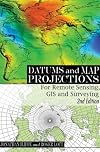
Datums and Map Projections: For Remote Sensing, GIS and Surveying
by Jonathan IIiffe
On This Page
Description
Over the years since its first appearance, Datums and Map Projections has become a key book for many students and professionals around the world. Its theme - a practical guide to coordinate reference systems - is as important now as when it was first published, probably more so when we consider the ever growing use of satellite navigation systems and the introduction of web mapping services such as Google Earth.Tags
Member Reviews
This book originally appeared in 2000. Its theme – a practical guide to coordinate reference systems – is as important now as when it was first published, probably more so when we consider the ever growing use of satellite navigation systems and the introduction of web mapping services such as Google Earth.
Contents
The second edition has grown with approximately 50% in size when compared to the first edition. Critics will say that the contents of the book can’t really have been changed and they are mostly right; datums and map projections as part of geodesy is a relatively stable subject and not much has changed over the last
eight years.
The contents therefore are what one would expect and give information on ellipsoids; datums; show more projections and most important information on transformations. The amount of formulas
is kept to a bare minimum, which, considering the extensive use of geodetic software is a good thing in my opinion. This way the reader is not distracted from what really matters nowadays: which geodetic parameter to select from the extensive list and why the results never seem to match the expectations.
Changes
The change between the two editions is not so much in the facts as it is in the way the information is presented. The first edition was strongly biased towards UK users. This new version includes examples from around the world. One of the most striking changes is the change from black and white towards full color publishing.
Even though this does not add to the information it does make the book easier to read.
New in the book are flowcharts at the beginning of every chapter showing the possible choices a user can be presented with. Further
information is given on which chapter to read to find the necessary information.
An extension of this user-oriented way of writing is the inclusion of a number of use cases that give very clear information on what to do when presented with a similar problem. The use
cases range from creating one’s own datum transformation to creating an overlay in Google Earth.
Also useful is the addition of a terminology list stating the terms that have been used within the geodetic community for years as well as the terms used in the ISO 19111 publication. The
latter is important since these terms are used in software packages and Internet registries such as the EPSG database more and more.
Conclusion
I can only find one downside to this book and that is the chapter on GNSS that has been retained from the first edition. The information in this chapter does not give much additional insight into GNSS systems and misses the method used by the satellites for transmitting their position towards the user. The other changes from the first edition to the second edition are however a good reason to buy the edition even if one already owns the first one.
Especially the addition of quite a number of user oriented information may prove very useful in every day geodetic life. show less
Contents
The second edition has grown with approximately 50% in size when compared to the first edition. Critics will say that the contents of the book can’t really have been changed and they are mostly right; datums and map projections as part of geodesy is a relatively stable subject and not much has changed over the last
eight years.
The contents therefore are what one would expect and give information on ellipsoids; datums; show more projections and most important information on transformations. The amount of formulas
is kept to a bare minimum, which, considering the extensive use of geodetic software is a good thing in my opinion. This way the reader is not distracted from what really matters nowadays: which geodetic parameter to select from the extensive list and why the results never seem to match the expectations.
Changes
The change between the two editions is not so much in the facts as it is in the way the information is presented. The first edition was strongly biased towards UK users. This new version includes examples from around the world. One of the most striking changes is the change from black and white towards full color publishing.
Even though this does not add to the information it does make the book easier to read.
New in the book are flowcharts at the beginning of every chapter showing the possible choices a user can be presented with. Further
information is given on which chapter to read to find the necessary information.
An extension of this user-oriented way of writing is the inclusion of a number of use cases that give very clear information on what to do when presented with a similar problem. The use
cases range from creating one’s own datum transformation to creating an overlay in Google Earth.
Also useful is the addition of a terminology list stating the terms that have been used within the geodetic community for years as well as the terms used in the ISO 19111 publication. The
latter is important since these terms are used in software packages and Internet registries such as the EPSG database more and more.
Conclusion
I can only find one downside to this book and that is the chapter on GNSS that has been retained from the first edition. The information in this chapter does not give much additional insight into GNSS systems and misses the method used by the satellites for transmitting their position towards the user. The other changes from the first edition to the second edition are however a good reason to buy the edition even if one already owns the first one.
Especially the addition of quite a number of user oriented information may prove very useful in every day geodetic life. show less
Ratings
Members
- Recently Added By
Author Information
1 Work 19 Members
Classifications
Statistics
- Members
- 19
- Popularity
- 1,328,508
- Reviews
- 1
- Rating
- (4.67)
- Languages
- English
- Media
- Paper, Ebook
- ISBNs
- 6