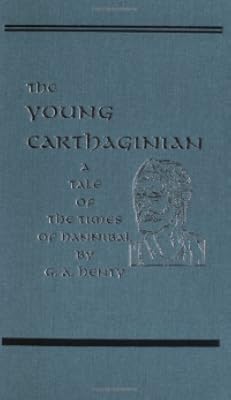
The Young Carthaginian
by G. A. Henty
G. A. Henty Historical Novels for Boys in Chronological Order (c. 218 B.C. - c. 216 B.C. (Start of the Second Punic War through the battle of Cannae))
On This Page
Description
"The Young Carthaginian" is set in ancient times, and tells the story of young Malchus, an officer in Hannibal's army, on his journey with the army across southern Europe and the Alps.Tags
Recommendations

















Member Recommendations

Member Reviews
I really enjoyed this book, but must admit that it is essentially unclassiifiable by today's standards.
Its detailed descriptions of battles, it's long "history dumps" as the characters discuss Carthaginian politics, the very leisurely descriptions of every kind of soldier in the Carthaginian army, and so forth, make it too sophisticated to classify it as a child's book, as does its shear length.
Yet, in spite of all the battles, it eschews descriptions of violence, and the love between the eponymous hero and his Cisalpine Gaulish maiden is awfully chaste. It does not have what are now considered to be the essential matters, sex and violence, of the YA _genre_.
So I think now it would actually be classified as an adult book; a pleasant way show more of reviewing historical events, interspersed with a narrative of adventure. show less
Its detailed descriptions of battles, it's long "history dumps" as the characters discuss Carthaginian politics, the very leisurely descriptions of every kind of soldier in the Carthaginian army, and so forth, make it too sophisticated to classify it as a child's book, as does its shear length.
Yet, in spite of all the battles, it eschews descriptions of violence, and the love between the eponymous hero and his Cisalpine Gaulish maiden is awfully chaste. It does not have what are now considered to be the essential matters, sex and violence, of the YA _genre_.
So I think now it would actually be classified as an adult book; a pleasant way show more of reviewing historical events, interspersed with a narrative of adventure. show less
G.A. Henty was a 19th century author of more than 120 books, many of them written for children. In the case of this book, I'd say it was aimed at 12 to adult.
I've read just about every popular account of Hannibal and his invasion of Italy, so I am quite familiar with the story. Henty does a superb job distilling the essentials of this story, without the usual comparisons of whether Polybius or Livy was a more accurate primary source.
The story is about a young Carthaginian noble, Malchus, who becomes part of Hannibal's inner circle from his battles to subdue Spain, the journey with the elephants across the Alps, and his invasion of Italy. Malchus himself is a fictional storyline, but he exists within as authentic a telling of show more Hannibal's story as there is. Henty shows us that one doesn't have to mess with a good true story to make it entertaining -- something Hollywood should take note of as they crank out ridiculous parodies such as "300".
While Malchus leaves Hannibal's service years before the general's recall to defend Carthage against Scipio's invasion and his defeat at the Battle of Cannae. Historians like to debate what might have happened had Hannibal attacked Rome after his destruction of 8 consular legions at Cannae, but Henty reminds us Carthage was no loveable underdog (although Hannibal himself might qualify). Corruption was rampant in Carthage, and the ruling party of Hanno was every bit as loathsome as Rome had been to date. Malchius experiences this corruption first hand. Again, it's an effective presentation of history, an interesting story to read with the added bonus of learning something in the end. What we know of Hannibal hasn't increased much over the 100 years or so since Henty's death; perhaps some of his other stories will seem more dated. His writing style is similar to his American contemporary Jack London; the story is one easily enjoyed by adults and children alike. show less
I've read just about every popular account of Hannibal and his invasion of Italy, so I am quite familiar with the story. Henty does a superb job distilling the essentials of this story, without the usual comparisons of whether Polybius or Livy was a more accurate primary source.
The story is about a young Carthaginian noble, Malchus, who becomes part of Hannibal's inner circle from his battles to subdue Spain, the journey with the elephants across the Alps, and his invasion of Italy. Malchus himself is a fictional storyline, but he exists within as authentic a telling of show more Hannibal's story as there is. Henty shows us that one doesn't have to mess with a good true story to make it entertaining -- something Hollywood should take note of as they crank out ridiculous parodies such as "300".
While Malchus leaves Hannibal's service years before the general's recall to defend Carthage against Scipio's invasion and his defeat at the Battle of Cannae. Historians like to debate what might have happened had Hannibal attacked Rome after his destruction of 8 consular legions at Cannae, but Henty reminds us Carthage was no loveable underdog (although Hannibal himself might qualify). Corruption was rampant in Carthage, and the ruling party of Hanno was every bit as loathsome as Rome had been to date. Malchius experiences this corruption first hand. Again, it's an effective presentation of history, an interesting story to read with the added bonus of learning something in the end. What we know of Hannibal hasn't increased much over the 100 years or so since Henty's death; perhaps some of his other stories will seem more dated. His writing style is similar to his American contemporary Jack London; the story is one easily enjoyed by adults and children alike. show less
As an avid fan of Roman and Carthaginian history, I thoroughly enjoyed this easy reading novel. Despite its status as historical fiction, the author presented an interesting account of the 2nd Punic War, i.e., from a Carthaginian solder's perspective. Equally interesting (and accurate) was the emphasis upon the rival political factions in Carthage that limited oversea support for Hannibal during his famous, but ill fated, attempt to overcome Rome and its allies.
The struggles between Rome and Carthage are the basis for this story.
A tale of the times of Hannibal in the of the Carthaginians against the Romans. Originally printed in 1886.
This book is about a young Carthaginian who fought for Carthage alongside Hannibal
Ratings
Members
- Recently Added By
Lists

CCE 1000 Good Books List
1,033 works; 12 members

The Story of the World: History for the Classical Child: Activity Book One
291 works; 3 members
Author Information

213+ Works 18,413 Members
G. A.Henty was born in 1832 and was filled with exciting adventure. He received his education at Westminster School, and he attended Cambridge University. Along with a rigorous course of study, Henty participated in boxing, wrestling, and rowing. The strenuous study and participation in sports prepared Henty to join the British army in Crimea, as show more a war correspondent witnessing Garbaldi fight in Italy. He was also present in Paris during the Franco-Prussian war, in Spain with the Carlists, at the opening of the Suez Canal, touring India with the Prince of Wales as well as a trip to the California gold fields. Henty wrote approximately 144 books, plus stories for magazines and was dubbed as "The Prince of Story-Tellers" and "The Boy's Own Historian." G. A. Henty died in 1902. (Bowker Author Biography) show less
Some Editions
Series

Belongs to Publisher Series
Common Knowledge
Classifications
Statistics
- Members
- 544
- Popularity
- 54,868
- Reviews
- 6
- Rating
- (3.84)
- Languages
- Dutch, English
- Media
- Paper, Audiobook, Ebook
- ISBNs
- 38
- ASINs
- 28