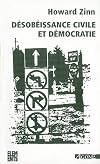
Disobedience and Democracy: Nine Fallacies on Law and Order
by Howard Zinn
On This Page
Description
Howard Zinn's cogent defense of civil disobedience with a new introduction by the author. In this slim volume, Zinn lays out a clear and dynamic case for civil disobedience and protest, and challenges the dominant arguments against forms of protest that challenge the status quo. Zinn explores the politics of direct action, nonviolent civil disobedience, and strikes, and draws lessons for today.Tags
Recommendations

































Member Reviews
Written as a critique of Supreme Court Justice Abe Fortas´Concerning Dissent & Civil Disobedience, this really serves as an excellent rebuttal to any critics of extra-legal civil disobedience, dismantling their arguments one by one. Zinn's language is precise, accessible, and utterly logical. One can sense the seething emotion behind his words even though he does well maintaining his argument dispassionate. I suffered a minor cringe within the first few pages upon seeing his "The time for action is now" reference, bracing myself for a dated 60's political diatribe. Most of his argument, however, is beautifully timeless. Only towards the end does Zinn lapse into somewhat generalized ideas of the ripeness of the 60s for political change, show more and the extreme turbulence of the period begging for revolution. He then betrays a now-quaint idealism, though it does little to damage his main argument. This is a must-read for anyone sympathetic to civil disobedience as political action. Zinn offers invaluable arguments in its defense. show less
Written in 1968, this is a 124 page rant aimed at (then) Supreme Court Justice Fortas’ booklet “Concerning Dissent and Civil Disobedience.”
Nothing groundbreaking, just Zinn doing what he does best: providing a counter note to the oppressive drone of establishment politics and powers that be.
Nothing groundbreaking, just Zinn doing what he does best: providing a counter note to the oppressive drone of establishment politics and powers that be.
Ratings
Members
- Recently Added By
Author Information

86+ Works 26,271 Members
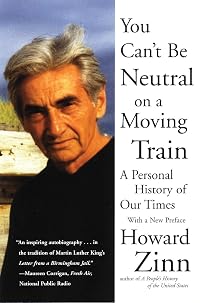
A committed radical historian and activist, Howard Zinn approaches the study of the past from the point of view of those whom he feels have been exploited by the powerful. Zinn was born in Brooklyn, New York in 1922. After working in local shipyards during his teens, he joined the U.S. Army Air Force, where he saw combat as a bombardier in World show more War II. He received a Ph.D. in history from Columbia University in 1958 and was a postdoctoral fellow in East Asian studies at Harvard University. While teaching at Spelman College in Atlanta, Georgia, Zinn joined the civil rights movement and wrote The Southern Mystique (1964) and SNCC: The New Abolitionists (1964). He also became an outspoken critic of the Vietnam War, writing Vietnam: The Logic of Withdrawal (1967) and visiting Hanoi to receive the first American prisoners released by the North Vietnamese. Zinn's best-known and most-praised work, as well as his most controversial, is A People's History of the United States (1980). It explores American history under the thesis that most historians have favored those in power, leaving another story untold. Zinn discusses such topics as Native American views of Columbus and the socialist and anarchist opposition to World War I in examining his theory that historical change is most often due to "mass movements of ordinary people." Zinn's other books include You Can't Be Neutral on a Moving Train: A Personal History of Our Times (1995) and Artists in Times of War (2004). He has also written the plays Emma (1976), Daughter of Venus (1985), and Marx in Soho (1999). (Bowker Author Biography) Howard Zinn grew up in the immigrant slums of Brooklyn, where he worked in shipyards in his late teens. He saw combat duty as an air force bombardier in World War II, and afterward received his doctorate in history from Columbia University. His first book, "La Guardia in Congress", was an Albert Beveridge Prize winner. In 1956, he moved with his wife and children to Atlanta to become chairman of the history department of Spelman College. He has since written and edited many more books, including A People's History of the United States, SNCC: The New Abolitionist; Disobedience and Democracy; The Politics of History; The Pentagon Papers: Critical Essays; You Can't Be Neutral on a Moving Train: A Personal History of Our Times; and The Zinn Reader (Seven Stories Press, 1997). Zinn is also the author of three plays, Emma, Daughter of Venus, and Marx in Soho. Among the many honors Zinn has received is the 1998 Lannan Literary Award for nonfiction. A professor emeritus of political science at Boston University, he lives with his wife, Roslyn, in the Boston area, near their children and grandchildren. (Publisher Provided) show less
Some Editions
Series
Belongs to Publisher Series
Radical Sixties (4)
Vintage Books (V-483)
Common Knowledge
- Original title
- Disobedience and Democracy: Nine Fallacies on Law and Order
- Original publication date
- 1968
- Dedication
- to Peter Irons
and the others
Classifications
- Genres
- Politics and Government, Nonfiction, General Nonfiction, History, Philosophy
- DDC/MDS
- 303.61 — Society, government, & culture Social sciences, sociology & anthropology Social processes Conflict and conflict resolution ; Violence Civil disobedience
- LCC
- JC328 .Z55 — Political Science Political theory Political theory. The state. Theories of the state Consensus. Consent of the governed
- BISAC
Statistics
- Members
- 173
- Popularity
- 190,108
- Reviews
- 2
- Rating
- (3.71)
- Languages
- Catalan, English, French, Italian
- Media
- Paper, Ebook
- ISBNs
- 8
- ASINs
- 5