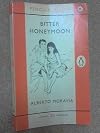
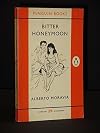
Bitter Honeymoon
by Alberto Moravia
On This Page
Tags
Recommendations





















Member Reviews
This collection of short stories concerns affairs of the heart, though some of these lovers are a little heartless. Rich in detail and atmosphere, reading Bitter Honeymoon is a little like wandering through a dusty, yet wonderful deli in a forgotten sidestreet of Rome. Here are blousy, soon-to-be-abandoned mistresses, Italian fascist officers whose lives are unravelling as defeat nears, a young man stalked in a boarding-house by a mother-and-daughter on the make, and a young Communist trying to consummate her marriage. I loved this book, and if you ever find it - probably in some tatty bookstall, in the 50 pence box - I urge you to take it home and cherish it.
Two favourites are "A Sick Boy's Winter", a wretched tale about shame and self-loathing in a TB clinic. Moravia spent some of his youth in a sanatorium. There's an authenticity about this story that is compelling, and the other is "The Imbroglio" where a student falls for a young woman who makes off with money he has borrowed to help with family debts, but does find love with an older woman who has been generous to him. Excellent reading.
Bitter Honeymoon is a collection of eight stories about relationships between men and women. In "Tired Courtesan", a young man tries to discard his ageing mistress, a young patient in a sanatorium becomes infatuated with a girl whom he will never see again in " A Sick Boy's Winter", in "the Imbroglio", a student in Rome falls for a beautiful girl out to swindle him. "The Fall" is about a small boy who, in his exploration of the rooms of an old mansion where the family was staying on holiday, spies without meaning to, on an indiscretion, "The Unfortunate Lover" is about a heartbroken man who gets an unexpected visit from the woman he loved but who realizes she had no plans of staying, "Back to the Sea" is about an elderly politician who show more realizes too late that he had fallen in love with his much younger wife who is now leaving him, "The English Officer" is about an officer and a girl he meets in a foreign city who only wished to find someone who would buy her a coveted silk scarf, and "Bitter Honeymoon" is about how a wife's politics weighed heavily on the husband's mood on their first days as a married couple.
Most of these stories depict trivial and commonplace encounters, but it is this ordinariness which Moravia captures so well that the stories feel like our own. Who is not familiar with the angst of young love, crushed expectations, and silent acrimony in any relationship? A common thread in these stories which I find disconcerting, though, is that women are portrayed as flippant and easy, or rejecting and opportunistic. The men, on the other hand, except for the first story, are portrayed as gullible, committed, and passionate. Moravia wrote these stories between 1927 and 1952, so the stereotyped roles played out by his characters are suggestive of the period. Still, they are well-written and provide entertaining snapshots of the idiosyncracies of love and attraction. Moravia is considered one of Italy's foremost novelists of the 20th century. show less
Most of these stories depict trivial and commonplace encounters, but it is this ordinariness which Moravia captures so well that the stories feel like our own. Who is not familiar with the angst of young love, crushed expectations, and silent acrimony in any relationship? A common thread in these stories which I find disconcerting, though, is that women are portrayed as flippant and easy, or rejecting and opportunistic. The men, on the other hand, except for the first story, are portrayed as gullible, committed, and passionate. Moravia wrote these stories between 1927 and 1952, so the stereotyped roles played out by his characters are suggestive of the period. Still, they are well-written and provide entertaining snapshots of the idiosyncracies of love and attraction. Moravia is considered one of Italy's foremost novelists of the 20th century. show less
Ratings
Members
- Recently Added By
Author Information

461+ Works 10,452 Members
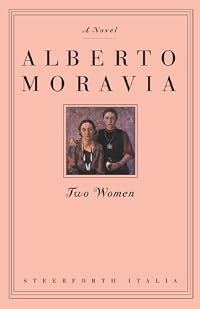
Born in Rome of Jewish-Roman Catholic parents, Moravia was not much affected by the "Fascist racial laws" until Mussolini's fall in 1943 and the consequent German occupation of Rome. Under fascism, Moravia published his first novel, The Time of Indifference (1929), at his own expense when he was only 22; yet it was a great success and remains his show more most characteristic work. He produced nothing to match it until after World War II, when he emerged as the leading Italian neorealist, publishing in rapid order The Woman of Rome (1947), Disobedience (1948), The Conformist (1951), Ghost at Noon (1948), Roman Tales (1954), and Two Women (1957). Many believe the latter is his best novel, telling of the efforts of a shopkeeper and her daughter, raped by Italy's liberators and learning to adapt themselves to the postwar new order. Moravia made a great stir in world literary circles after World War II by announcing his conversion to Roman Catholicism, which had given him solace and protection during the German occupation. Among his more recent publications is 1984. In 1941 Moravia married ~Elsa Morante. They separated in 1962. (Bowker Author Biography) show less
Common Knowledge
- Original publication date
- 1954
Classifications
Statistics
- Members
- 94
- Popularity
- 341,042
- Reviews
- 3
- Rating
- (4.17)
- Languages
- English
- Media
- Paper
- ISBNs
- 3
- ASINs
- 13