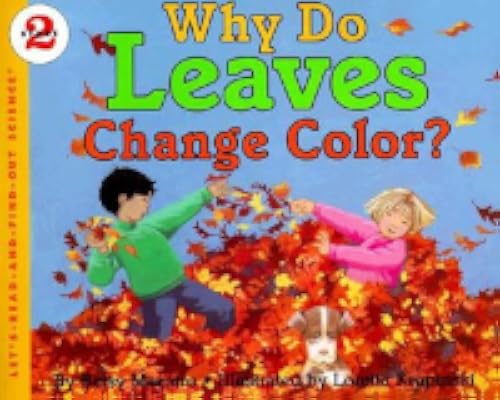
Why Do Leaves Change Color?
by Betsy Maestro
On This Page
Description
Explains how leaves change their colors in autumn and then separate from the tree as the tree prepares for winter.Tags
Recommendations











Member Reviews
The autumnal change of colors is explored in this non-fiction picture book from author Betsy Maestro and illustrator Loretta Krupinski, which offers a basic scientific explanation, as well as some hints on how to enjoy the season. After a brief explanation of what makes leaves green and what they do for a tree, the narrative turns to the changes brought by fall, as leaves begin to die, making less chlorophyll and slowly changing color as a result. Concluding with some discussion of cleaning up and playing in leaves, the book closes with some craft ideas, and with a list of parks within the US where beautiful fall foliage can be seen...
Part of the second stage of HarperCollins' Let's-Read-and-Find-Out Science series, intended to show more familiarize primary-school students with basic scientific concepts, Why Do Leaves Change Color? is the first title I have read from Betsy Maestro, who appears to be quite a prolific author of non-fiction for children. Apparently most of her many books have been illustrated by her husband, Giulio Maestro, although Loretta Krupinski—whose work I know from Shirley Climo's The Irish Cinderlad—was the illustrator here. In any case, while overall I enjoyed this exploration of one of my favorite natural phenomena—namely the changing colors of autumn—I did have two criticisms of the text. The first was its somewhat repetitive nature, with phrases that would appear again and again. The second was that I felt certain specifics should have been provided, when it came to the pigments causing specific color changes. Having named chlorophyll, as well as mentioning the tannins which produce the brownness of autumn oak leaves, why not name what causes red, yellow and orange hues in leaves? Leaving these critiques aside, in general I thought this was an educational and fun book, and I enjoyed the gouache and colored pencil illustrations, which captured the beauty of my favorite season. I wasn't impressed, the first time I encountered Krupinski's work, but now I think I would like to see more of it, as well as more of Maestro's (despite my criticism). Recommended to young scientists curious about what make the leaves change in the fall. show less
Part of the second stage of HarperCollins' Let's-Read-and-Find-Out Science series, intended to show more familiarize primary-school students with basic scientific concepts, Why Do Leaves Change Color? is the first title I have read from Betsy Maestro, who appears to be quite a prolific author of non-fiction for children. Apparently most of her many books have been illustrated by her husband, Giulio Maestro, although Loretta Krupinski—whose work I know from Shirley Climo's The Irish Cinderlad—was the illustrator here. In any case, while overall I enjoyed this exploration of one of my favorite natural phenomena—namely the changing colors of autumn—I did have two criticisms of the text. The first was its somewhat repetitive nature, with phrases that would appear again and again. The second was that I felt certain specifics should have been provided, when it came to the pigments causing specific color changes. Having named chlorophyll, as well as mentioning the tannins which produce the brownness of autumn oak leaves, why not name what causes red, yellow and orange hues in leaves? Leaving these critiques aside, in general I thought this was an educational and fun book, and I enjoyed the gouache and colored pencil illustrations, which captured the beauty of my favorite season. I wasn't impressed, the first time I encountered Krupinski's work, but now I think I would like to see more of it, as well as more of Maestro's (despite my criticism). Recommended to young scientists curious about what make the leaves change in the fall. show less
An educational book about autumn foliage. I find it flat and dull to read, but my daughter enjoyed it when she was six, probably because of the pretty pictures and the dog that accompanies two kids throughout the book.
FOR REFERENCE:
Rated "Indifferent" in our old book database by Rod; rated "Good" by Adelia.
FOR REFERENCE:
Rated "Indifferent" in our old book database by Rod; rated "Good" by Adelia.
This book is amazing for so many reasons. The first is that the book offers so many forms of relaying information to the reader. The book is in the format of a story but it also has diagrams such as the diagram that shows the inside of a leaf. Additionally, the book has labeled illustrations that help to focus the reader’s attention. For example, many of the leaves are labeled and there are a large variety of leaves. Another reason why I absolutely loved this book is because of the illustrations. The illustrations are very realistic, and show the true beauty of nature. They are detailed and accurate. For example, there is a picture of a squirrel and the reader can see each individual hair on the squirrel’s back. This book also show more teaches the reader about the process of how trees grow and the leaf cycle. Each season has a page with a tree that shows what the tree looks like during that season. The main idea of the book is to teach the reader about trees and how they change depending on the season. It raises the reader’s awareness of nature around them. show less
This book is all about the transition into fall and how the changing leaves signal that. I like how it both talks about the different leaves and shows pictures of them! In addition to this, I would include it in my classroom, because it has activities included in the back. For these reasons, I would use this book in a study of leaves/season-themed lesson plan with grades 1st-3rd.
I absolutely loved this book for teaching children why and how leaves change color in Autumn/Fall. This children's book is very informative on showing kids the different sizes, shapes, and colors of leaves. It gives great details on why the leaves change colors and it also gives you great activity ideas to do with children. The book is very easy to follow and the facts are clearly stated for the children. The illustrations are very colorful and the leaves are big enough for them to see. This book truly makes learning something with science and nature a fun and easy way to learn.
The cover does not do justice to the quality of the illustrations within. They range from simple color diagrams of the interior of a leaf, or of a root system, to pleasant fall landscapes. There is a lot of information here, pitched to the interests of a primary school audience. The second grade class was extremely interested in the topic.
Autumn is a beautiful season. This book explains in a simple format why leaves change color. Leaves from different trees change to different colors in fall. The book has nice illustrations of leaves from various trees and the different colors they will become. It walks through the process of photosynthesis in a well laid out format that is easy for elementary students to read and comprehend.
I think this is a great informational book about fall. The illustrations are eye catching and enjoyable to look at. I enjoyed learning about the various trees and their colors.
I would use this book in conjunction with a nature walk in the fall. You could use the book to classify the various leaves found. You could also have students bring leaves show more they found at home and then compare them to the leaves in the book. It is a great addition to the photosynthesis concept in science. show less
I think this is a great informational book about fall. The illustrations are eye catching and enjoyable to look at. I enjoyed learning about the various trees and their colors.
I would use this book in conjunction with a nature walk in the fall. You could use the book to classify the various leaves found. You could also have students bring leaves show more they found at home and then compare them to the leaves in the book. It is a great addition to the photosynthesis concept in science. show less
Members
- Recently Added By
Lists

Children's Books About Science and Math
461 works; 12 members
Author Information

54+ Works 15,493 Members
Betsy Maestro was born in Brooklyn, New York in 1944. She received a bachelor's degree in early childhood education and a master's degree in elementary guidance from Southern Connecticut State College. Before becoming a writer, she worked as a kindergarten and first grade teacher for eleven years. During that time she became aware of the need for show more imaginative nonfiction to spark children's interests. She has been creating books with her husband Giulio since 1974. She writes and he does the illustrating. They are best known for their nonfiction titles which include the American Story series. Together, they have produced over ninety titles. Her other works include How Do Apples Grow? and Why Do Leaves Change Color? (Bowker Author Biography) show less
All Editions
Series
Belongs to Publisher Series
Let's-Read-and-Find-Out Science (Level 2)
Common Knowledge
- Canonical title
- Why Do Leaves Change Color?
- Original publication date
- 1994
- First words
- Look at the leaves!
- Last words
- (Click to show. Warning: May contain spoilers.)The trees are ready-are you?
- Original language
- English
Classifications
Statistics
- Members
- 2,871
- Popularity
- 6,338
- Reviews
- 45
- Rating
- (3.85)
- Languages
- English
- Media
- Paper, Audiobook, Ebook
- ISBNs
- 17
- ASINs
- 10