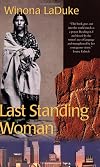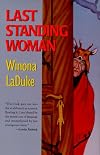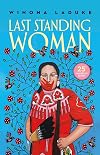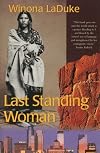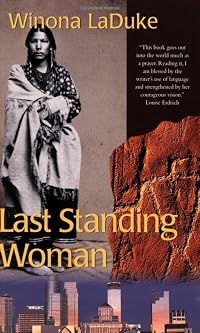
Last Standing Woman
by Winona LaDuke
On This Page
Description
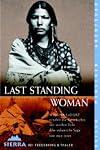
"Born at the turn of the 21st century, The Storyteller, also known as Ishkwegaabawiikwe (Last Standing Woman), carries her people's past within her memories. The White Earth Anishinaabe people have lived on the same land since time immemorial. Among the towering white pines and rolling hills, each generation is born, lives out their lives, and is buried. The arrival of European missionaries changes the community forever. Piece by piece, government policies rob the people of their land. show more Missionaries and Indian agents work to outlaw ceremonies the Anishinaabeg have practised for centuries. Grave-robbing anthropologists dig up ancestors and whisk them away to museums as artifacts. Logging operations destroy traditional sources of food, pushing the White Earth people to the brink of starvation. Battling addiction, violence, and corruption, each member of White Earth must find their own path of resistance as they struggle to reclaim stewardship of their land, bring their ancestors home, and stay connected to their culture and to each other. In this highly anticipated 25th anniversary edition of her debut novel, Winona LaDuke weaves a nonlinear narrative of struggle and triumph, resistance and resilience, spanning seven generations from the 1800s to the early 2000s."-- show lessTags
Recommendations

















Member Reviews
LaDuke's novelization of 140 years of her family's history is a heavy lift at first before things settle down and she begins to hopscotch over events among the Anishinaabe peoples of northwestern Minnesota.
The reader is hit, in the early passages, with a mind-bending list of characters and text heavy with content in the Ojibwe language. It’s a conscious and purposeful choice by the author to establish the worldview and culture about which she is writing, but most monolinguists will stumble through it a few sentences at a time, pausing every few words to mentally pronounce an agglomeration of syllables and striving afterward to re-catch the flow and intent of the story. Some may give up altogether at that point, but those who persevere show more will be rewarded.
The language smooths out somewhat as the story moves into the clashes between Native tribes and U.S. government forces in the 1800s and the episodic structure moves from pivot point to pivot point in the region’s history.
Some of the material will be familiar to readers who have followed the fortunes of most Native peoples – the clashes between tribal culture and the encroachment of European-based immigrants, the loss of land as the notion of Indian reservations took hold, the removal of Native children to boarding schools, the frequent misappropriations and internal betrayals, the diaspora as families moved to urban areas in search of a better life, and the resurgence of Native rights movements in the latter part of the 20th century. LaDuke always chooses to look at these issues through the lens of the personal experiences of her characters, whether fictional, fictionalized, or historical.
She winds up the journey on a hopeful note as part of the story comes full circle, admitting that “there are many stories here. And, there is much to learn for the future. For all the pain and heartache we have felt, there has been and will be, an equal amount of joy. That is how everything works. There is always a struggle to maintain the balance.” show less
The reader is hit, in the early passages, with a mind-bending list of characters and text heavy with content in the Ojibwe language. It’s a conscious and purposeful choice by the author to establish the worldview and culture about which she is writing, but most monolinguists will stumble through it a few sentences at a time, pausing every few words to mentally pronounce an agglomeration of syllables and striving afterward to re-catch the flow and intent of the story. Some may give up altogether at that point, but those who persevere show more will be rewarded.
The language smooths out somewhat as the story moves into the clashes between Native tribes and U.S. government forces in the 1800s and the episodic structure moves from pivot point to pivot point in the region’s history.
Some of the material will be familiar to readers who have followed the fortunes of most Native peoples – the clashes between tribal culture and the encroachment of European-based immigrants, the loss of land as the notion of Indian reservations took hold, the removal of Native children to boarding schools, the frequent misappropriations and internal betrayals, the diaspora as families moved to urban areas in search of a better life, and the resurgence of Native rights movements in the latter part of the 20th century. LaDuke always chooses to look at these issues through the lens of the personal experiences of her characters, whether fictional, fictionalized, or historical.
She winds up the journey on a hopeful note as part of the story comes full circle, admitting that “there are many stories here. And, there is much to learn for the future. For all the pain and heartache we have felt, there has been and will be, an equal amount of joy. That is how everything works. There is always a struggle to maintain the balance.” show less
In this beautifully-written saga of a Minnesota Ojibwe family, author and activist Winona LaDuke chronicles their lives on the White Earth Reservation over the course of generations, from early conflicts with white encroachment and theft of land, resources and culture, to exuberant celebrations of identity, to contemporary challenges and victories.
Although fiction, the trials and injustices contained within this book are almost certainly based on actual events, and to be honest it likely wouldn't be difficult to convince me every word was true. There were times I was fervently hoping some parts were untrue, while simultaneously wishing others were. I'm inspired to learn more about how best to support land recovery projects currently show more underway in my state, and I agree with other readers that this would be a good candidate for required high school reading, especially in Minnesota. As a Minnesotan, I felt this was an important book for me to have read. I was left feeling heartbreak, shame and sadness for all that has been lost, but also a little bit hopeful that — maybe — some wrongs can perhaps be righted. show less
Although fiction, the trials and injustices contained within this book are almost certainly based on actual events, and to be honest it likely wouldn't be difficult to convince me every word was true. There were times I was fervently hoping some parts were untrue, while simultaneously wishing others were. I'm inspired to learn more about how best to support land recovery projects currently show more underway in my state, and I agree with other readers that this would be a good candidate for required high school reading, especially in Minnesota. As a Minnesotan, I felt this was an important book for me to have read. I was left feeling heartbreak, shame and sadness for all that has been lost, but also a little bit hopeful that — maybe — some wrongs can perhaps be righted. show less
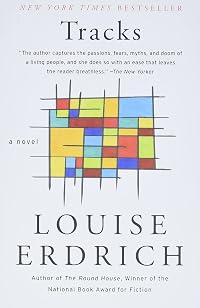
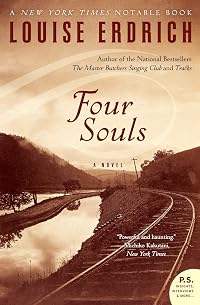
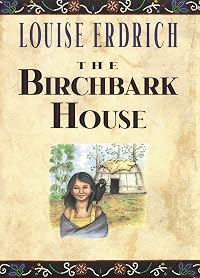
For some reason I thought this was going to be a biography, so I was a little confused by the progress of the story. There also seemed to be a lot of similarity of characters and events with the writings of Louise Erdrich, which also confused me --Pillagers as a common family name, Philomena as a housekeeper for a priest, a priest who rewrites history by moving headstones. While I haven't gone back in Erdrich's books to verify my perception that there is commonality, I've decided that both women use their tribe's history as inspiration for their novels.
Rather than a progressive narrative, LaDuke intermingles a compressed history from the 1860's when the "land stealers" came with later events when the people acted to take back their land show more and reclaim their culture. Altho portions do focus on the different women who shared the name Last Standing Woman, the reader is left to discover what the relevance of past events is to current lives.
I'm afraid I haven't made the book sound that interesting. But even if you're not sure what's going on, all the stories are interesting, pull you in, and give you a view of native perceptions of their culture and heritage. Women can be strong active leaders. LaDuke possesses the Native American passion for poking fun at themselves. show less
Rather than a progressive narrative, LaDuke intermingles a compressed history from the 1860's when the "land stealers" came with later events when the people acted to take back their land show more and reclaim their culture. Altho portions do focus on the different women who shared the name Last Standing Woman, the reader is left to discover what the relevance of past events is to current lives.
I'm afraid I haven't made the book sound that interesting. But even if you're not sure what's going on, all the stories are interesting, pull you in, and give you a view of native perceptions of their culture and heritage. Women can be strong active leaders. LaDuke possesses the Native American passion for poking fun at themselves. show less
Last Standing Woman is a novel largely set on the White Earth reservation in northern Minnesota, telling an intertwined story over several generations in the history of the Ojibwa people. While it is a work of fiction LaDuke incorporates several historical events, as well as a number of circumstances and situations that are nearly universal to the history of relations between Native Americans, their neighbors and the United States government. As someone who is not Native but has lived on a reservation for the past two years I found within this novel many of the kinds of things that are normal here but which can be barely comprehended in a non-reservation environment. It is a well-written book and was a delight to read.
This was recommended to me by a friend. I gave it an honest try but just couldn't do it.
Ratings
Members
- Recently Added By
Lists

KW Wishlist
61 works; 1 member

Indigenous America Reader
145 works; 12 members
Author Information

Winona LaDuke is an internationally renowned activist working on issues of sustainable development, renewable energy, and food systems. She lives and works on the White Earth reservation in northern Minnesota, and is a two time vice presidential candidate with Ralph Nader for the Green Party. She serves as Executive Director of Honor the Earth, show more and is the founder of the White Earth Land Recovery Project, one of the largest reservation-based nonprofit organizations in the country. LaDuke is the author of five books, including Recovering the Sacred, All Our Relations, and Last Standing Woman. show less
Some Editions
Work Relationships
Is contained in
Common Knowledge
- Canonical title
- Last Standing Woman
- Original publication date
- 1997
- People/Characters
- Ishkwegaabawiikwe, Last Standing Woman; Wazhaashkoons; Namaybin Minnogeeshig; Elaine Mandamin
- Important places
- White Earth reservation, Minnesota, USA
- Epigraph
- I want to die before all the Indians wear polyester
and all the gringos wear Indian clothes...
---Franz Blom - Dedication
- Dedicated to the memory of Fred Weaver, Dick LaGarde, George Aubid, Charlotte Jackson, and Elaine Kier, and those who struggle for justice and the people of White Earth.
- First words
- [Prologue] I was born exactly eight years to the day after George Ahnib took out the logging equipment.
There were many migrations that brought the people here.
[Epilogue] It was the child who had the gift of the story and the word.
[Journal of Ishkwegaabawiikwe] Emiwak mewinzha gii-aaawan gaa ako-ishwaasobiboonagak giiwan gii-saagijiwidood aw George Ahnib iniw aabajichiganan gaa-izhi-abajitoowaad imaa anaamakamig endazhi-biiwaabikokeng iko gaa-tazhi-an... (show all)okiiwad ingiw biiwaabikokewininiwag. - Last words
- (Click to show. Warning: May contain spoilers.)[Journal of Ishkwegaabawiikwe] What carries us through is the relationship we have to the Creation and the courage we are able to gather from the experience of our aanikoobijigan, our ancestors, and our oshkaabewisag, our helpers.
(Click to show. Warning: May contain spoilers.)[Prologue] But that is not where this story begins.
(Click to show. Warning: May contain spoilers.)She held her daughter close to her chest and turned her so she could watch the people dancing to the drum.
(Click to show. Warning: May contain spoilers.)[Epilogue] He was a hundred years old, and his changing of worlds marked the ending of one time and the beginning of another. - Blurbers
- Alexie, Sherman
Classifications
Statistics
- Members
- 198
- Popularity
- 165,236
- Reviews
- 5
- Rating
- (3.72)
- Languages
- English, German
- Media
- Paper, Ebook
- ISBNs
- 10
- ASINs
- 2