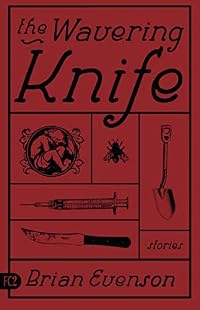
The Wavering Knife: Stories
by Brian Evenson
On This Page
Description
Brian Evenson's fifth story collection constructs a human landscape as unearthly as it is mundane. Replete with the brutality, primordial waste, and savage blankness familiar to readers of his earlier works, Evenson's Kafkaesque allegories entice the mind while stubbornly disordering it. In the title story an obsessive consciousness folds back on itself, creating a vertiginous mélange of Poe and Borges, both horrific and metaphysical. Here, as in "Moran's Mexico," and "Greenhouse," the show more solitary nature of reading and writing leads characters beyond human limits, making the act of putting words to paper a monstrous violation opening onto madness. In "White Square" the representation of humans by dimly colored shapes confirms our feeling that something lies behind these words, while seeming to mock us with the futility of seeking it. Evenson's enigmatic names-Thurm, Bein, Hatcher, Burlun-placeable landscapes, and barren rooms all combine to create a semblance of conceptual abstraction, as though the material universe had come to exist inside someone's head. Small wonder that Evenson's work has attracted so much attention among philosophers, literary critics, and other speculative intelligences, for it continuously projects a tantalizing absence, as though there were some key or code that, if only we knew it, would illuminate everything. However, the blade of discernment wavers, and we are left to our own groping interpretations. show lessTags
Recommendations



















Member Reviews
Half of these stories are brutal, relentless, and cold. The other half (and I don't mean exactly 50 percent, but *some*) present a lighter, easier fare. The latter and lighter group are about silly men and the dumb things they do and say -- from the Promisekeeper group that meets in a bar to the guy who tries to set up a church in Walmart, to the pair of redneck gravediggers who have so much trouble getting their corpse into a shallow hole in hard packed dirt that they chop him up, pee on him, eviscerate him, stomp on him, and eventually throw what's left of him into a ravine and pretend to cover up the grave. What happens next? The family and minister come over the hill, with the coffin he was supposed to go in, asking to "dig up" the show more body. These stories are smart and wry.
The other half of the book, however, is priceless. Evenson's great accomplishment, his genius, lies in these other stories: "The Ex-Father," "The Intricacies of Post-Shooting Etiquette," "The Wavering Knife," "Virtual," "One Over Twelve," "The Progenitor," and my favorite, though it isn't the showiest story in the book, "House Rules." "House Rules" affected me the most, though it is quiet and drab, and the image of the velvet rope across the stairway will stick with me for sure.
Maybe these stories are evolved Kafka, or maybe they're perfect scifi. This is a fiery imagination kept rigidly contained in exacting boxes, let out in discreet units, each one perfect and with a strange serenity. These stories take you in utterly, and then truly reward you, like magic tricks that really work. I can't really give you any plot nuggets or summaries for these, because they don't work except in their own context, provided by the stern, rigorous language and the limitations of the prose. They're so strange and explosive in the ideas that drive them that they need Evenson's specific containers to make them conceivable. Story after story I would finish and then say, "That was so WEIRD. And FABULOUS." Then I'd hungrily go on to the next.
It's not surrealism -- everything is true within its own law. It's maybe alterealism. Whatever it is, it was enormously engaging and challenging to read and halfway through I was already thinking in my head of people I know who would love a book like this. Definitely read it. A small black rendering on a blank tablet, of something truly different, is more intriguing than a dense and colorful mural, six blocks long, of something we already know. show less
The other half of the book, however, is priceless. Evenson's great accomplishment, his genius, lies in these other stories: "The Ex-Father," "The Intricacies of Post-Shooting Etiquette," "The Wavering Knife," "Virtual," "One Over Twelve," "The Progenitor," and my favorite, though it isn't the showiest story in the book, "House Rules." "House Rules" affected me the most, though it is quiet and drab, and the image of the velvet rope across the stairway will stick with me for sure.
Maybe these stories are evolved Kafka, or maybe they're perfect scifi. This is a fiery imagination kept rigidly contained in exacting boxes, let out in discreet units, each one perfect and with a strange serenity. These stories take you in utterly, and then truly reward you, like magic tricks that really work. I can't really give you any plot nuggets or summaries for these, because they don't work except in their own context, provided by the stern, rigorous language and the limitations of the prose. They're so strange and explosive in the ideas that drive them that they need Evenson's specific containers to make them conceivable. Story after story I would finish and then say, "That was so WEIRD. And FABULOUS." Then I'd hungrily go on to the next.
It's not surrealism -- everything is true within its own law. It's maybe alterealism. Whatever it is, it was enormously engaging and challenging to read and halfway through I was already thinking in my head of people I know who would love a book like this. Definitely read it. A small black rendering on a blank tablet, of something truly different, is more intriguing than a dense and colorful mural, six blocks long, of something we already know. show less
Ratings
Members
- Recently Added By
Author Information

61+ Works 4,053 Members
Brian Evenson is the author of five books of fiction. He is a senior editor for Conjunctions magazine and the director of creative writing at the University of Denver. Evenson lives in Denver
Awards and Honors
Awards
Work Relationships
Contains
Classifications
Statistics
- Members
- 134
- Popularity
- 241,370
- Reviews
- 1
- Rating
- (3.75)
- Languages
- English
- Media
- Paper, Audiobook
- ISBNs
- 1
- ASINs
- 1