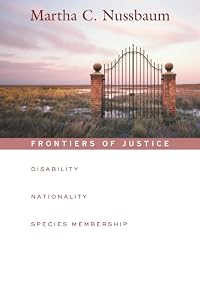
Frontiers of Justice: Disability, Nationality, Species Membership
by Martha Nussbaum
On This Page
Description
Theories of social justice are necessarily abstract, reaching beyond the particular and the immediate to the general and the timeless. Yet such theories, addressing the world and its problems, must respond to the real and changing dilemmas of the day. A brilliant work of practical philosophy, Frontiers of Justice is dedicated to this proposition. Taking up three urgent problems of social justice neglected by current theories and thus harder to tackle in practical terms and everyday life, show more Martha Nussbaum seeks a theory of social justice that can guide us to a richer, more responsive approach to social cooperation. The idea of the social contract-especially as developed in the work of John Rawls-is one of the most powerful approaches to social justice in the Western tradition. But as Nussbaum demonstrates, even Rawls's theory, suggesting a contract for mutual advantage among approximate equals, cannot address questions of social justice posed by unequal parties. How, for instance, can we extend the equal rights of citizenship-education, health care, political rights and liberties-to those with physical and mental disabilities? How can we extend justice and dignified life conditions to all citizens of the world? And how, finally, can we bring our treatment of nonhuman animals into our notions of social justice? Exploring the limitations of the social contract in these three areas, Nussbaum devises an alternative theory based on the idea of "capabilities." She helps us to think more clearly about the purposes of political cooperation and the nature of political principles-and to look to a future of greater justice for all. show lessTags
Recommendations










































Member Recommendations

Member Reviews
Prof. Nussbaum explores three "frontiers" (disability, nationality, and speciec membership) into which she attempts to extend the role of justice. She argues first that contractarianism, best exemplified by Rawls, has structural flaws that prevent incorporating these topics into the realm of justice, then that her approach, the "capabilities approach" does allow such an incorporation by providing a better theory of "the good".
The better theory of "the good" is a reflection-refined intuitive vision which manifests as a set (or the feeling that there could be a set if we worked hard enough to create it) of bare-minimum capabilities which would provide a life worthy of a particular species' dignity. Justice will prevail, her argument goes, show more when institutions are created to implement that vision, an implementation that will primarily consist of redistributing wealth according to need.
She loses me completely when she argues (p. 377) for treating animals with a "species-specific paternalism" after spending much of the book invoking Aristotle to insist that we humans are just another species, suggesting that a species-specific paternalism is the proper treatment for humans as well. She never says that, of course, but other ideas she presents, such as the need the erase the distinction between public and private spheres to allow coercive institutions to enforce justice within the family, lead me to believe that her overarching vision is of a benevolent despotism, in possession of knowledge of "the good" and coercing compliance despite our preferences to the contrary (our preferences being highly suspect because they can be tainted by our adaptation to unjust societal norms).
I have ready my last Martha Nussbaum book. To be fair, though, advocates for better treatment of disabled people and any kind of animal might find worthwhile talking points in the relevant sections of her book. Anyone looking for insight on nationality and justice, though, should just look elsewhere. show less
The better theory of "the good" is a reflection-refined intuitive vision which manifests as a set (or the feeling that there could be a set if we worked hard enough to create it) of bare-minimum capabilities which would provide a life worthy of a particular species' dignity. Justice will prevail, her argument goes, show more when institutions are created to implement that vision, an implementation that will primarily consist of redistributing wealth according to need.
She loses me completely when she argues (p. 377) for treating animals with a "species-specific paternalism" after spending much of the book invoking Aristotle to insist that we humans are just another species, suggesting that a species-specific paternalism is the proper treatment for humans as well. She never says that, of course, but other ideas she presents, such as the need the erase the distinction between public and private spheres to allow coercive institutions to enforce justice within the family, lead me to believe that her overarching vision is of a benevolent despotism, in possession of knowledge of "the good" and coercing compliance despite our preferences to the contrary (our preferences being highly suspect because they can be tainted by our adaptation to unjust societal norms).
I have ready my last Martha Nussbaum book. To be fair, though, advocates for better treatment of disabled people and any kind of animal might find worthwhile talking points in the relevant sections of her book. Anyone looking for insight on nationality and justice, though, should just look elsewhere. show less
Ratings
Members
- Recently Added By
Published Reviews
ThingScore 50
added by MLister
Author Information

82+ Works 6,375 Members
Martha C. Nussbaum is the Ernst Freund Distinguished Service Professor of Law and Ethics, appointed in the Philosophy Department and the Law School of the University of Chicago. She gave the 2017 Jefferson Lecture for the National Endowment for the Humanities and won the 2016 Kyoto Prize in Arts and Philosophy, which is regarded as the most show more prestigious award available in fields not eligible for a Nobel. Most recently, she was awarded the 2018 Berggruen Prize for Philosophy and Culture. She has written more than twenty-two books. show less
Awards and Honors
Awards
Series
Belongs to Publisher Series
Common Knowledge
- Canonical title
- Frontiers of Justice: Disability, Nationality, Species Membership
- Original title
- Frontiers of Justice: Disability, Nationality, Species Membership
- Original publication date
- 2006
- Dedication
- For
John Steven Paul
and
Margaret Franson - Original language
- English
- Disambiguation notice
- Frontiers of Justice by Martha Nussbaum is not the same work as Leading Lives That Matter by Mark R. Schwehn and Dorothy C. Bass and the two works should never be recombined! Thank you.
Classifications
Statistics
- Members
- 273
- Popularity
- 118,570
- Reviews
- 1
- Rating
- (3.40)
- Languages
- 7 — Dutch, English, German, Italian, Japanese, Portuguese, Spanish
- Media
- Paper, Ebook
- ISBNs
- 14
- ASINs
- 1